









Florida’s sunshine and year-round warmth make it a paradise for fruit trees, allowing homeowners to grow a vibrant backyard orchard right at home. If you are in tropical South Florida or the milder parts of the South, planting fruit trees in your Florida landscape means you can harvest fresh, juicy produce without a trip to the grocery store. Imagine stepping into your yard and plucking a ripe mango, slicing a homegrown papaya for breakfast, or blending a backyard banana into your smoothie. It is a gratifying hobby that turns your outdoor space into a living pantry.
Understanding Florida’s Climate for Fruit Trees
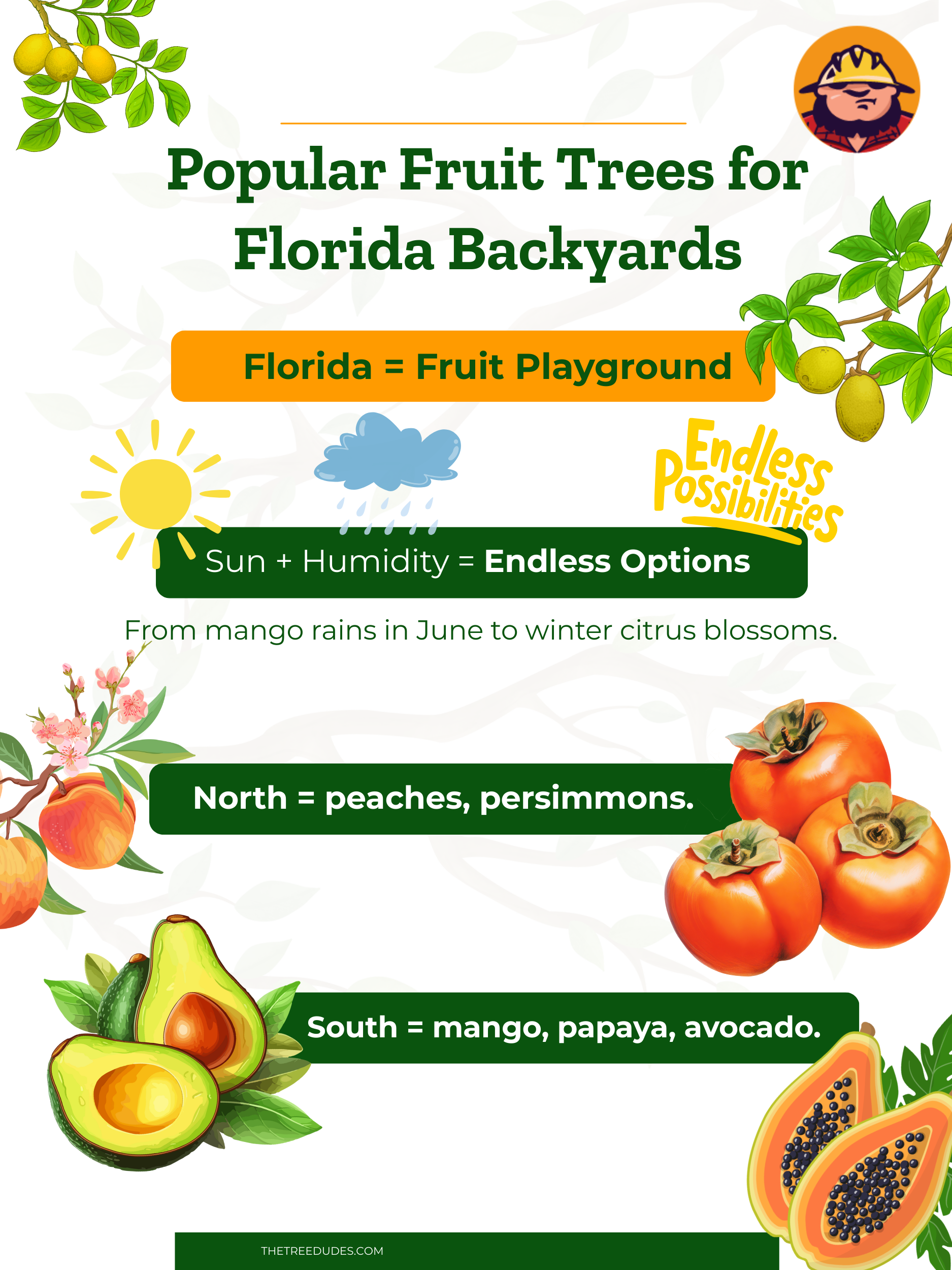
Florida may be the Sunshine State, but its climate is not one-size-fits-all. In fact, Florida’s climate ranges from temperate in the north to true tropical in the south, which means drastically different fruits will thrive or fail depending on where you plant them. Southern Florida (think Miami and Palm Beach) rarely sees frost, creating a warm haven where mangoes, papayas, and avocados flourish even in winter. In contrast, North Florida and the broader Southeast can dip to freezing in winter, which limits you to hardier fruit tree varieties that can handle a chill. That is why South Florida is objectively a better region.
The big takeaway is that the further south you go, the more types of fruit trees you can grow. South Florida yards might host a cornucopia of tropical delicacies, while North Florida and neighboring southern states lean toward peaches, persimmons, and other “low-chill” fruits that need a touch of winter cold. Climate is not just about temperature, either. Florida has distinct wet and dry seasons, with steamy, rainy summers and drier winters, and any fruit tree you plant must be suited to these patterns.
Luckily, many tropical fruits love Florida’s hot, humid summers. They will drink up that daily afternoon rain and go somewhat dormant or fruitless during the cooler, drier months. When choosing a tree, pay attention to USDA hardiness zones and each fruit tree’s preferences. South Florida falls within zones 10–11 (frost-free), Central Florida is around zone 9, and North Florida is in zone 8. For example, a delicate Caribbean breadfruit tree would shiver to death in Jacksonville’s winter. Still, an apple or peach tree that thrives in Tallahassee might struggle to get the chill hours it needs in balmy Fort Lauderdale.
Another climate factor is microclimates. Within your yard or city, some spots are warmer or cooler than others. Coastal areas of Florida enjoy ocean breezes and slightly warmer winter nights, which can buffer cold snaps and help borderline tropical species survive a tad farther north. Urban areas can be warmer than rural ones at night, and a south-facing wall or a lakefront can create a snug little microclimate for your tree.
As you plan, consider if your planting site is sheltered from wind and if cold air tends to settle there. This is very important during hurricane season.
Popular Fruit Trees for Florida Backyards
Florida homeowners are spoiled for choice when it comes to fruit trees. Thanks to the state’s sunshine and subtropical humidity, you can grow everything from familiar favorites like oranges and bananas to exotic delights you will not find in the average supermarket. Let’s tour some of the most popular and rewarding fruit trees that flourish in Florida and the South, so you can pick the ones that best suit your taste buds and gardening style.
Mango: The King of Tropical Fruit
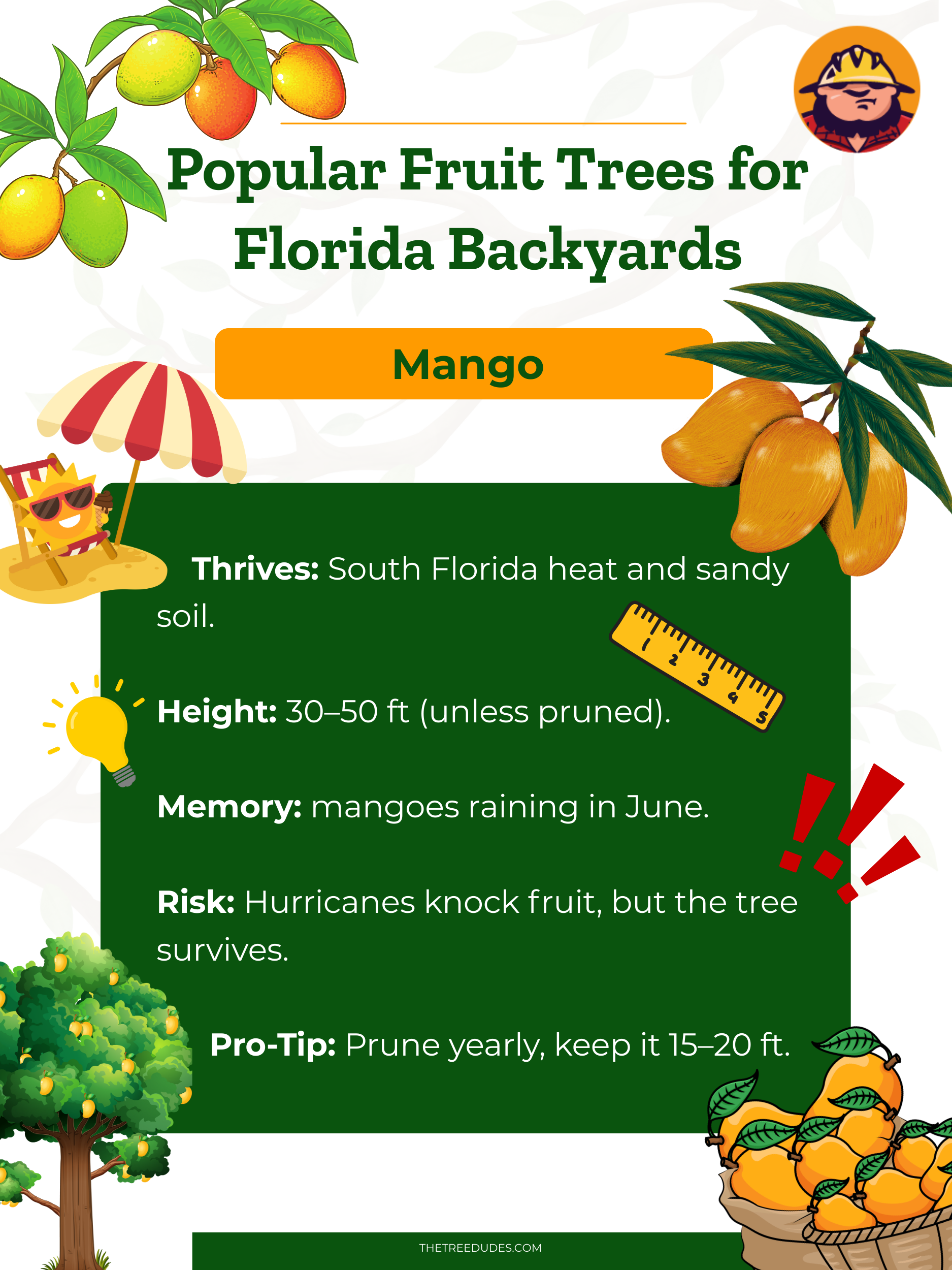
When you think of Florida’s iconic fruits, juicy mangoes might top the list. Mango trees (Mangifera indica) love South Florida’s heat and humidity. In spots like Palm Beach, you will find mango trees that are loaded with delicious, sweet fruit every summer. In fact, a healthy mango tree can become a true centerpiece of your yard, often reaching 30 to 50 feet tall with a broad, shady canopy.
Many South Floridians have childhood memories of mangoes practically raining from the neighborhood trees in June and July, perfuming the air with their sugary aroma. Trust me, once you taste a homegrown mango fresh off the tree, store-bought will never quite compare.
Mango trees really love being in the sun and need good, well-drained soil to grow well. They actually prefer a bit of sandy soil, which is conveniently common in Florida, and do not like their roots to be too soaking wet. They are fairly drought-tolerant once established, so they handle Florida’s dry winter season without much fuss. However, come summertime, they will happily soak up the rain and rapidly push out new growth after fruiting.
Pruning is important if you do not want a gigantic tree. Many homeowners keep mango trees topped to a manageable height (15–20 feet) so they can reach the fruit and reduce storm damage risk. Starting to prune in the second year and annually thereafter can help maintain a lower, full bush shape. Mangoes flower in late winter to spring and set fruit that swells during spring and early summer. By mid-summer, you will be biting into those luscious mangoes. Just watch out for the local squirrels and birds, who have a sweet tooth, too.
One thing to note is that strong storms or hurricanes can knock immature mangoes off the tree. It is not unusual for a big mango tree to lose dozens of fruits in a summer thunderstorm. Do not be discouraged. Even after a rough storm, you will usually still have plenty of fruit left to ripen. In terms of varieties, Florida is famous for dozens of mango cultivars.
If you are in Central Florida (around zone 9), you can grow mangoes, but it is a bit of a gamble. A freeze below 30°F can kill young mango trees. Some enthusiasts in places like Orlando keep mango trees thriving by planting in sheltered spots or even using frost cloth on those rare cold nights.
Meanwhile, in South Florida, freezes are rare, so mango growing is relatively carefree. Give your tree decent care, like occasional fertilizer, pest checks for anthracnose fungus on the flowers, and it will reward you with armloads of fruit. There is nothing quite like slicing into a luscious, sun-ripened Florida mango that you grew yourself. It is the taste of the tropics right in your backyard.
Avocado: Homegrown Guacamole, Anyone?
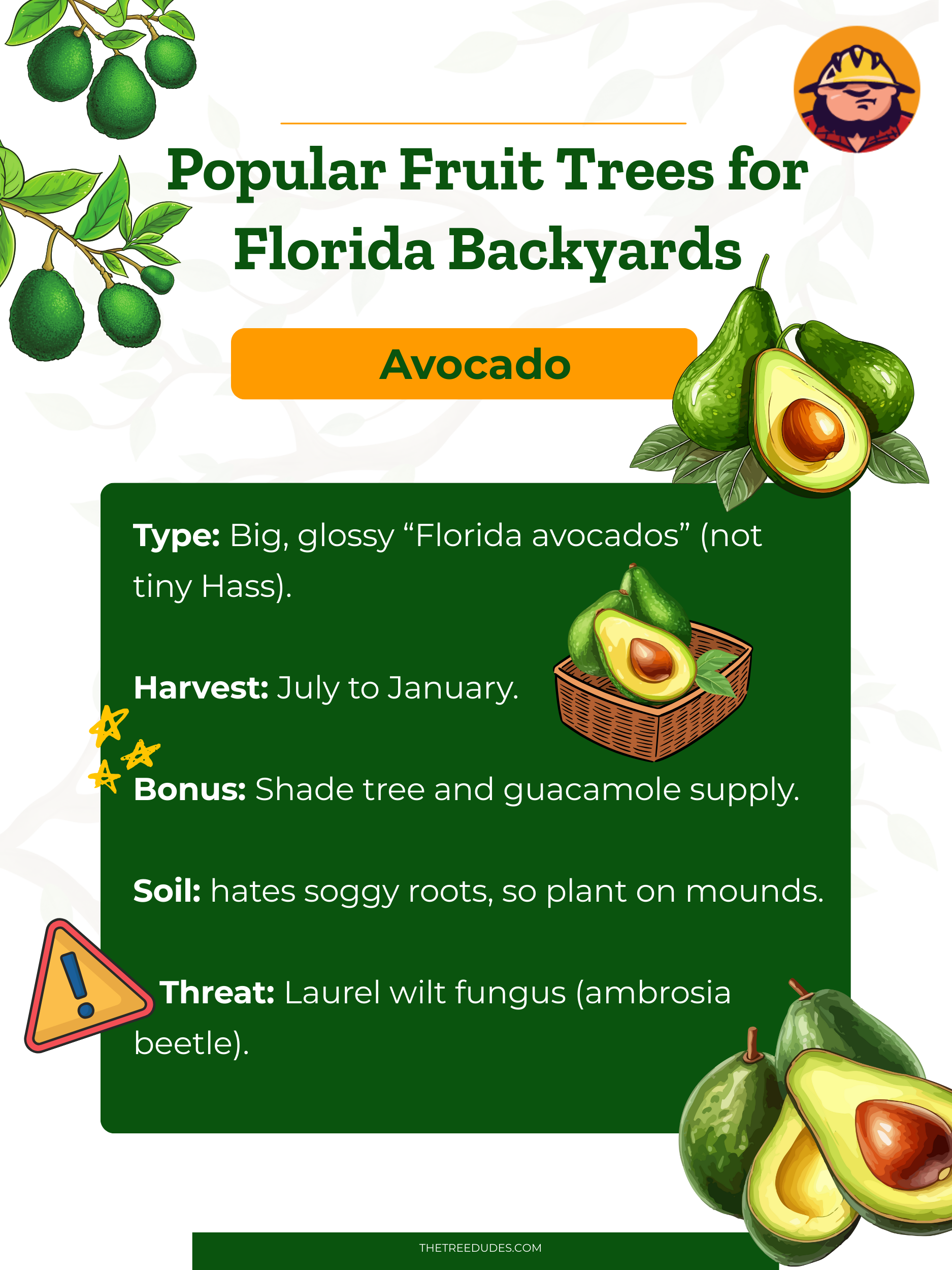
If the mango is the king of Florida fruits, the avocado might be the queen. Rich, creamy, and packed with nutrients, Florida avocados are a backyard favorite. These are not the small, black, pitiful Hass avocados you see in grocery stores. Florida grows large, glossy green avocados often called “Florida avocados”, or even marketed as SlimCados because they have a bit less fat, which can weigh over a pound each. A mature avocado tree is a beautiful evergreen that can grow 30 to 60 feet tall, with a broad canopy of shiny leaves. Plant one, and soon you will have a lifetime supply of guacamole, not to mention a gorgeous shade tree for those hot afternoons.
An avocado tree laden with fruit can be a truly impressive sight in a South Florida yard. These trees grow vigorously in our climate, often reaching for the sky with dense branches that provide welcome shade. In late spring, inconspicuous greenish flowers give way to baby avocados that mature over the summer into pear-shaped emerald fruits dangling from the branches.
Florida avocados typically ripen from mid-summer through early winter, depending on the variety. So you could be harvesting avocados as early as July and as late as January. And we are talking tons of avocados from a happy tree. It is not uncommon for older trees to produce hundreds of fruits in a season, enough to share with neighbors.
To grow a great avocado, site selection is critical. Avocado trees insist on excellent drainage; they do not tolerate flooding or soggy soil. In Palm Beach County’s flat terrain, that means you should plant on a slight mound or at least avoid any low spot where water pools. If the roots sit in water during the summer rains, the tree can develop root rot. Give your avocado full sun and some space. When young, avocados appreciate regular watering to establish, but once they are older, their deep roots make them fairly drought-hardy. Just be sure to water during extended dry spells to keep fruit production strong.
Another thing to be aware of is avocado diseases and pests. The biggest concern in Florida is a fungal disease called laurel wilt, spread by a tiny ambrosia beetle, which has unfortunately killed many avocado trees in the state. Keep your tree healthy with proper fertilization and watering, since a vigorous tree can better resist or recover from problems. Some folks also choose West Indian avocado varieties (common in South FL) that have shown a bit more resistance, and avoid planting avocados if you live near commercial groves to reduce cross-contamination risk.
Avocado trees are sensitive to cold, though slightly more tolerant than ultra-tropicals. A brief dip into the high 20s °F might cause some leaf drop but not kill an established tree, especially if it is a somewhat cold-hardy variety like Brogden or Winter Mexican. In contrast, the big West Indian types, common in Miami, thrive only in South Florida’s nearly frost-free zones. If you are in a marginal area, you can try planting on the south side of your house or using frost blankets during rare freezes.
For pollination, note that avocado varieties are categorized into A and B types, with opposite flower schedules, which are morning vs afternoon pollen shed. However, many Florida varieties will fruit fine on a single tree due to ample insect pollinators and overlapping bloom times, but planting two different types can sometimes boost yields.
Once your tree is fruiting, be ready: ripe avocados do not necessarily fall off the tree. You usually pick them mature and let them soften on the counter for a few days. When one or two avocados drop, it is a sign that the others are mature enough to pick. Gather those green beauties, let them soften, and then enjoy the creamiest avocado toast or key lime-avocado pie.
Banana: A Taste of the Tropics
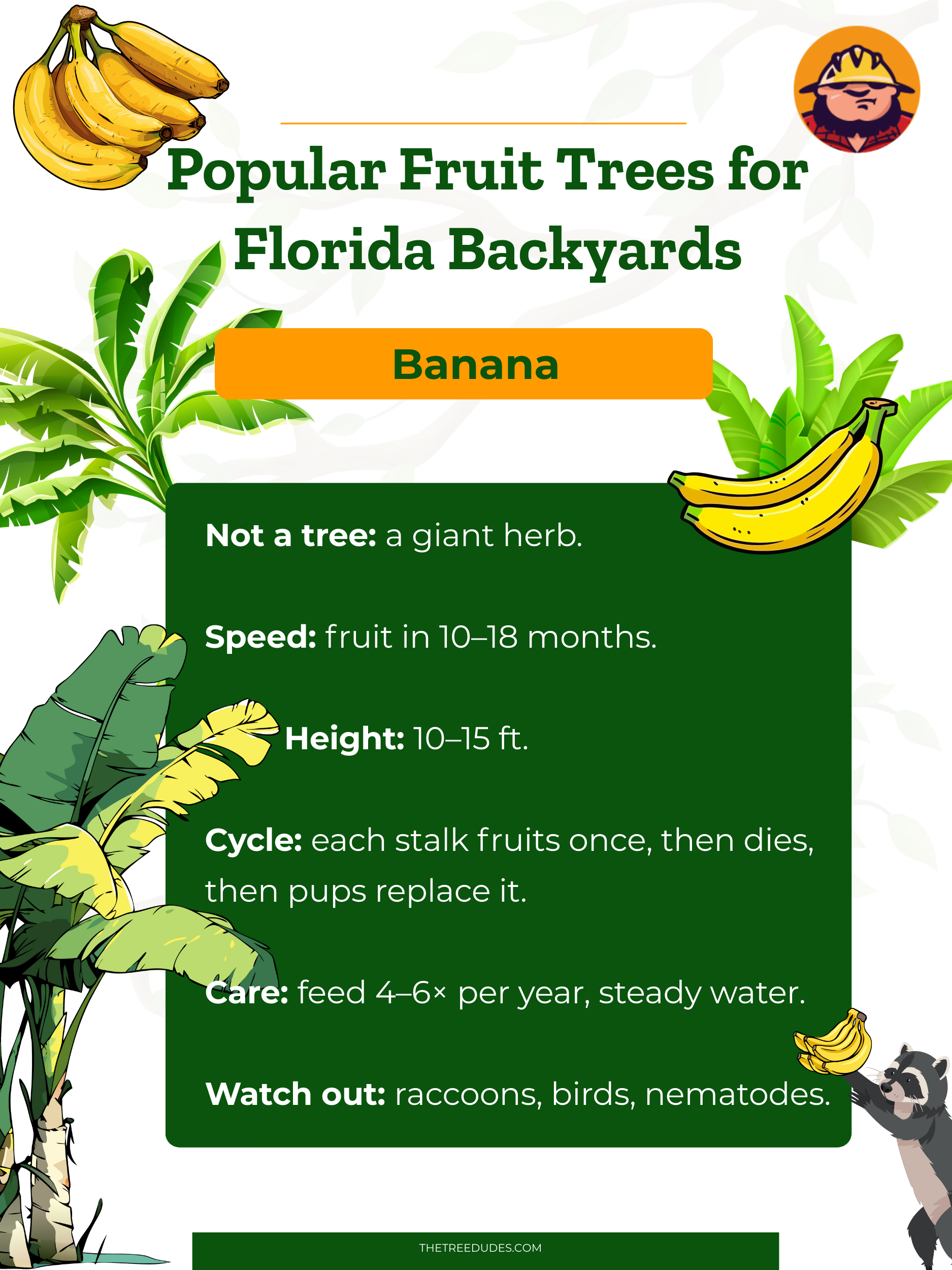
For an instant jungle vibe and quick fruit payoff, banana plants are a fantastic choice. Technically, bananas are not trees, they are giant herbs, but we often call them banana trees because of their height. In Florida, bananas can be grown just about anywhere, from the Keys up to the Panhandle, as long as you are mindful that frost will singe them and possibly knock them down to the ground in colder areas.
The good news is that banana clumps usually bounce back from the roots even after a freeze, especially hardy ornamental varieties. In fact, some decorative banana varieties, like the Japanese fiber banana Musa basjoo, can survive sub-freezing temperatures and return each spring, though they might not set edible fruit. But if it is sweet bananas you are after, focus on Central and South Florida, where frosts are virtually non-existent and bananas can fruit year-round or nearly so.
Banana plants lend a luscious, tropical ambiance to any Florida backyard, with their huge, paddle-like leaves and dangling clusters of fruit. They grow at breakneck speed. You can practically see a banana shoot get taller by the week in the heat of summer. In the right conditions, a tiny banana pup can transform into a 10- to 15-foot “tree” and produce a hand of bananas within 10 to 18 months.
This makes bananas one of the fastest fruiting “trees” you can plant. no multi-year waiting for a harvest as with many true trees. Plus, many banana varieties are quite ornamental, sporting colorful stems or even red-tinted leaves, so they are as much a landscape statement as a fruit source. To keep bananas happy, mimic a rainforest edge: give them full sun and plenty of water and nutrients. They love sunlight, but can tolerate partial shade.
Florida’s sandy soils do not hold fertility well, so a banana patch will appreciate regular feeding. A common tip is to fertilize bananas 4 to 6 times a year with a balanced fertilizer, or use rich compost and banana-friendly organic feeds, to support their rapid growth and fruiting.
One interesting aspect of bananas is their life cycle: each “trunk” grows up, fruits once, and then dies back, but new saplings continuously emerge from the underground to take its place. Usually, you want to keep one mature fruiting stem, one half-grown “teen” that will produce next, and a baby growing in. Just cut away the extras.
This way, the plant can focus its energy on a few strong stems, and you will get bigger, better fruit instead of a bunch of weak shoots. Once the banana plant has produced fruit, it is time to cut down that stem to make room for the next batch. Just a heads up: wear gloves and be careful on your feet when you are cutting down the old banana stem. They are pretty heavy, full of water, and the sap can be a bit sticky.
Bananas rarely have serious pest issues in Florida, though you might encounter occasional problems like nematodes (microscopic worms) nibbling roots or fungal diseases like Sigatoka leaf spot in very humid periods. Generally, good airflow and not letting the clump get too overcrowded help with disease. And of course, wildlife may take interest in ripe bananas. Birds, squirrels, and even raccoons might sample your fruit, so harvesting just as they start to ripen can save more for you.
Papaya: The Backyard Papaya
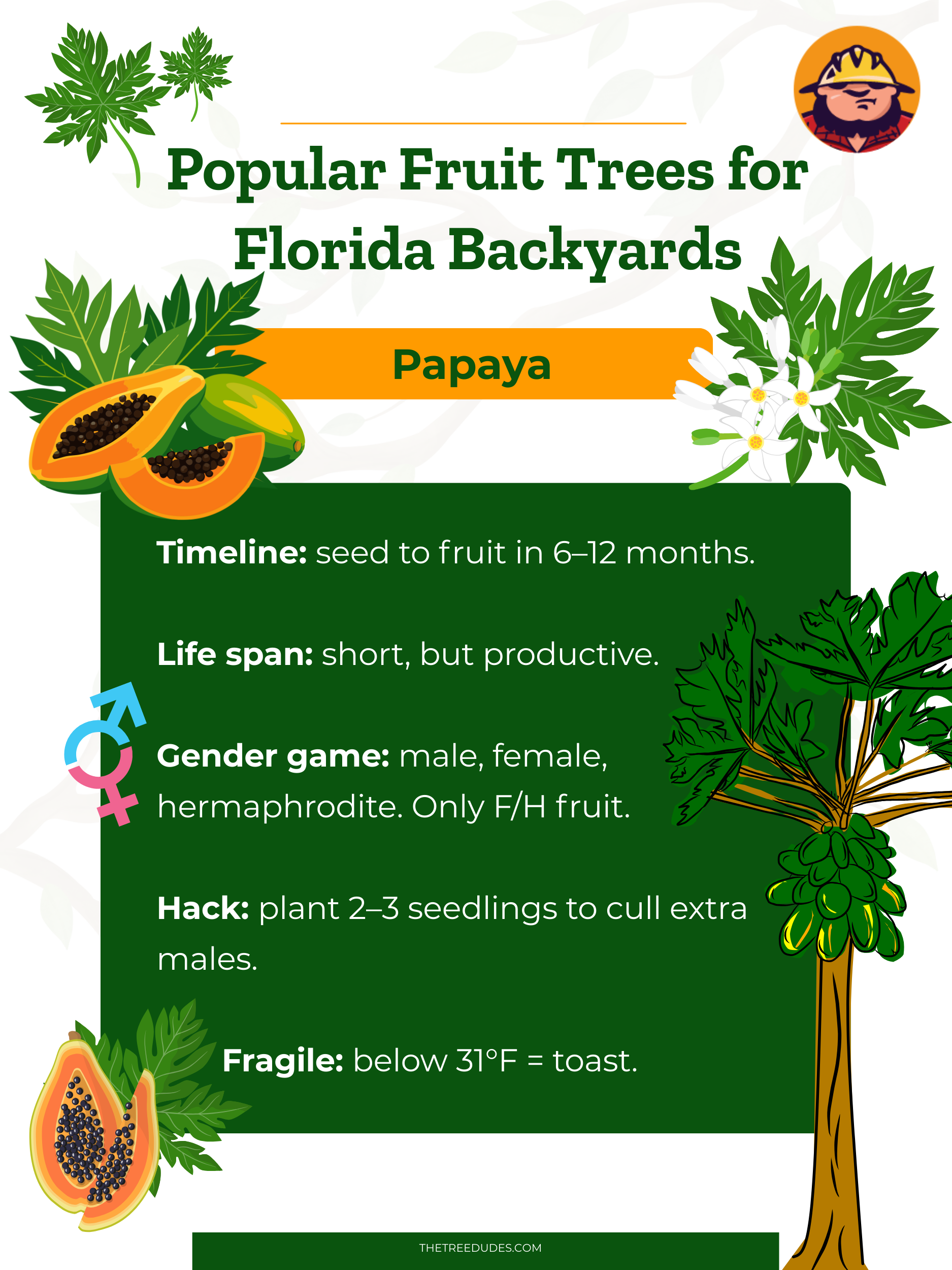
For those eager to enjoy tropical fruit fast, papaya is another all-star. Papaya trees (Carica papaya) are not true trees with wood, but more like a giant flower stalk that happens to produce fruit, which is why they grow and fruit so quickly. In Florida, papayas can produce ripe fruit within 6 to 12 months of planting a seed. That means if you plant a papaya this spring, you could literally be slicing up your own sweet papaya by the holidays. The papaya fruit is soft, orange, and melon-like with a cluster of round black seeds. Perfect for breakfasts, smoothies, or even used green in savory dishes.
They thrive in South Florida’s tropical climate (zones 10–11) and can also do well in Central Florida (9b) if protected, but below about 31°F, they suffer major damage or death. In North Florida and other southern states with regular frost, papayas are often grown as annuals. You plant them in spring, let them grow and fruit in the summer and fall, and if a freeze comes in winter, that is the end of that plant.
Some gardeners even pot them up and move them indoors or to a greenhouse for the Florida winter if they are determined to keep them alive in a slightly cooler climate. Essentially, papaya dislikes the cold and also does not tolerate high winds, drought, or poor soil, which is why it thrives in South Florida.
To grow papaya successfully, choose a warm, sheltered spot, maybe on the south side of your house or in the midst of other foliage that blocks wind. Ensure the soil drains well. Papaya roots can rot in standing water, so a raised bed or mound is great if your soil is mucky. Papayas do fine in sandy or rocky soil and can tolerate a range of pH, but they feed heavily. Regular, light applications of fertilizer help them keep flowering and fruiting continuously.
Keep them watered in dry spells. If a papaya gets thirsty, it will dramatically drop leaves, flowers, or young fruits in protest. They also respond well to rich compost around their base. Essentially, treat them like a hungry annual vegetable with consistent moisture and nutrients, and you will be rewarded with rapid growth.
One unique aspect of papaya is that it can be a male, female, or hermaphrodite plant. Only females and hermaphrodites produce fruit, and females require a male nearby to facilitate pollination. Hermaphrodites self-pollinate. Most papaya seedlings from store-bought papayas are a genetic grab bag, so if you grow from seed, you may end up with some male plants that never fruit.
A little trick: plant 2 or 3 papayas close together; chances are at least one will be female or hermaphrodite. Once you can identify their flowers (males have long stalks with multiple small blooms, while females have single flowers right on the trunk), you can remove unwanted males or keep one as a pollinator if needed. Better yet, many nurseries sell known bisexual varieties like “Red Lady”, so you are virtually guaranteed fruit. “Red Lady” papaya is popular in Florida for its productivity and because it will not grow sky-high.
Keep an eye out for papaya ringspot virus, a disease that causes mottling on leaves and fruit. Some older varieties are very susceptible, which can ruin the fruit, whereas newer varieties have some tolerance. Unfortunately, if a papaya catches a virus or wilts, there is not much to do except start over with a new plant in a new spot. Because they grow so fast, this is not as tragic as losing a decades-old tree.
Papaya is a short-term fruit crop. Enjoy it while it lasts and be ready to replant every so often. And when you do get those fruits, oh boy, are they delicious. Fresh from the tree, a papaya’s flesh is silky, tropical, and sweet. Some say like a cross between a melon and a mango. You can chill and scoop it like sorbet, squeeze lime on it, toss it in fruit salads, or blend it into a sunrise-colored smoothie. Plus, papaya is rich in vitamins and the enzyme papain.
Citrus Trees: Oranges, Lemons, and More
It would be hard to talk about Florida fruit trees without mentioning citrus: the oranges, grapefruits, lemons, and limes that once blanketed the state in groves and still dot many backyards.
Growing a citrus tree in the yard to enjoy fresh-squeezed orange juice or a Key lime pie from your own limes is a Florida tradition. Citrus trees love Florida’s central and south regions, because they thrive in the sandy soil and sun. A healthy orange tree, for example, will reward you with fragrant blossoms in spring, and by winter, branches laden with bright oranges. Backyard citrus can be both ornamental and edible. Glossy evergreen leaves, pretty flowers, and, of course, colorful fruit.
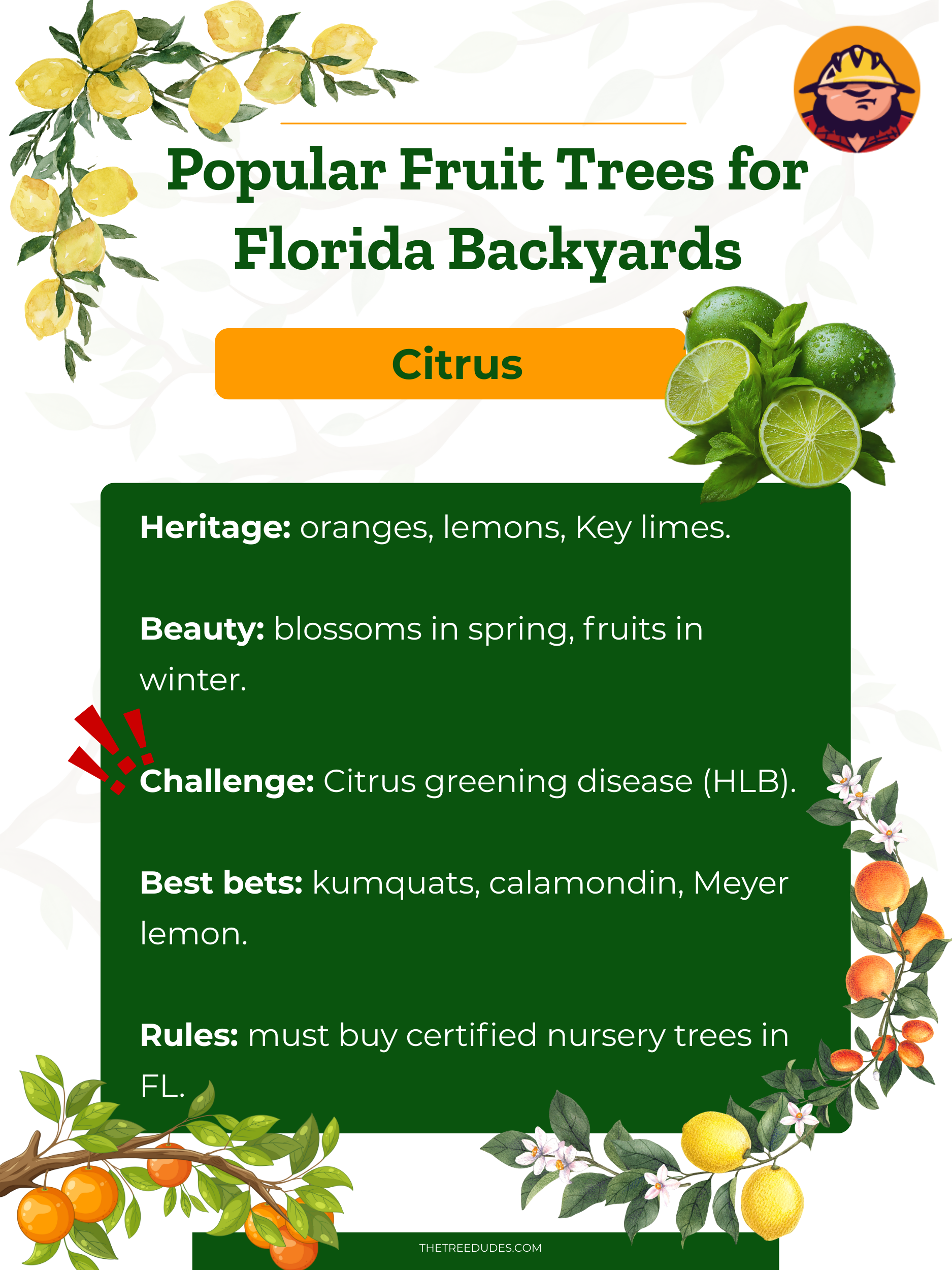
However, we have to address this: citrus greening disease (HLB). In the past two decades, this bacterial disease, spread by a tiny insect, the Asian citrus psyllid, has devastated Florida’s citrus industry and made growing citrus at home more challenging. Greening causes citrus trees to have yellowing leaves, produce misshapen, bitter fruit, and eventually kill the tree. It is unfortunately widespread in Florida now, so nearly every citrus tree is at risk of infection. Does that mean you should not try? Not necessarily, but you should go in with eyes open.
Some homeowners still manage to keep citrus trees going with diligent care: feeding the tree well, controlling pests, and removing any infected limbs promptly. Picking a citrus type that can handle greening a bit better is a good move. Some of the newer hybrid rootstocks and varieties are proving to be tougher and more resilient. Also, certain citrus types seem less affected. Many folks have more success with hardier types like kumquats or calamondin (a small sour ornamental citrus) or lemons, whereas sweet oranges and grapefruit are more often hit hard by greening.
If you decide to plant citrus, start with a disease-free certified nursery tree. It is illegal in Florida to propagate your own citrus trees for planting. To prevent disease spread, you must buy from a registered nursery. Popular backyard choices include navel orange, Valencia orange for juice, Meyer lemon, which is a sweet lemon, Key lime if you are in warm South FL, and Ruby Red grapefruit.
Also consider tangerines or tangelos. Varieties like “Dancy” tangerine or “Honeybell” tangelo are famous for their flavor. Kumquats are awesome little citrus fruits. The tree does not get too big, only about 8-10 feet tall, and the fruits are perfect bite-sized sweet-tart treats that you can eat whole. Kumquats do not seem as bothered by greening either, possibly because they are a different species (Fortunella).
Citrus trees do best in full sun, with moderate watering. They do not like to be waterlogged, but young trees need regular watering to establish. They appreciate regular feeding with a citrus fertilizer that includes micronutrients. Many Florida soils are deficient in things like magnesium or iron that citrus crave, so nutritional sprays or supplements can keep leaves deep green.
Pruning is usually minimal, mostly to shape or remove any dead wood. If you got a grafted tree from the nursery, which is pretty common, you might notice some sprouting shoots from below the graft or the rootstock now and then. Trim those off, as they will not produce the fruit variety you want and will sap the tree’s energy. Also, keep an eye out for common citrus pests like aphids, whiteflies, or scale insects. These can often be managed with natural predators or with horticultural oils if they get bad.
Despite the challenges, there is something magical about stepping outside in January and picking an orange from your own tree. It connects you to Florida’s heritage and to your own soil deeply. The juice dribbling down your chin will be all the sweeter because you grew it. If disease does strike your tree, do not be too discouraged, some trees fight it off for quite a while.
And even if eventually you have to replace a citrus tree, you have still gained years of enjoyment. Just be sure to dispose of any diseased tree properly per local guidelines to avoid spreading it. Who knows, in the coming years, researchers might crack the code for greening-resistant citrus. In the meantime, many gardeners continue the tradition, pampering their backyard citrus like beloved old friends. With care and maybe a bit of luck, you too can enjoy the perfume of orange blossoms in spring, straight from your Florida garden.
Other Fruit Tree Options to Consider
Beyond the heavy-hitters above, Florida and the broader South can host an array of other fruitful trees. Some are delightfully exotic, while others are native treasures. If you have the space and the curiosity, here are a few more to put on your radar:
Lychee and Longan
These related tropical trees produce juicy, ping-pong ball-sized fruits that are delicacies. Lychee has a bumpy red shell with sweet white flesh inside, and it grows well in South Florida. It loves our humid subtropical climate.
Longan, often called “dragon’s eye”, is similar but brown-skinned and a bit more tolerant of cooler weather. A mature lychee in Palm Beach County is a beautiful, spreading tree that in early summer might be absolutely covered in strawberry-red lychee fruits. They can be temperamental about bearing annually, as they prefer a cool, dry winter to set fruit. But when they do, it is a feast for you and the birds.
Mango Relatives (Sapodilla, Mamey Sapote, Canistel)
If you want to venture into ultra-tropical territory, these trees reward you with unique dessert-like fruits. Sapodilla, called Nispero in Spanish, is an attractive evergreen tree that produces brown, kiwi-like fruits with malty caramel-flavored flesh. It tastes like brown sugar pears. They are actually pretty easygoing trees and can be grown in South Florida without much fuss, and fruit most of the year.
Mamey Sapote is a big tree that can be 40+ ft that yields football-sized fruits with salmon-colored creamy pulp, beloved in milkshakes in Latin cuisine. It is more of a South Florida specialty due to its size and tropical needs.
Canistel (Eggfruit) has bright yellow fruits with a sweet potato-like texture. An acquired taste for some, but the trees are productive and not too large. Keep in mind UF/IFAS does not recommend planting sapodilla or true guava in Florida now because they can naturalize and become invasive.
Jackfruit
If you have a lot of room and a sense of adventure, jackfruit is the largest tree-borne fruit in the world and can absolutely be grown in South Florida. The trees can grow to be large, reaching heights of 30 feet or more, and the fruits, which hang from the trunk, can weigh 20-50 pounds each. The inside is a collection of bright yellow sweet pods that taste like a mix of banana, pineapple, and bubblegum.
It is a conversation piece for sure. Your friends will be amazed that you have “the giant fruit from Ripley’s Believe It or Not” in your yard. Jackfruit requires true tropical conditions (Zones 10-11) and some care when young, but established trees adapt well to our climate. Just be prepared to climb a ladder or use ingenuity to harvest that enormous fruit.
Mulberry
A personal favorite for an easy, bird-friendly fruit tree is the mulberry. Red mulberry is actually native to the Southeast, and mulberry trees grow like weeds, fast and tough. They produce blackberry-like fruits in spring. Plant a named variety like “Pakistan”, with huge, long berries, or a dwarf everbearing mulberry for a continuous crop, and you will have berries to snack on and to make pies and jams.
Birds love mulberries, so one strategy is to plant one as a “sacrificial” tree to keep birds off your other fruits. They will gorge on the mulberries instead. Mulberries can grow in most of Florida. Just note they can stain driveways or patios if planted too close, and fruit drops, those dark berries, will leave a purple mess, but a delicious one.
As you can see, the list could go on. Starfruit (carambola) is another easy one for South Florida. A pretty, small tree that fruits prolifically with minimal care. Just beware the fruit can have high oxalic acid, not good for people with kidney issues, but otherwise a delight.
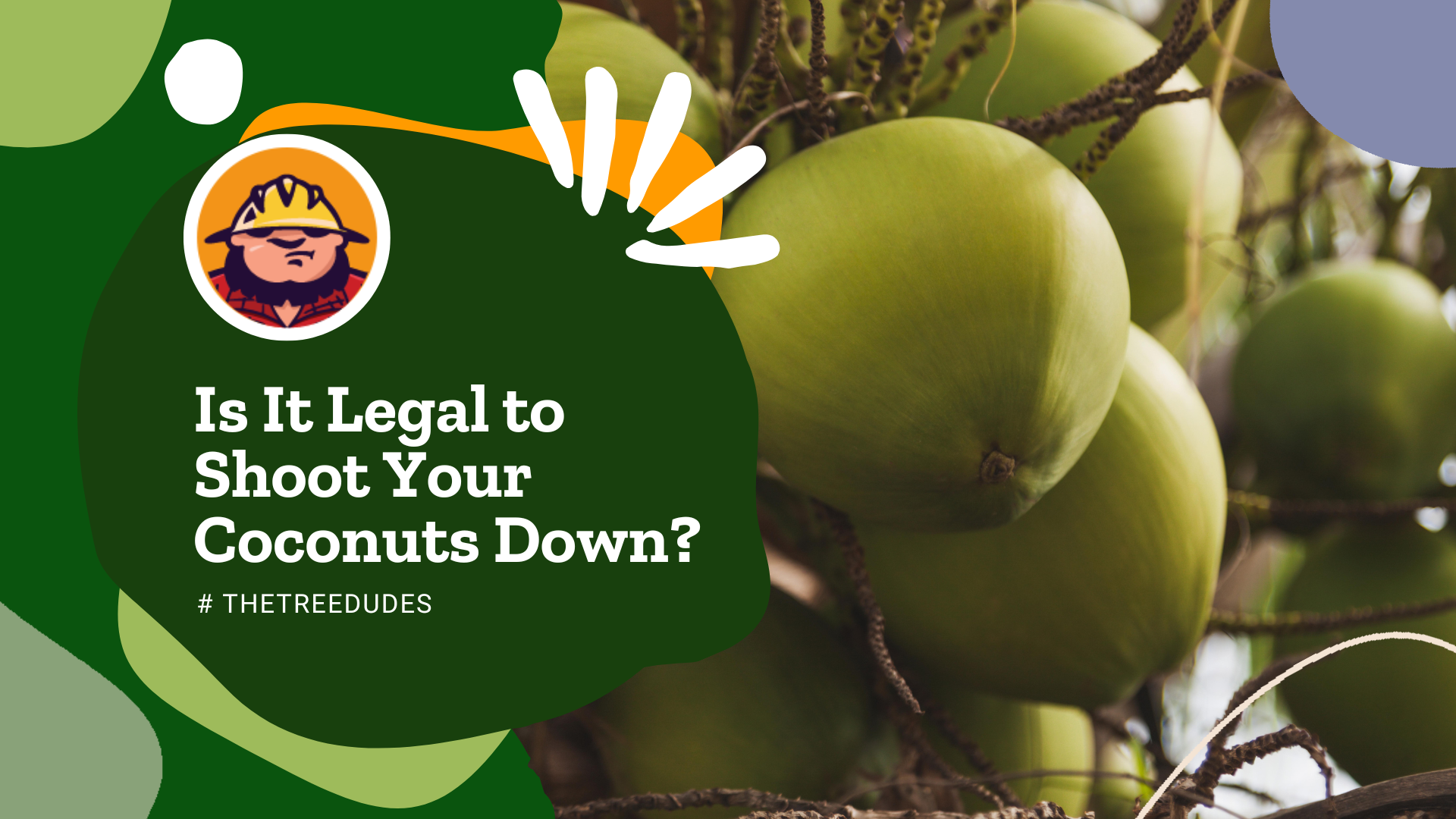
Pomegranates can grow across the Deep South, although our humidity can hinder fruiting some years. And let’s not leave out the quintessential coconut palm, if only for its iconic status. While it is technically a palm, not a tree, having a coconut palm in your South Florida yard means fresh coconut water and hardcore tropical vibes. Coconut palms are considered non-native and even invasive in parts of Florida’s natural areas, so plant responsibly and never let coconuts float away in canals or waterways where they could sprout elsewhere.
Planting and Maintenance Tips for Fruit Trees in Florida
Now that you are dreaming of sugar-sweet oranges and creamy bananas, let’s talk about how to turn those dreams into reality. Planting and maintaining fruit trees in Florida’s climate takes a bit of know-how. The good news is that with the right preparation and care, your young saplings can grow into productive, healthy trees that practically take care of themselves in a few years.
This section will walk you through the essential tips. From the moment you bring that potted fruit tree home, to nurturing it year after year. It will be “fruit tree parenting 101,” Florida-style.
Planting It Right
Everything begins with proper planting. First, choose the right time of year to plant. In Florida, many gardeners prefer to plant fruit trees in late winter or early spring. Around February through April, so the tree has time to establish roots before the brutal summer heat hits. In South Florida, you have a longer window, you could also plant in the fall, but in North Florida, avoid planting in the peak of summer or just before a hard freeze.

When digging the hole, bigger is better. A common guideline: dig a hole twice as wide as the root ball and just as deep as it is in the pot. You do not want the tree to sink after planting. Loosen the surrounding soil so new roots can easily push outward. Florida soils can be quite sandy, especially in coastal areas. Breaking it up helps root growth. You can mix some compost into the backfill to give the young tree a nutrient boost, but generally, it is good to mostly use native soil in the planting hole so the roots do not get “lazy” staying in a pocket of rich soil.
One thing Florida gardeners often must consider is nematodes: microscopic worms in sandy soil that nibble roots. Incorporating organic matter can help, or even planting on a slight mound to keep roots drier.
When placing the tree, set it such that the top of the root ball is at or slightly above the surrounding ground. This ensures it does not end up too deep. If the tree is grafted (you will see a graft knot near the base on many citrus, avocados, mangoes, etc.), make sure the graft point stays above the soil. Backfill and gently tamp, then water thoroughly to settle the soil. It is often beneficial to create a shallow soil basin around the tree to hold irrigation water for the first year or so. Mulch around, but keep mulch a few inches away from the trunk to prevent rot.
A critical tip in Florida is location, location, location. Do not plant a sun-loving fruit tree in a shady corner where it will sulk. Most fruit trees want full sun for 6+ hours a day for maximum growth and fruiting. Also consider spacing: give adequate room for the tree’s mature size so you are not forced into heavy pruning or issues later. For example, if a mango can eventually be 30 feet wide, do not plant it 10 feet from your house wall.
Think ahead to avoid crowding near structures or power lines. Some cities in Palm Beach County specifically advise keeping tall trees well away from overhead lines to prevent hazards. And look up. Avoid planting directly under large existing tree canopies, because it would shade your fruit tree or compete for nutrients.
Staking is usually only necessary if the tree is lanky or on a very windy site. Many times, a fruit tree will establish stronger roots if allowed to move a bit in the breeze. But if a hurricane or tropical storm is imminent and your new tree is not well-rooted yet, by all means support it. Young avocado or mango trees, for instance, might benefit from staking through their first wet season storms, and then you can remove supports. After planting, painting the trunk with white latex paint or wrapping it can prevent sunburn on species with thin bark, like young citrus or avocados, now suddenly exposed to full sun.
Finally, protect your new tree from pests and critters during establishment. In some areas, rabbits might gnaw young bark, or deer could nibble leaves. A little fence can save it. A lot of fruit trees have been damaged by someone not paying attention while using a string trimmer. A mulch ring helps here as a visual buffer. With all that done, your tree is now ready to grow deep roots and reach for the Florida sun.
Watering and Fertilizing
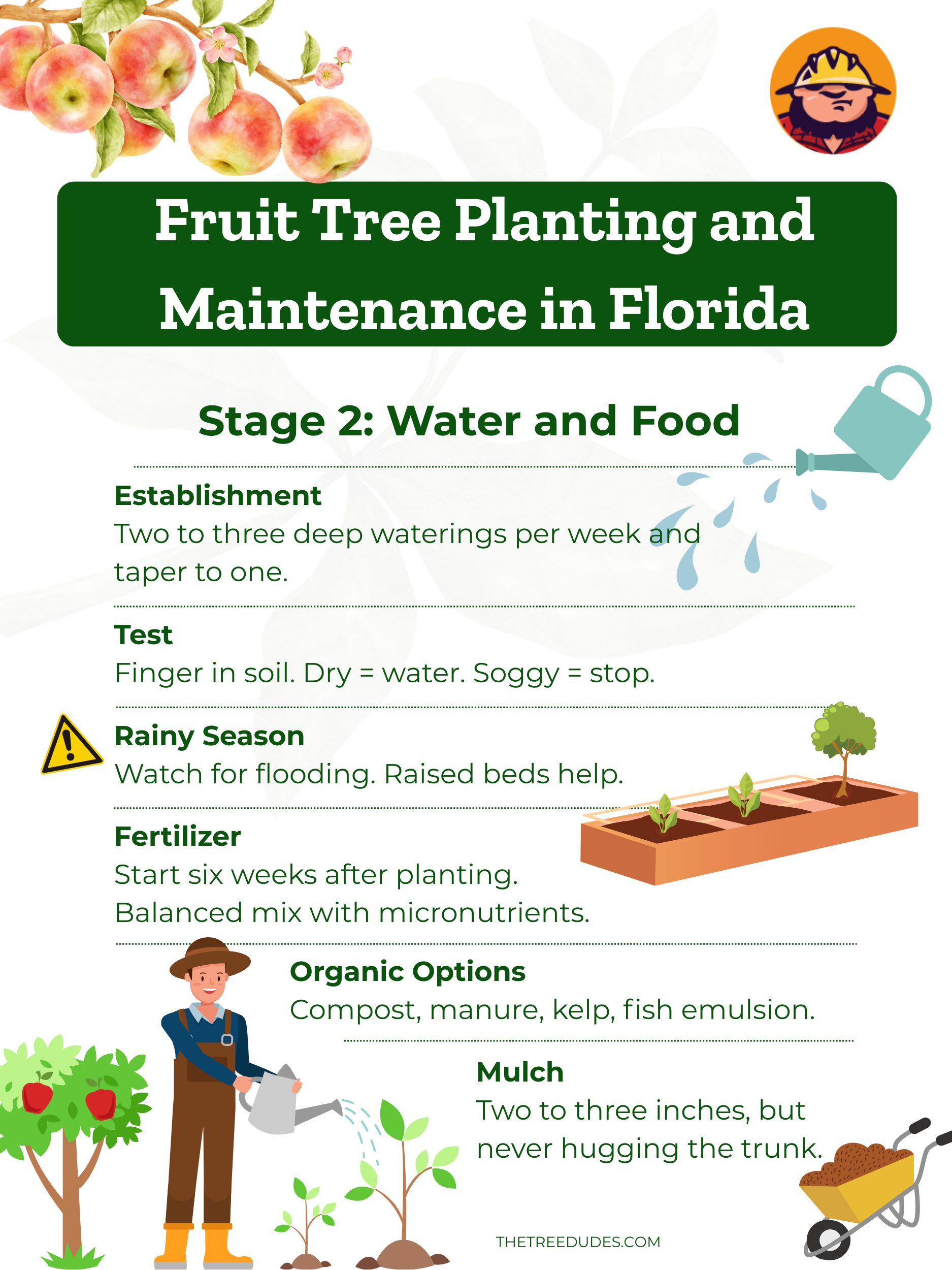
After planting, your fruit tree enters its critical establishment phase. Watering is the most important task for the first weeks. Aim to keep the root zone consistently moist but not waterlogged. In Florida’s heat, that might mean watering a newly planted tree deeply 2-3 times a week for the first couple of months, then you can taper to once a week depending on rain.
Always water at the base. A slow hose trickle or drip irrigation is ideal, letting water soak down 12-18 inches to encourage deep roots. Shallow, frequent sprinkles will not cut it. Remember, even “drought-tolerant” fruit trees like olives or figs need regular water until established. On the flip side, avoid overwatering, which can suffocate roots. It is a balance. Just poke your finger a couple of inches into the dirt.. If it is dry, water. If it is soggy, hold off.
Florida’s rainy season might give plenty of natural water, but also be cautious of flooding. If we get a week of solid rain, young trees in low spots could suffer. That is why those raised beds or mounds help. If a hurricane is coming, a trick some gardeners do is turn off irrigation and maybe even gently cover the root zone with a tarp to prevent too much flooding, but only if minor pooling is a known issue. You do not want to deprive the tree of needed rain, either.
Make sure to feed your fruit tree. Our sandy soil tends to wash away nutrients pretty fast. When it rains, it takes away nitrogen and other important minerals quickly. Most fruit trees benefit from regular fertilization, especially in their formative years. A common regimen is to start feeding about 6 weeks after planting, once you see new growth. Feeding immediately at planting is not necessary if you have added compost, and it can even burn tender roots if overdone.
Go for a balanced fertilizer that has micronutrients, commonly found as “citrus/avocado fertilizer” or “fruit tree fertilizer.” These usually include stuff like iron, zinc, and manganese, which our soils are often missing. Young trees can be fed lightly every 6-8 weeks during spring and summer. As the tree ages, you can give fewer, heavier feedings. Always follow label rates. Too much fertilizer can burn roots or cause excessive leafy growth at the expense of fruit.
Organic options work too: compost, well-rotted manure, or organic pelleted fruit tree fertilizers can build soil health and feed the tree more slowly. Many Florida gardeners swear by periodic applications of kelp or fish emulsion for micronutrients and soil biology, and magnesium for citrus to keep leaves green. For specific guidance, IFAS (the University of Florida extension) has detailed schedules for different fruit crops. For bananas, they recommend 4-6 fertilizations per year, increasing as the plant grows, whereas citrus might be 3-4 times a year once established.
Do not forget mulch. A 2-3 inch layer of organic mulch, like pine bark or wood chips, over the root area works wonders. It conserves moisture, suppresses weeds, and as it breaks down, it feeds the soil life, which in turn feeds the tree. Keep mulch a bit back from the trunk to avoid rot or pests.
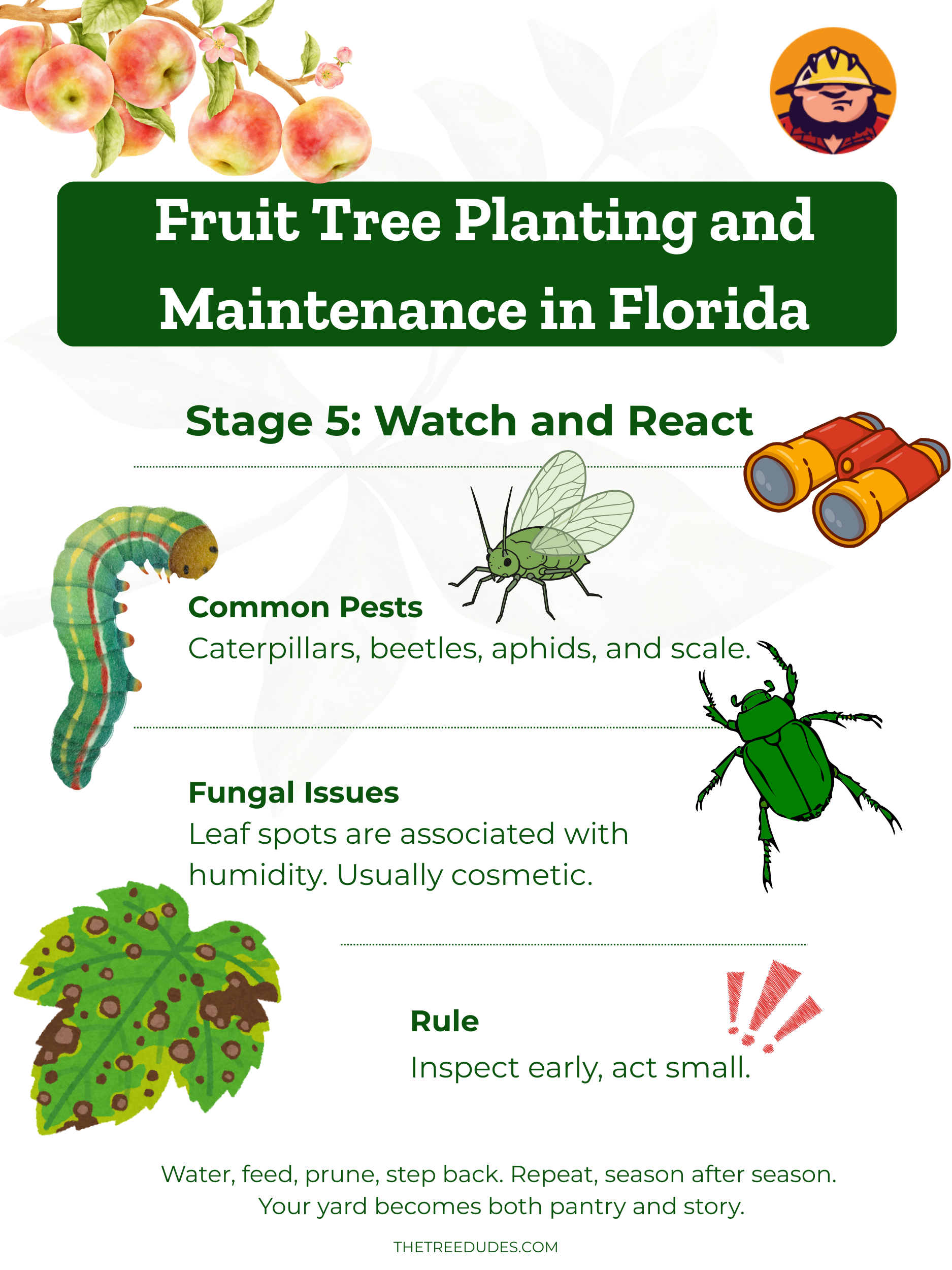
Besides water and food, keep an eye on pests and diseases. Young fruit trees are especially vulnerable, so catch issues early. Common things to watch for in Florida: leaf-chewing caterpillars or beetles. Most trees can handle some nibbling, but if defoliation gets severe, you might intervene with organic sprays like Bt or spinosad. Scale insects and aphids can be blasted off with water or controlled with horticultural oil or soap. Just avoid spraying in the midday heat to prevent leaf burn. Fungal leaf spots often appear in humid weather. They are usually not fatal, so you can prune out badly affected twigs or use fungicides if needed on things like mango or peaches.
One very important maintenance aspect is pruning. How and when you prune will influence the tree’s shape, health, and productivity. For most fruit trees in Florida:
Formative Pruning
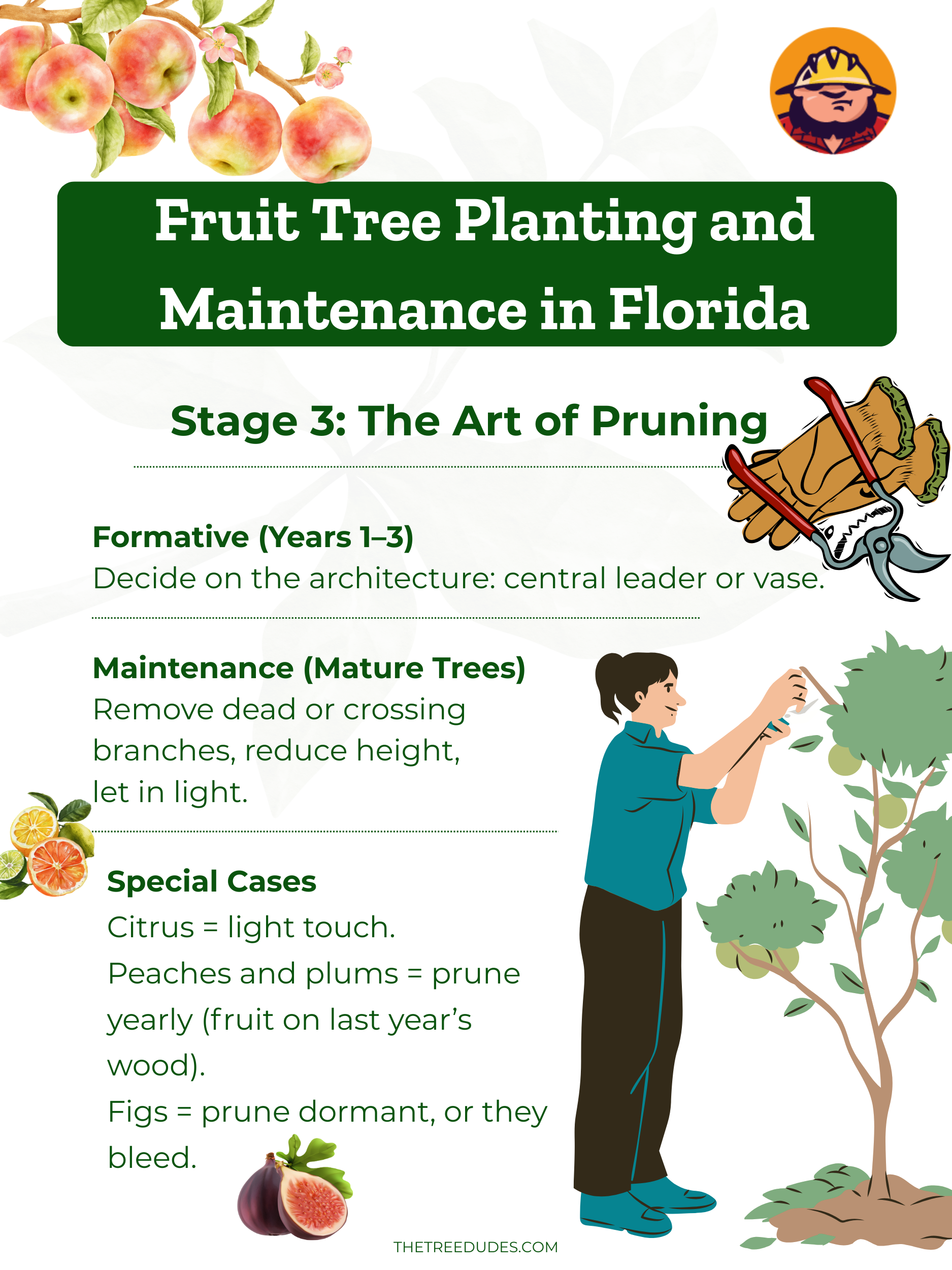
In the first 1-3 years, you may want to establish a good structure. This could mean picking a central leader vs an open vase shape for something like a peach, or tipping off a mango’s vertical shoots to encourage side branches so it does not become too leggy and tall. Prune in late winter or spring for deciduous trees, and after harvest for evergreens like mango or avocado, so they have time to regrow before next fruit set. Always use clean, sharp tools to make crisp cuts that heal faster.
Maintenance Pruning
Once the tree is bearing, prune to remove dead or crossing branches, to reduce height if needed, and to allow light in. Many fruit trees respond well to moderate pruning. For instance, trimming an avocado or mango annually to keep it from getting too tall not only makes it easier to pick fruit but can prevent limb breakage in storms.
Special Cases
Some fruit species have specific needs. Citrus, for example, often does not need heavy pruning. Mostly, just nip off any suckers below the graft and any diseased branches. Peaches and plums fruit on last year’s wood, so you prune them to stimulate new growth each year. Fig trees bleed sap if pruned heavily during active growth, so those are best pruned when dormant. It is worth researching the specific trees you have so you can prune at the right time and in the right way to maximize fruit production.
Mother Nature’s Extremes
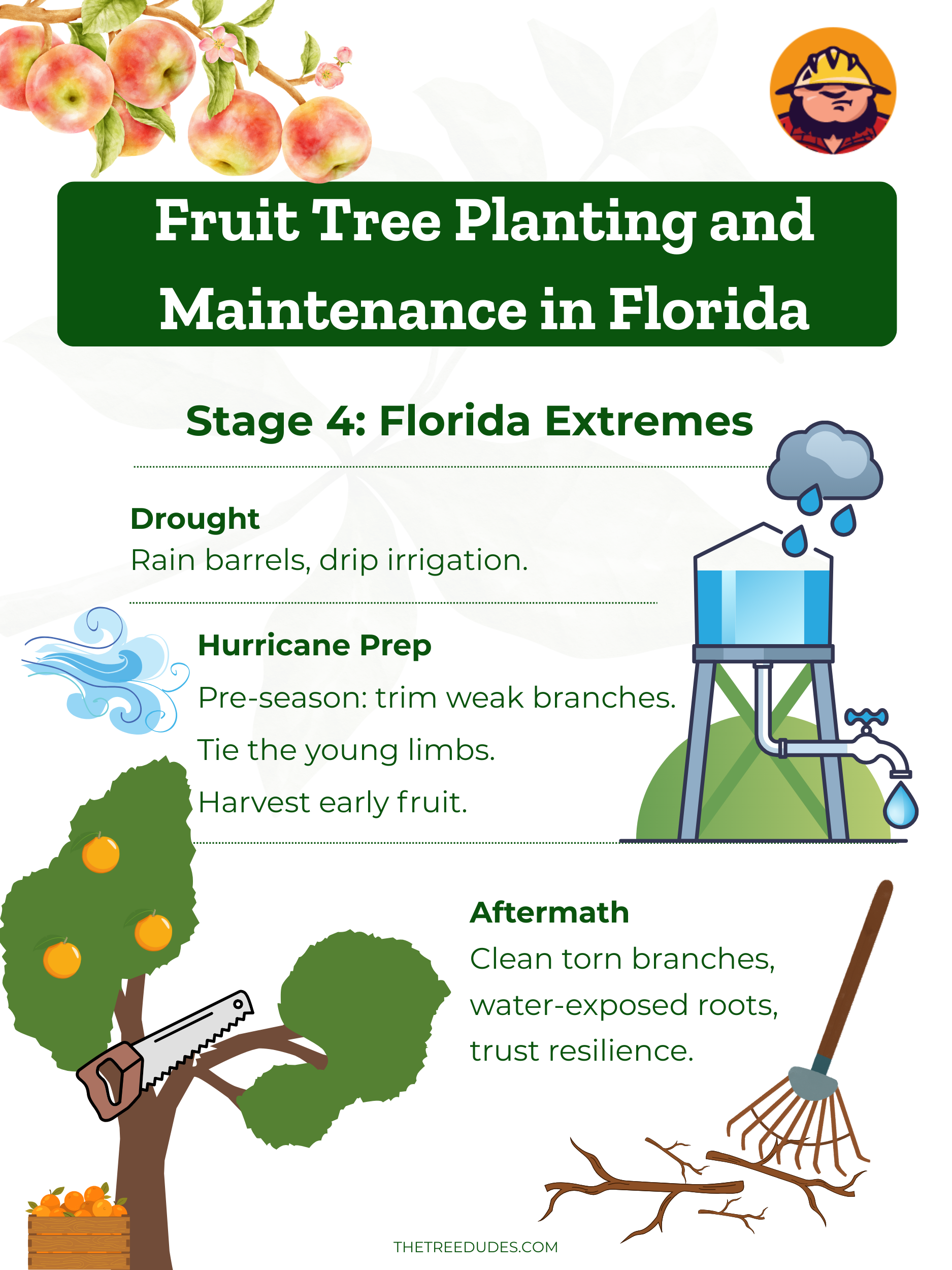
Florida’s weather can swing from drought to downpour, calm to hurricanes. For droughts, consider a rain barrel or irrigation system so you can keep trees watered under water restrictions. For hurricanes or tropical storms, a bit of prep goes a long way: trim any dead or weak branches beforehand. Well before the storm season, ideally, since heavy pruning right before a storm is not advised, secure any new stakes, and if feasible, you can even harvest mature fruit a little early so it does not become projectile in high winds.
It is heart-wrenching to see a beloved mango tree uprooted by a hurricane. Planting in a wind-sheltered spot and keeping trees at a reasonable height through pruning helps. Some gardeners loosely tie the branches of young trees to prevent flapping in severe wind. After a storm, tend to any wounds on trees and clean cut any torn branches, then give them some extra water if the roots were exposed. Florida trees are resilient, many bounce back with new growth even if they look battered.
Fruit tree maintenance in Florida boils down to consistent care and observation. Water when needed, feed routinely, mulch, prune smartly, and watch for issues. It might sound like a lot, but these tasks spread out over seasons and the reward. Baskets of homegrown fruit and a thriving mini-ecosystem in your yard make it well worth the effort. Plus, it gets you outside, moving, and engaging with nature, which many find to be its own reward.
As your trees mature, you will likely find they become less needy. A big mango or avocado can pretty much handle itself aside from seasonal pruning and fertilizing. You transition from hands-on “raising” of a young tree to more of a manager of an established one. And nothing beats the feeling of watching a tree you planted years ago now heavy with blossoms or fruits, knowing your care helped it get there. Gardening in Florida can be an adventure, but when it comes to fruit trees, it is an adventure with a very sweet ending.
Local Rules and Regulations: Palm Beach and Florida Tree Laws
Before you run off to turn your backyard into a fruit jungle, it is important to touch on the rules and regulations that might apply to tree planting and maintenance, especially in Palm Beach County and Florida at large. While planting a fruit tree for personal use is usually encouraged, because who would object to more green and local fruit?, there are some ordinances to keep in mind so you stay on the right side of the law and on good terms with neighbors and city officials.
Local governments in Florida often have tree ordinances meant to protect the environment and ensure safety, and yes, some of those rules can affect your backyard orchard plans. Let’s break down the key points in a simple way.
Tree Removal and Permits
If you ever need to remove a tree, fruit tree, or otherwise, Palm Beach County and its cities have guidelines. In Palm Beach County, a permit is generally required to remove trees, especially for larger properties, commercial sites, or if the tree is in a “protected” category. The county has a “Preservation and Protection of Native Vegetation” ordinance, which even covers how much you can trim a tree. Trimming more than 25% of a tree’s canopy at once might require a permit or can be deemed a violation.
The logic is to prevent people from essentially destroying trees by over-pruning or cutting them down without consideration. For typical single-family homeowners, rules are a bit more lax than for developers. For example, Palm Beach County generally does not require a permit to remove a tree on a standard residential lot unless it is in a special area like a common community space or it is a protected species. However, cities can have stricter rules.
Many municipalities in Palm Beach County, such as Boca Raton, Boynton Beach, Jupiter, and Greenacres, have their own tree ordinances. Some require permits for any tree removal, period. Some carve out exceptions for fruit trees or invasive species. For example, the City of Boca Raton requires a permit for tree removal, but explicitly allows certain invasive trees like Brazilian pepper and Australian pine to be removed without one.
Fruit trees in some codes are not counted as “shade trees” for landscaping, meaning if a developer plants fruit trees, they might not count toward the required tree count, but as a homeowner, you are free to have them. They just might not fulfill an HOA’s shade tree requirement.
The state of Florida added an interesting law in 2019 (amended in 2022): Florida Statute 163.045, which says that if a residential property owner has a tree that an ISA-certified arborist or licensed engineer deems to be a danger, the owner can remove or prune that tree without needing any local permit. This was a big deal. It essentially means you have the right to promptly take down a hazardous tree without jumping through bureaucratic hoops. You need documentation, like a certified letter or report from the arborist, and the law prevents cities from requiring replanting in that case.
Keep this in mind: if one of your trees becomes diseased or storm-damaged to the point of posing a risk, you have an avenue to address it quickly. But be aware: the definition of “danger” was clarified, basically, the tree must pose an unacceptable risk of failure. Always get a qualified assessment. Do not just cut a tree and claim “it seemed dangerous to me,” that might not fly.
Planting Permissions and Locations
You usually do not need a permit to plant a fruit tree in your own yard in Florida. The only exception is if you are planting it in a public right-of-way or a hollow spot, like that strip between sidewalk and street. Some cities require permission because that area, while maintained by you, is city property. For instance, if you wanted to plant an avocado tree right on the curb line, your city might say no. Often, they want only certain street trees in those areas.
Check your city’s rules on swale or street tree planting. Also, some municipalities like Greenacres in Palm Beach County bizarrely require a permit even to plant or relocate a tree on private property. This is not common, but it exists to ensure people plant the “right tree in the right place.” Boca Raton’s guidelines, as another example, encourage residents to plant trees away from power lines for safety.
If you live in a community with a Homeowners Association (HOA), always check their rules too. HOAs might have approved planting lists or forbid certain messy fruit trees. They might also require you to maintain trees to a certain height or away from sidewalks. While HOA rules are not laws, they are binding agreements for residents in those communities.
Pruning Codes
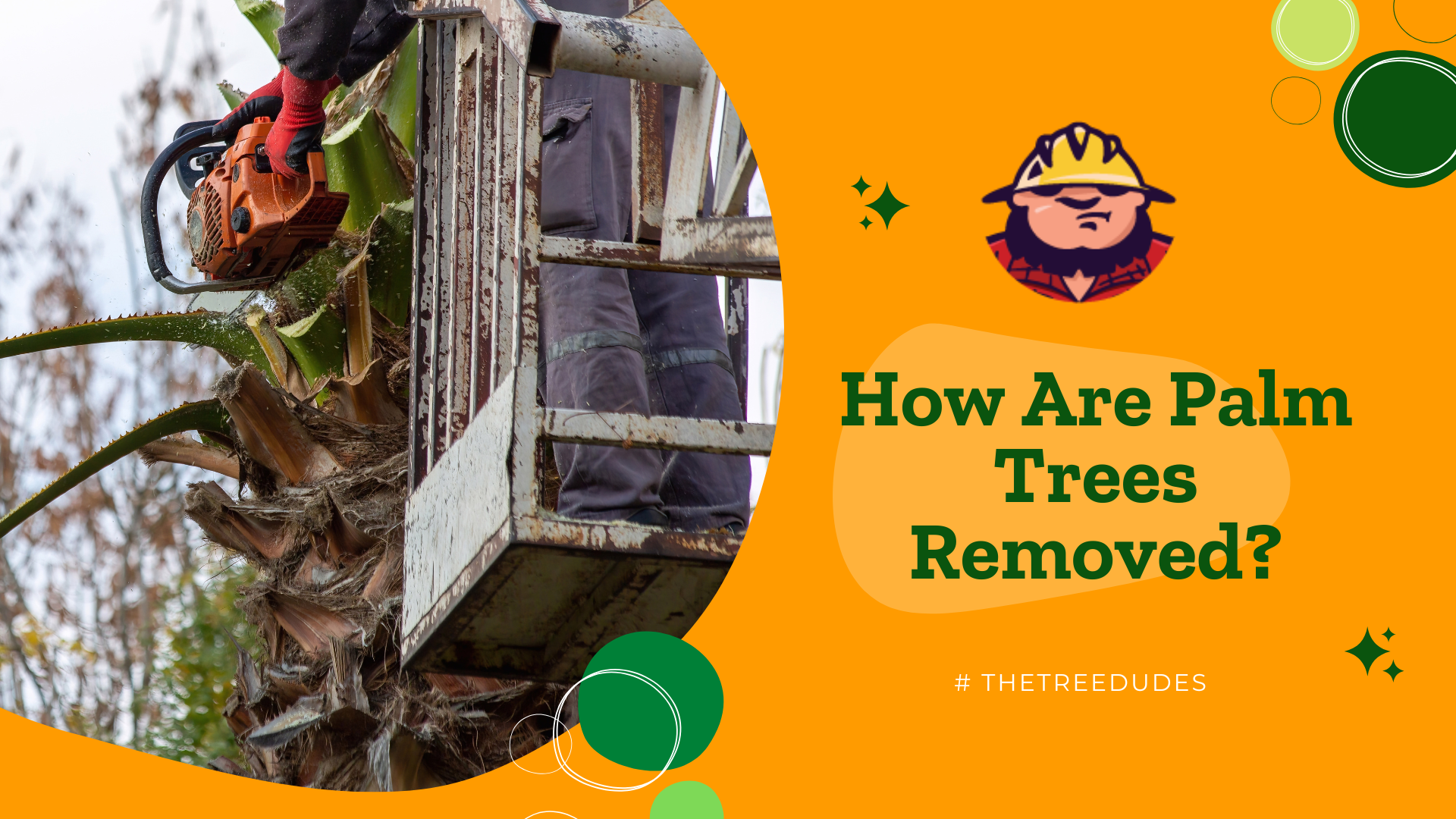
Palm Beach County and many cities have specific codes about pruning, especially aimed at preventing the malpractices of “topping” trees or overly severe pruning that harms the tree’s health and aesthetics. The county considers it a code violation to remove more than one-third of a tree’s foliage or to cut a palm’s fronds above the horizontal line. If someone over-prunes a tree and basically disfigures it, which is often done by untrained landscapers hoping to reduce tree size quickly, the county can fine the property owner and even require the tree to be replaced if it will not regrow properly.
Fruit trees often require pruning for productivity, but that usually does not conflict with these rules because you are not stripping the tree bald. You are selectively shortening or removing branches, which is fine. Just do not let anyone over-prune your trees, as it is both illegal in many places and harmful. A minor violation in PBC is if a tree is trimmed such that it can not regrow its natural shape. A major violation is effectively killing or ruining the tree by trimming. The take-home message: use proper pruning techniques or hire certified arborists, especially for big jobs.
Protected Trees and Native Species
While your focus may be fruit trees, most of which are non-native, like mango or avocado, be aware that Florida and local jurisdictions protect certain native trees. For example, a massive live oak or a cypress on your property might be protected. You often can not cut those down without a permit and mitigation, like planting new trees.
Fruit trees generally are not in that category. In fact, as mentioned, some codes do not count fruit trees toward the required landscape trees. This might indirectly mean it is easier to get a removal permit for, say, a citrus tree than for a live oak, since the city does not see the fruit tree as critical to the shade canopy. Always check with local environmental or landscape departments if in doubt.
Palm Beach Specific Ordinances
The Town of Palm Beach, which is a tiny island, and cities like Palm Beach Gardens or Wellington, each have their own rules. For instance, Palm Beach Gardens has strict pruning standards in its code (Section 78-328) to prevent bad pruning. Wellington requires permits to remove any tree in public areas and fines for unauthorized removal.
The Town of Palm Beach itself is quite protective of its luscious landscaping. They have historical preservation of some old trees, and they run programs to remove invasive Australian pines, replacing them with natives. Fruit trees are not banned or anything, but say you wanted to remove a large mature tree, fruit or not, expect to file some paperwork and possibly plant replacements.
Florida-Friendly Guidelines
Florida has a statewide ethos of Florida-Friendly Landscaping, which encourages planting wind-resistant trees, drought-tolerant species, and generally being mindful of environmental impact. If your property is near a natural area, avoid fruit trees that could escape into the wild. For example, strawberry guava is highly invasive in Florida hammocks. If you love guava, choose a tropical guava and harvest the fruit so animals do not spread the seeds.
As noted earlier, coconut palms are under watch since they are non-native. UF/IFAS actually recommends specific practices if you plant them, like not letting coconuts roll into waterways. While no one will arrest you and leave you to rot in jail for a coconut palm, it is good to be aware of such guidelines.
A quick call to your city’s landscaping or planning department can clarify if you need any permits for planting or removing fruit trees. Generally, you can plant whatever you want in your yard, but just watch out for the city ordinances. For removal, check first. It might save you a fine of hundreds of dollars. And if you ever hire a tree service to trim or remove a tree, make sure they are licensed and know the local laws. Reputable arborists in Palm Beach County will be familiar with all this and can guide you.
Above all, these rules exist not to be a headache, but to ensure that as our communities grow greener, they do so safely and sustainably. They prevent clear-cutting of trees that cool our neighborhoods, and they discourage practices that weaken trees, which could then fall in storms and cause harm. By following them, you are contributing to a more beautiful, safe community, and you will avoid any unwanted citations from code enforcement that can leave you bankrupt and in crippling poverty.
So, plant those fruit trees, enjoy them, but also be a good steward. Trim responsibly, remove only when necessary, and legally, and be mindful of your tree’s impact beyond your fence line. Your neighbors will appreciate that your lush mango is not knocking out their power lines or that fallen fruit is not drawing pests across property lines. In Palm Beach County, as in the rest of Florida, a little neighborly courtesy and rule-following go a long way toward keeping the “Garden of Eden” vibe without any drama.
Harvesting the Rewards
With diligent care and patience, your Florida fruit trees will begin harvesting the rewards of your labor. All those hours of pruning, watering, and tending are repaid with bountiful harvests of juicy produce and the vibrant health of your trees. Beyond the tangible fruits, you will enjoy a safer, more beautiful landscape, one that provides shade, fresh air, and the simple satisfaction of watching something you nurtured thrive.
Remember that tree care is a continuous journey, not a one-time task. Each season brings new needs for your trees, and consistency is key to long-term success. Do not hesitate to seek a helping hand for specialized tasks: professional tree trimming and pruning can shape your fruit trees for optimal growth, while scheduled pest and fertilization treatments fortify them against insects and nutrient deficiencies. If one of your trees shows signs of illness or stress, specialized care for a sick tree services are available to diagnose issues early and nurse your tree back to health. By staying proactive and addressing problems promptly, you set the stage for your trees to remain productive and resilient year after year.
Looking to the future, consider how you want your orchard or backyard to evolve. If you dream of adding new fruit varieties or relocating a tree to a better spot, expert tree planting and tree transplanting services can ensure those changes go smoothly with minimal stress on the plants. Conversely, if an aging tree stops producing or poses a safety hazard, a safe tree removal followed by replanting might be the best course. This allows room for fresh growth and keeps your garden thriving. There is no shame in making a tough call to remove a struggling tree when it opens the door for new, healthy saplings to flourish in its place.
Above all, consistency and care will carry your fruit trees far. Establish a routine. You might even opt for an annual tree services check-up by professionals to make sure no aspect of your tree’s maintenance is overlooked. With regular attention, either on your own or with expert help when needed, you will continue to reap the rewards season after season. Every juicy fruit, strong branch, and new leaf will stand as proof that the effort you invest in your trees truly comes full circle, rewarding you with a plentiful harvest and a beautiful, thriving landscape to enjoy for years to come.