






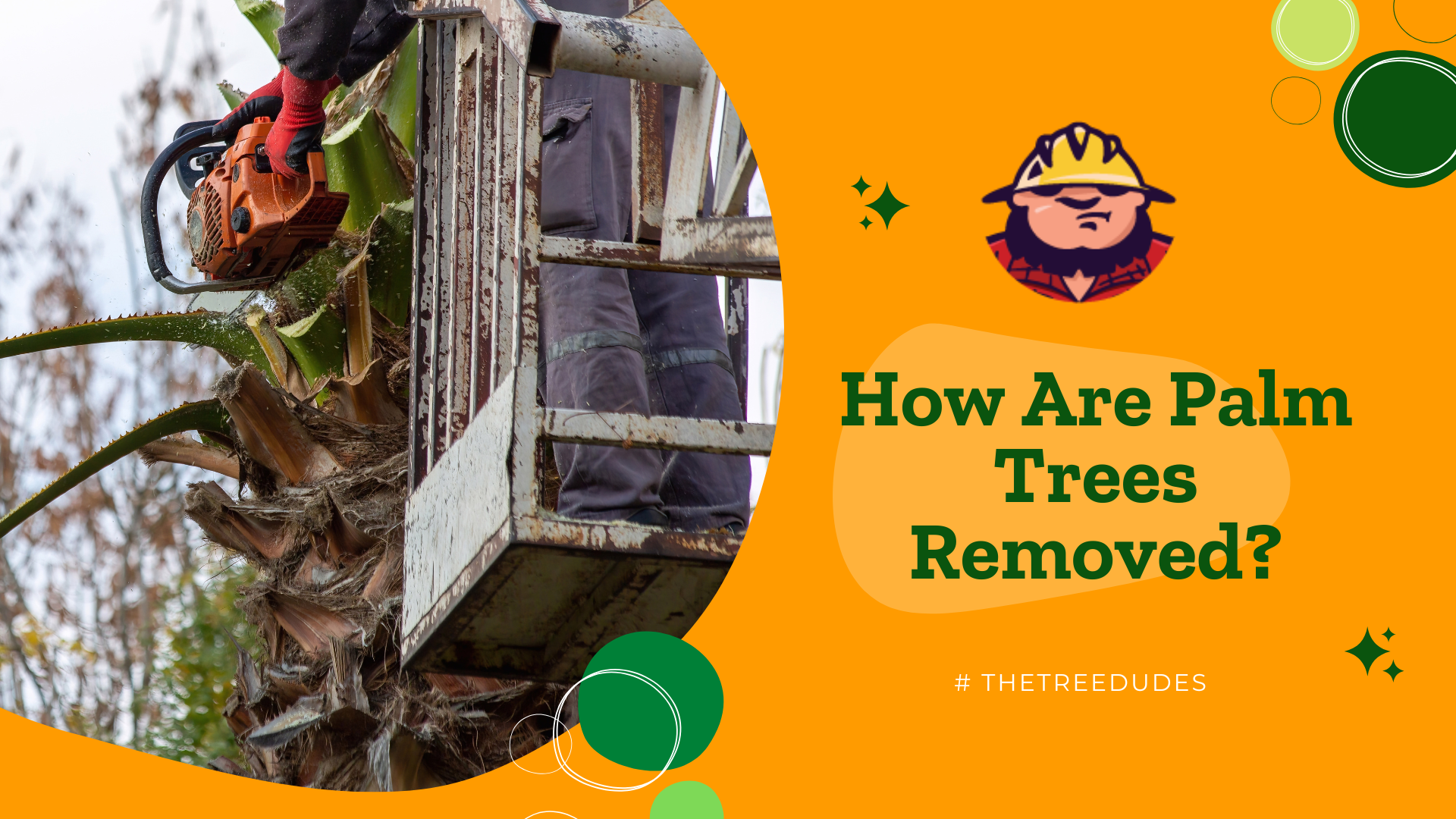
Florida’s iconic palms might be as much a part of the landscape as sandy beaches and afternoon thunderstorms, but there are times when even a beloved backyard palm has to go. Perhaps it has grown dangerously close to your house, maybe it is dying from disease, or it has simply become an eyesore blocking that gorgeous sunset view. Whatever the reason, taking down a palm tree is serious business, and safety comes first. In this guide, we will walk through the entire palm removal process, tailored specifically for Florida homeowners.
Why Remove a Palm Tree?
Palm trees may symbolize a tropical paradise, but there are plenty of down-to-earth reasons a Florida homeowner might need to remove one.
First and foremost is safety. If a palm has died or become structurally unsound, maybe due to lightning strikes or decay, it can turn into a 50-foot spear threatening your roof or your neighbor’s property during the next hurricane. Dead palms are especially hazardous in storm season without live fronds to cushion a fall, as a trunk can come crashing down like a telephone pole. Speaking of storms, even healthy palms can be safety risks if they are leaning precariously or entangled in power lines. Taking out a tree before it becomes a problem could save you from a big headache down the line, not to mention a hefty repair bill.
Another big reason for palm removal is disease or infestation. Florida is home to a few silent palm killers, like Ganoderma butt rot, which is a fungus that rots a palm’s trunk from the bottom up, and also lethal yellowing disease. Once a palm gets infected with Ganoderma, there is no way to fix it. The mushroom on the trunk means the palm is living on borrowed time.
It is tough to say goodbye to a tree that has been part of your yard for ages, but leaving a diseased palm in place could jeopardize all the other palms on your street. In cases of infestation, such as invasive red palm weevils or other pests, removal may also be the best course of action if the damage is beyond treatment.
Sometimes It Is Not You, It Is the Palm
Sometimes, the decision is more about practicality or aesthetics. Palms can outgrow their space. That cute little queen palm you planted near the pool a decade ago might now tower at 30 feet, dropping messy fronds and berries in your filter. Or perhaps it is casting too much shade on your garden, or its roots are encroaching on your foundation or plumbing. Palm roots are usually not aggressive, but a large date palm too close to a driveway can still cause issues.
Florida yards often have multiple palm species, and not all are equally desirable. Remove a scraggly, poorly placed palm to make room for a different tree or a home addition.
Homeowners’ insurance or HOA rules can also influence the decision. Some HOAs frown on certain palm varieties if they are deemed messy or unsafe. And of course, there is the scenario of invasive palms: although palms are generally beloved, a non-native species spreading where it should not, or sprouting palms everywhere via dropped seeds, could warrant removal to keep your landscape in balance.
Florida’s Iconic Palms and Their Unique Challenges
Florida is a palm tree paradise, boasting dozens of species, each with its character and considerations when it comes to removal. Let’s talk about a few common Florida palms and what makes them special:
Sabal Palm
This is Florida’s state tree and a native champion. Sabal palms have strong, rough trunks and can reach about 40 feet in height. They are hardy and hurricane-resistant, but if one dies or needs removal, expect a dense, fibrous trunk that can be tough on chainsaw blades. Sabals also have extensive root systems, so their stumps often need thorough digging.
On the bright side, they are common and not particularly valuable, so removal is usually straightforward, though you might need to handle that tough stump. Sabal stumps were used as scrub brushes for ships back in the day because they were tough and fibrous.
Queen Palm
A popular landscaping palm, the queen palm is everywhere in Florida’s suburbs. They can reach about 30 to 50 feet. Queens grow fast but are not especially long-lived or hardy. Many suffer from nutrient deficiencies or storm damage over time. Removal-wise, queen palms are relatively lightweight for their height, but still tall, meaning if yours is on the upper end, you are likely looking at a professional job with a bucket truck.
They also produce an orange fruit that makes a mess. By the time you are fed up with cleaning squished palm berries off your driveway, you might be ready to cut it down. Since queen palms are so common, do not expect to make money selling one. Nurseries will not pay for these “ordinary” palms.
Royal Palm
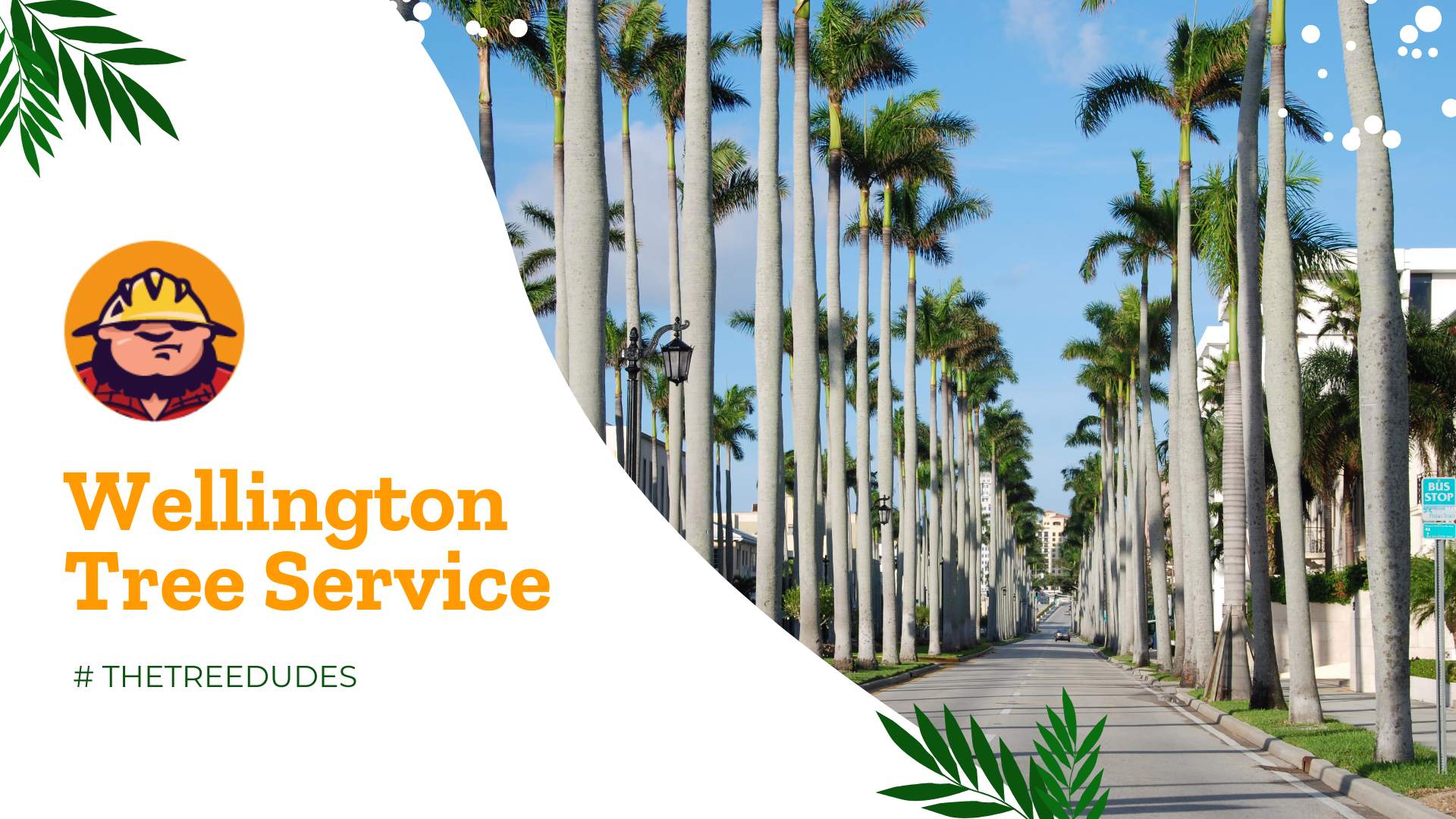
These palms are quite hardy. They can endure hurricanes, swaying through fierce winds with grace, so it is rare to remove a healthy royal palm unless necessary. But when you must, it is not a DIY scenario. A tall royal is extremely heavy, as the trunk holds a lot of water, and requires cranes or skilled crews to remove safely. A falling green royal palm can hit the ground with astonishing force due to its weight and lack of branches to slow it.
Professionals often remove these panels piece by piece to avoid turning your yard into a royal wreck. The upside is that large healthy royals might have some value to landscapers. Sometimes they transplant them to new developments, though moving an 80-foot palm is a spectacle in itself.
Coconut Palm
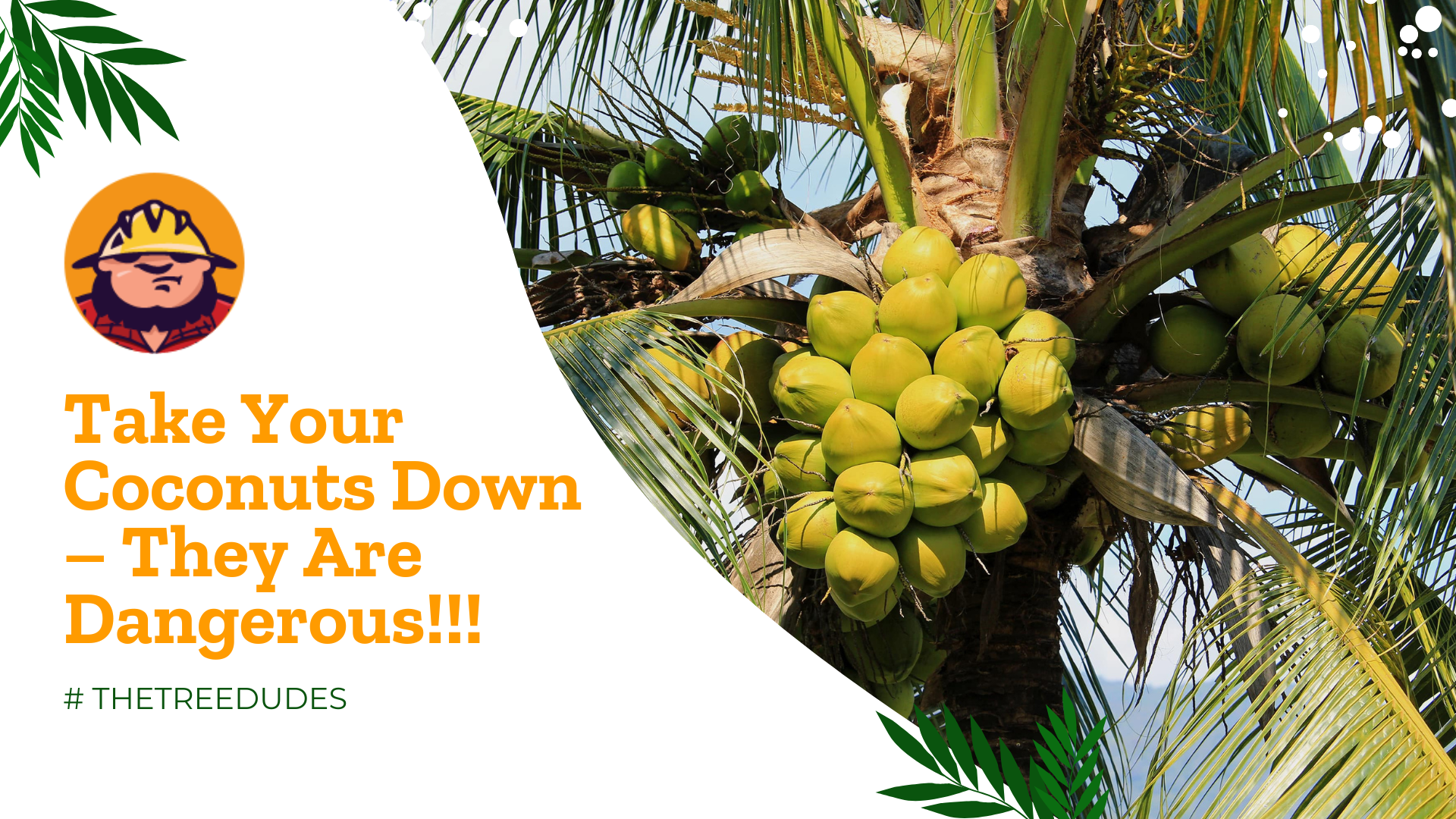
What is more Florida than a coconut palm swaying by the shore? These palms, iconic for their coconuts, typically grow 50-60 feet in South Florida. Removal considerations: those coconuts must be removed or secured before cutting the tree. They are cannonballs waiting to fall on someone’s head or smash a window. Coconut palms have a fairly smooth trunk, which can be slippery to climb, so proper climbing gear or lifts are needed if doing a sectional removal.
They are heavy too, though not quite like a royal palm. Interestingly, coconut palms have a relatively compact root ball, which can make mature specimens easier to uproot with a crane if a buyer wants them. Big, healthy coconuts are in demand for resorts and city beautification. It never hurts to snap a photo and ask around local tree services or nurseries if they are interested.
Pygmy Date Palm
Pygmy date palms are the cute little plants that everyone loves in landscaping, usually only growing about 6 to 12 feet tall. Often planted in clusters, they are more like overgrown houseplants than towering trees. If you need to remove one, it is often as simple as digging it out. Just watch out for the needle-like spines at the base of their fronds, which can surprise you, and not in a fun way.
Because they are small, homeowners can usually remove pygmy palms DIY-style with a shovel, a saw, and some elbow grease. Just be sure to remove the stump if you plan to replant in that spot, because pygmy palms will not sprout back, but the remaining stump can be unsightly or a pest attractant as it decays.
Preparation and Precautions Before Removal
Getting ready the right way makes all the difference between an easy removal and a total disaster. Here is what you need to do before you make any cuts:
Check the Rules and Permits
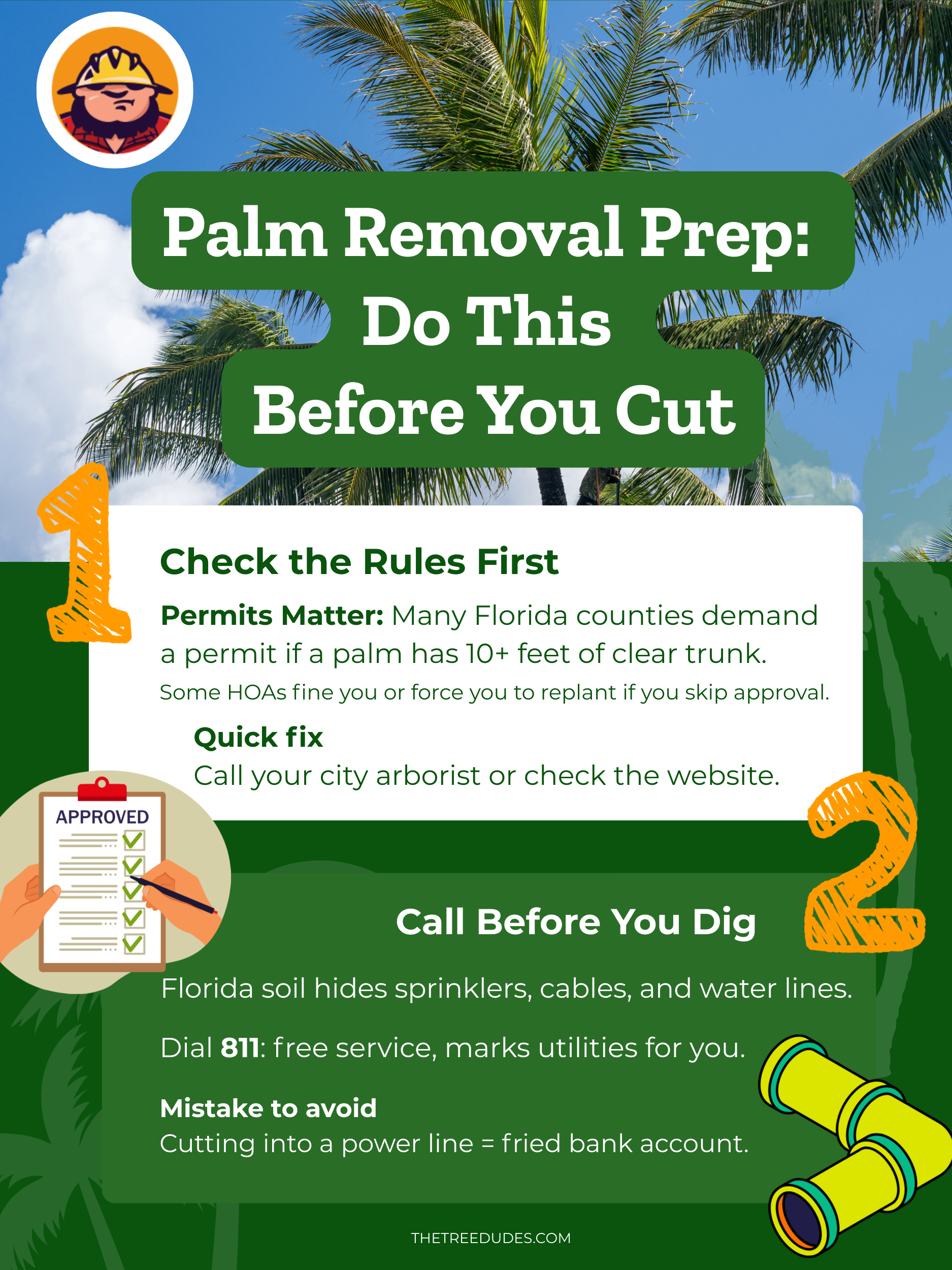
Florida has some laws and local ordinances regarding tree removal, and yes, palms are often included. While a dead or small palm typically can be removed without fuss, many municipalities require a permit for removing larger trees or certain protected species. For example, some South Florida counties insist on a permit for any palm with over 10 feet of clear trunk.
Homeowner Associations (HOAs) may also have rules about tree removals or replacements. The last thing you want is to violate a rule and face a fine or be forced to replant a new tree in its place unexpectedly. So, make a quick call to your city’s arborist or permit office, or check their website. It is usually a simple formality, but an important one. It is better to drown them in paperwork upfront than in apologies later.
Call Before You Dig
Florida’s sandy soils often hide utilities like sprinkler lines, plumbing, and cables. Dial 811 or your local utility locating service if you suspect any lines near the palm’s root zone, especially if you plan to grind or dig out the stump. It is a free service to mark utility lines. Hitting a water main or electrical line will ruin your day and your bank account. Safety first, always.
Gear Up for Safety
Removing a palm tree means working with sharp tools and heavy wood overhead, so personal protective equipment is a must. At minimum, wear a hard hat, as those coconuts or falling fronds can pack a punch, eye protection to prevent sawdust and palm fiber in your eyes, and hearing protection if using loud equipment.
Sturdy work gloves and boots are non-negotiable. Palms can be surprisingly spiky, as many have spines or rough edges, and you need a good footing. If you are planning to climb or use a ladder, think about wearing a safety harness. People who do this for a living often use climbing spikes, harnesses, and sometimes even cranes to reach tall palms. If you find yourself wobbly on a ladder, that is a sign to pause and possibly call a pro. Remember, a palm’s smooth trunk can be harder to climb than a branched tree. If you have a harness, secure it to the trunk or a sturdy anchor point to catch you in case of a slip.
And one more thing: wear long sleeves and pants. Yes, it is Florida, and it is hot, but you will thank yourself later when you are not covered in scratches from rough palm bark or irritated by sawdust. Not the coolest outfit, but the coolest look is you handling that tree like a pro, safely.
Assess the Surroundings
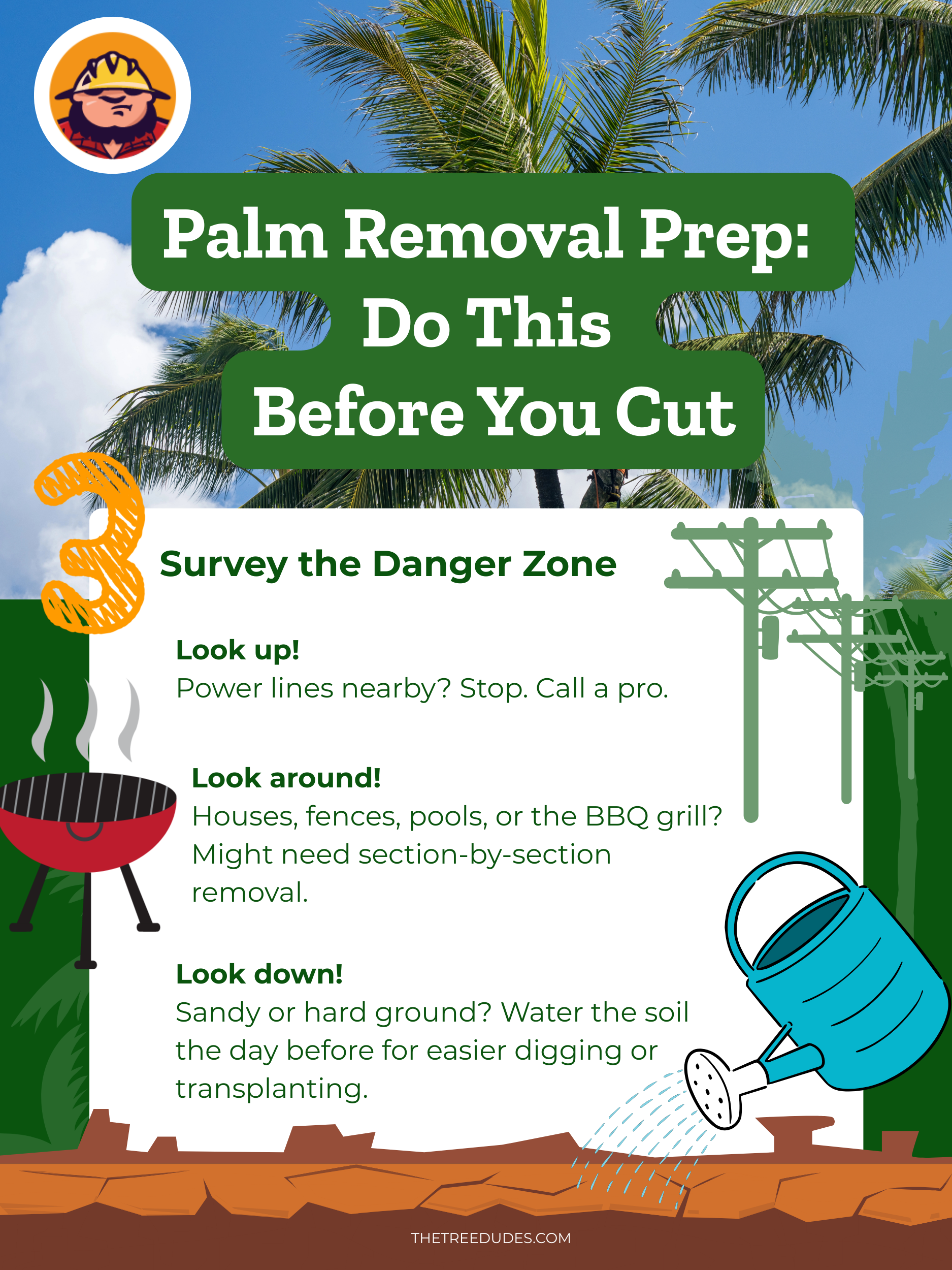
Take a slow walk around the palm and look at what is around it. Are there power lines running near or above it? If yes, stop. Call a professional arborist because trees plus power lines together are not for amateurs. Is the palm close to your house, a fence, or a pool? If so, you will likely need to remove it in sections to avoid crushing something. Palms often have a gentle lean, and they tend to fall in the direction they are leaning. Plan accordingly for where you want it to drop. Choose a clear landing zone if you intend to fell it in one piece. That zone should be at least as long as the tree is tall, preferably more, with no people, structures, or vehicles.
If such a space does not exist, say your yard is small or the palm is wedged in a tight spot, the plan will be to take the palm down piece by piece. Also, consider the ground: is it soft sand or hard ground? Soaking the soil a day before can help soften it up, which makes digging and getting out stumps way easier, especially if you’re planning to transplant something.
Assemble Your Tools
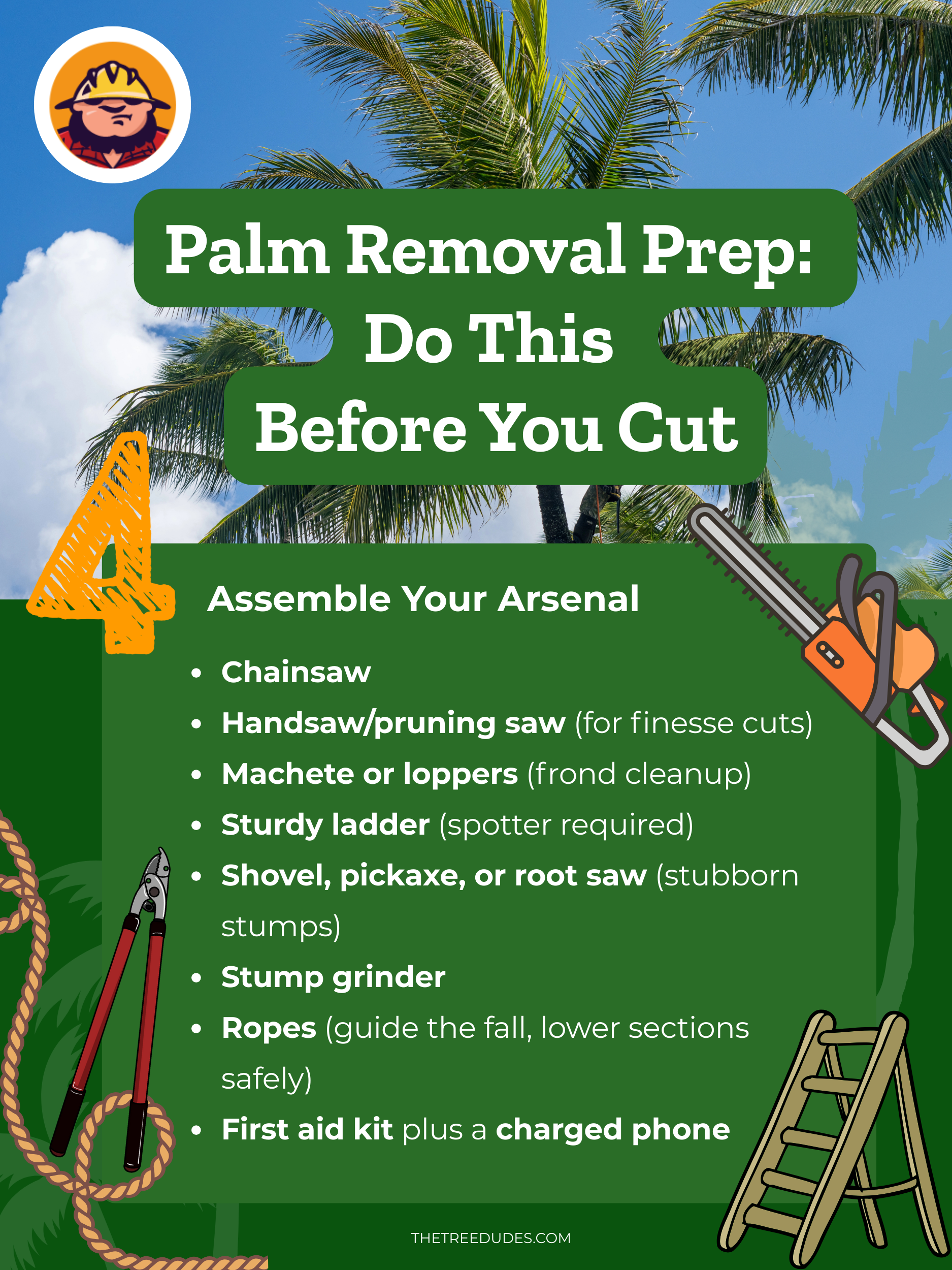
Having the right tools on hand is essential. For most palm removals, you will want: a chainsaw, which you have to make sure is in good working order, a sharp chain, filled with fuel or oil. Remember, palms can dull a blade quickly with their fibrous wood. You may also need a handsaw or pruning saw, which will be useful for smaller cuts or if you don’t want to fire up the chainsaw for every little thing. Additionally, a machete or long-handled loppers may be necessary for initial trimming of smaller fronds.
You will also need a sturdy ladder if the palm is tall and you are attempting some DIY height work. Again, be extremely cautious on ladders, and preferably have a spotter to hold it. For the stump, if you plan to dig, get a pointed shovel, maybe a pickaxe or digging bar for stubborn roots, and an axe or root saw.
If you intend to grind the stump, you will need to rent a stump grinder. Many home improvement stores in Florida rent them by the day. It is also smart to have ropes. A strong rope to help guide the tree’s fall or to secure heavy limbs as you cut, and maybe a few shorter ropes or straps if you are removing sections. You can cut sections down with ropes to avoid free-falling chunks.
Last but not least, have a first aid kit handy and your cell phone charged. Not being pessimistic, just prepared. Tell someone what you are doing, too, in case you need assistance. Now, with permits in hand if needed, gear on, and tools ready, you have set the stage.
Step-by-Step Palm Tree Removal Process
It is time to get down to business. We will go through this in the order you would typically do it, as if you are a DIY-er starting the job. However, please remember: if at any point you feel unsafe or unsure, or the job is bigger than you thought, pause and call a professional. There is no shame in knowing your limits. Palm trees can be unpredictable, and gravity is always waiting to prove us wrong.
Clear the Area and Plan the Drop
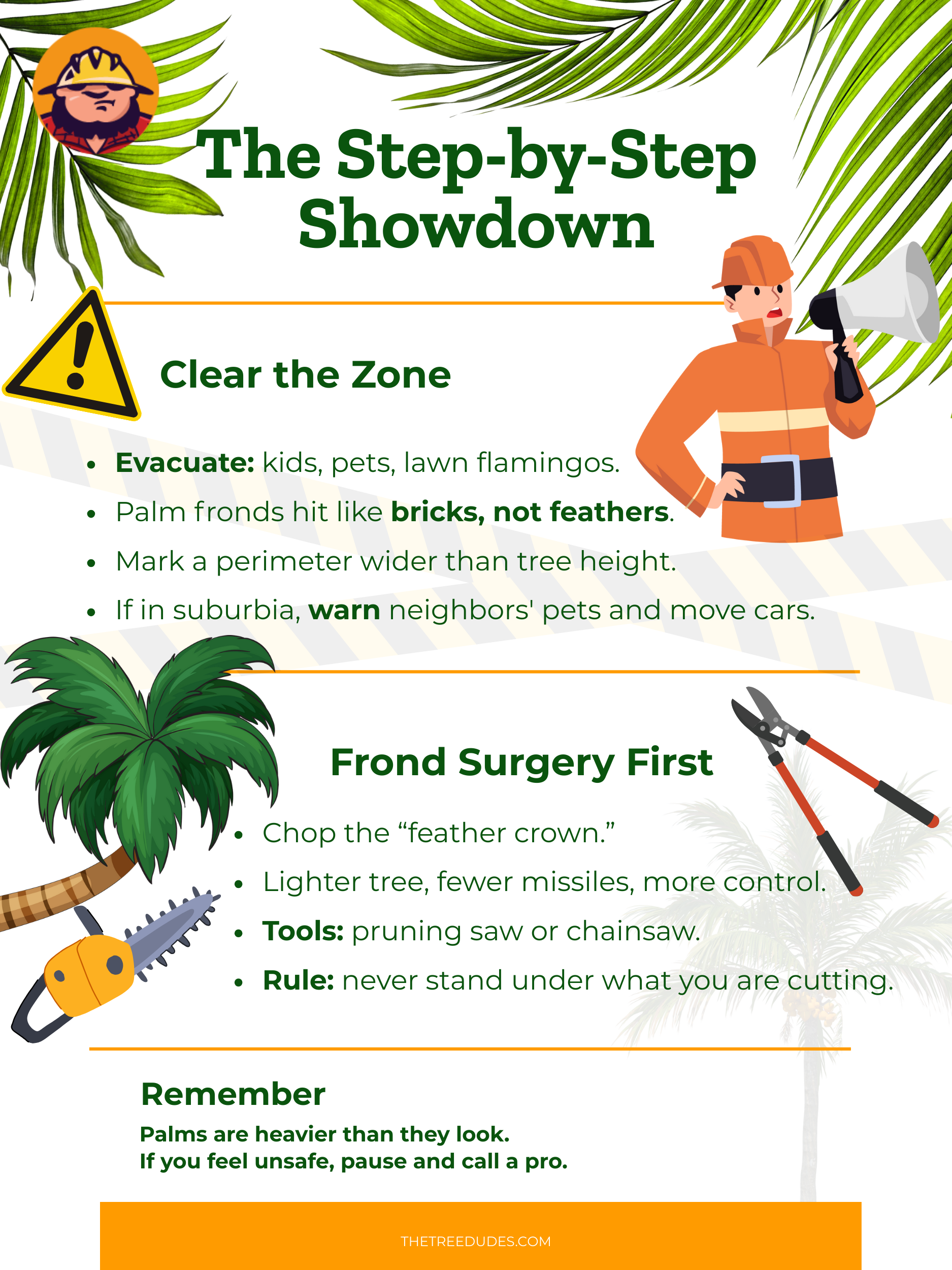
Before any cutting happens, make sure everything and everyone is out of the way. This means children, pets, lawn flamingos, garden gnomes, you name it, they all need to be at a safe distance. Well beyond the height of the tree, preferably. Palm fronds and trunk pieces will fall “heavier” than you expect, thanks to water weight and dense fiber, so even a smaller palm can cause damage if it hits something on the way down.
Set up a perimeter. If you are in a suburban neighborhood, let neighbors know you are felling a palm so they can steer clear or move their cars. Florida palm trees typically have big, wide fronds that can drop down with a loud smack. They will not flutter down like leaves, trust me. So, look up and imagine the path of each cut piece. Are you taking down the whole tree at once, or chopping it up bit by bit? This depends on the surroundings and the tree’s height. If you have a huge open yard and a relatively straight palm, a controlled felling cut might be feasible. If there is not much room or there are things in the way, it is usually safer to take the palm down piece by piece. Just climb up and cut it down in chunks from the top. Professionals call this piecemeal removal or tree lopping.
Next, study the palm’s natural lean one more time. If you plan to fell it in one piece, you usually want it to fall with the lean if that area is clear. Identify that fall zone and clear any last-minute obstacles from that patch of ground. Lay down old tires or logs in the drop zone if you have them. They can cushion the fall a bit, which is helpful, especially for very tall palms that might smack the ground hard.
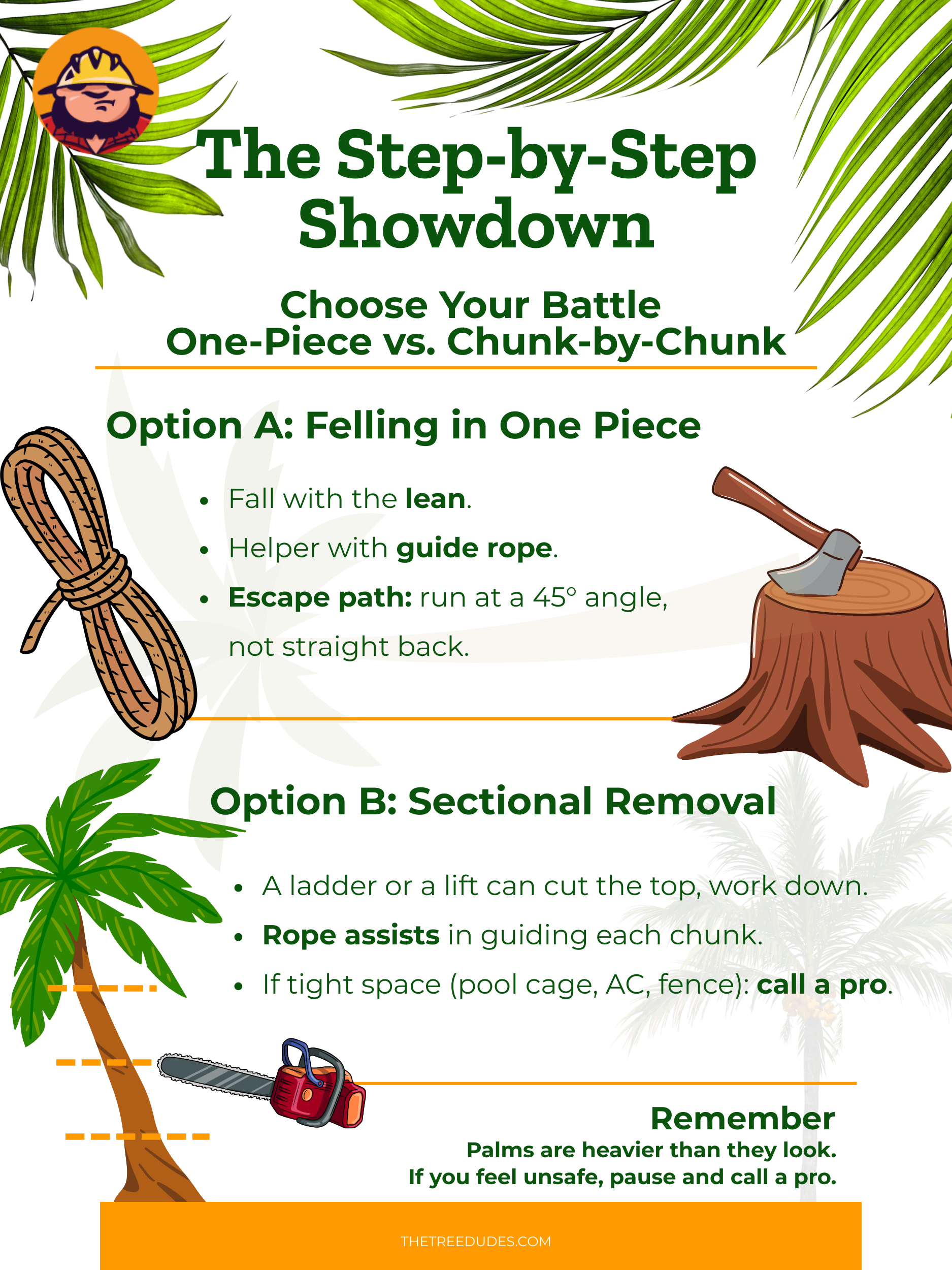
Consider tying a guide rope high up the trunk as high as you safely can, maybe using a ladder, and have a helper hold tension on it from the direction you want the tree to fall. This way, as it begins to go, they can help “pull” it toward the target zone. Agree on a plan and some basic signals. And make sure your helper is standing far enough away, which means off to the side, not in the line of the fall. Nobody should be where the tree is aimed to fall. With the drop zone clear and the plan decided, we can move on to the palm itself.
Trim or Remove the Fronds
Palms wear a big crown of fronds, and those have to come off first in almost all removal scenarios. Why? A couple of reasons:
Weight reduction fronds are heavy, especially when green and full of water. Removing them lightens the tree significantly, which makes it safer and more predictable to bring it down.
Control. A palm tree with all its fronds is like a giant arrow with feathers on top. The wind can catch it, or the fronds might snag on other trees or wires during a fall. We do not want that.
They are dangerous missiles. Dropping a large palm frond from 20+ feet can injure someone or crack a car windshield, so we want them off in a controlled manner. To trim the fronds, set up your ladder securely at an angle near the trunk, climbing to where you can reach the lower fronds. Never lean a ladder directly on a palm’s fronds or flimsy limb, always on the trunk itself, and have someone hold the base. Using a pruning saw or a chainsaw for thicker bases, cut each frond near the trunk.
Do not stand directly under a frond as you cut it. Position yourself to the side if possible, or above the frond if you have climbed higher safely, so you are not in the path when it falls. One by one, remove as many fronds as you can comfortably reach. If you have a short palm, say 10-15 feet, you might be able to cut all fronds this way. For a taller palm, you will trim what is within reach, you might not get the top crown fronds until you bring the whole tree down or climb higher with professional equipment. That is okay. Just remove what you can.
Each frond you take off is one less thing that can whack something later. Also, palms like date palms have spines on the frond bases. Be cautious, those can puncture skin or at least poke you good. Wear those gloves and long sleeves here for sure. Once cut, let the fronds fall to the ground, ensuring that the area is still clear of people or pets. Palm fronds do not decompose quickly, by the way, so plan to dispose of them properly. Check if your waste service will pick them up, or if you might need to haul them to a yard waste site.
Felling vs. Sectioning
We are finally getting to the main part: bringing the trunk down. There are two primary ways to do this, and the choice largely depends on the size of the palm and its surroundings:
Felling the Palm in One Piece
If conditions allow, such as ample space and no nearby hazards, you might opt to make a single felling cut and drop the whole palm at once. This is similar to cutting down any tree: you will create a directional notch on the side of the trunk facing the direction you want it to fall, then make a felling cut from the opposite side to meet the notch, sending the tree down. For a palm, make your notch cut at about waist or chest height.
This avoids leaving too tall a stump but also keeps the saw far enough from the ground. Using your chainsaw, cut roughly one-quarter to one-third into the trunk, in a wedge shape, a 90-degree wedge or so, on the fall side. Pull the saw out once the wedge piece is removed. This notch is the “hinge” guide. Now, on the opposite side of the trunk, slightly above the base of your notch, begin a horizontal cut straight in, aimed to meet the tip of the wedge cut.
As you saw, be vigilant: the palm may start to lean or crack. Stop cutting when you are near the notch or when the tree starts to fall. At that critical moment, get clear. Move away at a 45-degree angle from the direction of the fall. Never run directly backwards or forwards from the trunk. Bo off to the side to avoid any kickback or butt of the trunk jumping. Ideally, your helper is tugging on the guide rope if you set one up to encourage the tree to go toward the notch. With a loud crack, down it comes. Expect a big thud. Palms do not have graceful landings.
Because palms are fibrous, sometimes the “hinge” does not break as cleanly, or the fibers cause some odd tearing. Do not be alarmed if the trunk does not separate by itself once it is on the ground. You might need to finish off a few attached strands with the saw. Also, palms can sometimes start to fall before you have cut all the way through due to that wet, heavy top, so the moment you hear or see it starting, stop cutting and retreat promptly. Gravity is in charge now. Assuming all went well, you will have your palm tree down on the ground in one big piece. Take a breather and pat yourself on the back, but remember you still have to deal with the trunk and stump.
Removing the Palm Piece by Piece
For many Florida homeowners, this is the reality, especially if your palm is in a tight spot. Sectional removal means you will cut the trunk into segments, usually starting from the top and working downward. How do you get to the top? This typically requires climbing gear or a cherry-picker lift. Now, unless you are an experienced tree climber, scaling a tall palm with spikes and a harness is risky. You might consider hiring a pro just to do the climbing and cutting, while you handle the cleanup, if you are not comfortable.
But let’s say you have a plan: maybe the palm is not too tall, like 20 feet or so, and you can use a tall ladder to reach and cut it in half or thirds. The approach would be: climb and cut the top portion of the trunk off, then move down and cut the next, etc. If using a ladder, you might only realistically cut the palm in two sections, the top half and the bottom half, because going higher than that without proper equipment is unsafe.
Ensure your ladder is securely positioned and maybe even tied off to the trunk for stability. You can attach a rope around the section you are about to cut, and have a helper on the ground hold that rope, not directly below it, off to the side. Once you have sawn through the trunk section, the rope handler can help lower it down gently or at least guide its fall away from delicate targets.
Work on one section at a time. For each cut, it is wise to do a small notch on the side facing where you want that chunk to fall, then cut from the opposite side a bit lower. Essentially, a mini felling cut for each section. This prevents the saw from binding and helps the piece fall away from the trunk stub. Be very cautious: sections of the palm trunk are heavy. A 5-foot section of a thick palm can weigh a few hundred pounds easily.
Some professionals use cranes or rigging to lower each piece, especially for very tall palms, gently. You may not have that luxury, so your goal is to cut manageable lengths that will not completely crush whatever they hit. If space below is limited, like, say, there is a pool cage or AC unit nearby, do not proceed. Get a professional who can rig it properly. If space is clear, then cutting in sections is just a repetitive process: cut, drop, climb down, reposition ladder, repeat. Take your time. After a section drops, reposition any padding, like those tires or logs in the drop zone.
With each section down, you are closer to ground level. Soon, you will have a final trunk piece, maybe 4-6 feet tall standing (or whatever height you left to cut at ground). That can be felled in one last cut if it’s easier, or just cut it up where it stands. Sectional removal is labor-intensive, but it greatly reduces the risk of property damage in tight quarters.
Remove or Grind the Stump
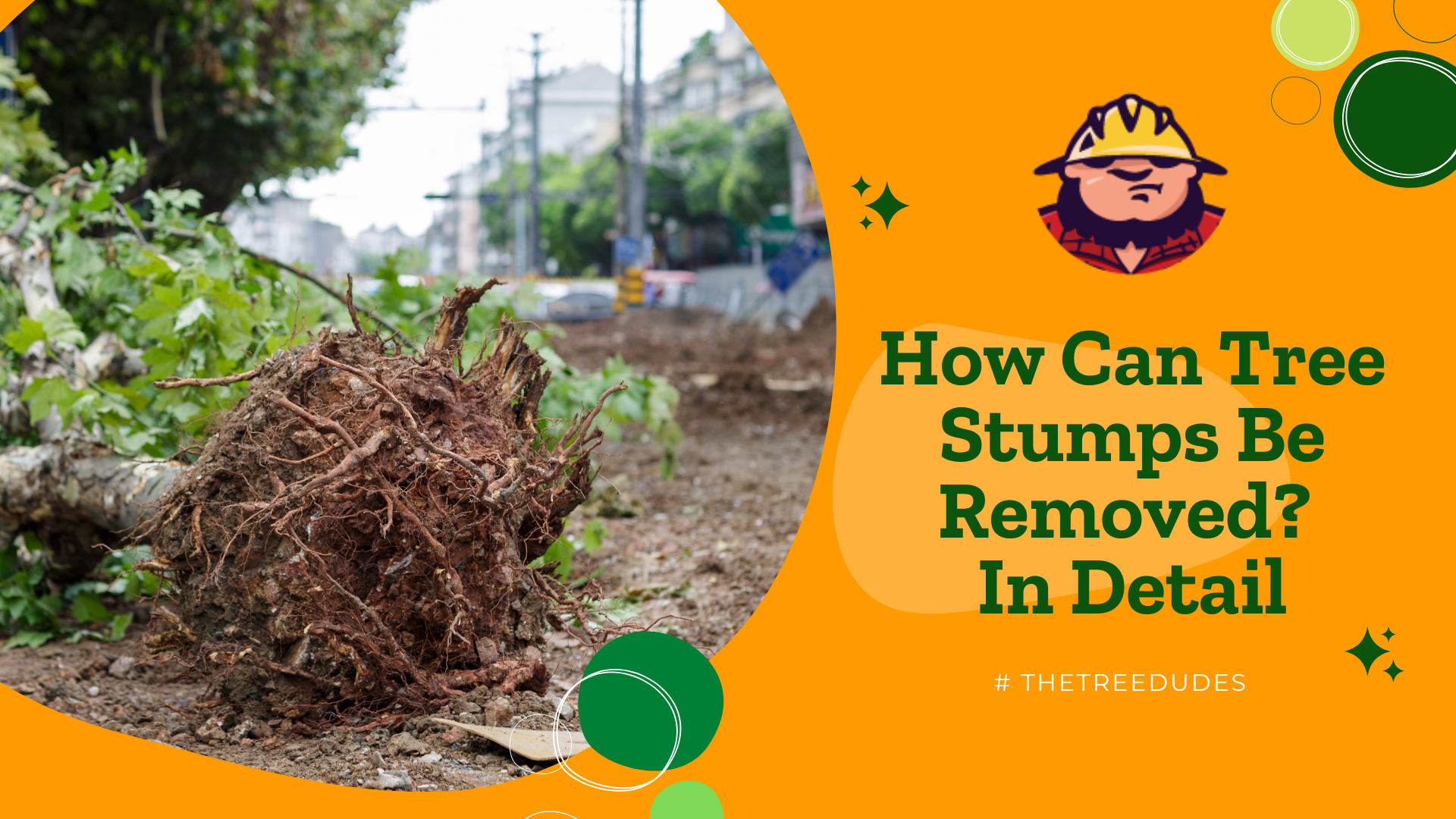
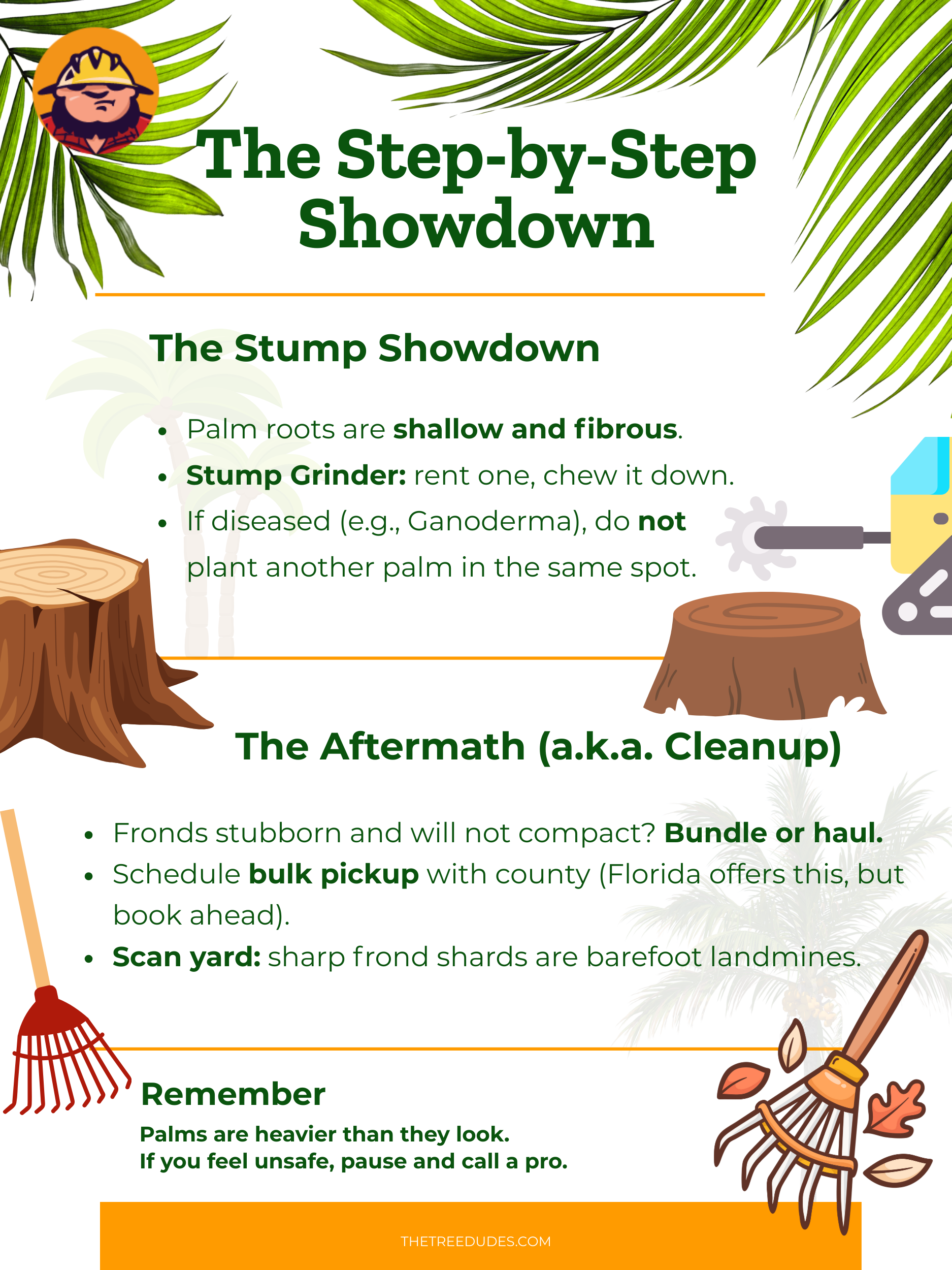
Palms are unique in the tree world, even below ground. Unlike oaks or pines, they do not have deep taproots or huge woody roots that spread far and wide. Most palm roots grow outward from the base in a dense mass, staying within the top 2-3 feet of soil. That is good news for you: palm stumps are often easier to remove than many tree stumps. The simplest and cheapest method is usually digging out the stump by hand, especially for medium and small palms.
Start by clearing away any remaining dirt or mulch around the base. Use a shovel to dig around the stump, exposing the root mass. You will find lots of fibrous roots rather than a few large roots. You do not need to get every root out. You can not grow a new palm tree from the roots once the trunk and leaves are gone.
So the goal is mainly to get the stump and the thick root ball out. Dig in a circle, gradually loosening the soil and severing roots. A sharp spade, an axe, or even a pruning saw can slice through the tougher roots attached to the stump. Try to get underneath the stump if you can and lift it up. Many palm stumps, after enough roots are cut, will pop out like a loose tooth with a bit of leverage. Having a friend or two yank on the stump, or using that rope tied to a truck very carefully in an open area, can assist once you have freed most of the roots.
If the palm was large, say, a trunk thicker than 12 inches in diameter, expect a more stubborn root base. But it is still typically manageable with some effort because it is not super deep. An old trick: keep a hose or a big bucket of water handy; moistening the soil as you dig can help soften the earth and wash out sand, making it easier to cut through roots and see what you are doing.
If manual digging sounds like torture, or perhaps the stump is right next to something that makes digging impractical, like it is for whatever reason embedded in a patio or near a wall, then stump grinding is your best friend. You can rent a stump grinder, which is essentially a power tool with a spinning cutting wheel that chews up the wood. When grinding a palm stump, be aware that the fibrous wood might not chip out in nice chunks like an oak stump. It can turn into a stringy mess.
But a decent grinder will still get the job done. Grind the stump a few inches below ground level or as far down as the machine allows, moving it in a sweeping motion across the stump until all the visible wood is shredded. You will be left with a pile of palm sawdust, which, by the way, tends to be fibrous and may not compost as nicely as other wood chips, but you can mix it with soil or mulch elsewhere. Remember to dig out or grind a bit around the stump, too, because palm roots fan out a bit around the base. Some people drill holes in a stump and use a chemical stump dissolver like potassium nitrate to rot it away.
Honestly, for a palm, that is often not worth it unless you are very patient. Palms rot slower than you would think, and since they are easier to dig, you might as well remove them physically in a day rather than wait months for chemicals and decay to do the work. But, if you are in no rush and the stump is not bothering your wife or pets, you could try the “rot it in place” method: cut some slots in the stump with your saw, cover it with soil and a tarp to keep it moist. This way, you will be promoting microbial breakdown.
Once the stump is out or ground down, fill the hole with soil or sand to level the ground. If you removed a big stump, you might have a crater. Pack it well, add topsoil, and maybe plant some grass seed or sod on top if it is in the lawn. If you had a diseased palm, like one which cached a Ganoderma, do not replant another palm in that exact spot, or at least treat the soil first.
If you have a stump that you are not able to remove alone, consider hiring a professional stump grinding or rootball removal service.
Clean Up the Debris
By now, you likely have a pile of palm fronds, a stack of trunk sections or long logs, and a bucket of stump grindings or a chunky root ball sitting around just in case. Disposal can be a bit of work, you know. Palm fronds are tough and do not compact well, so you might need to cut them into smaller pieces for yard waste bags or tie them in bundles for curb pickup later, but be sure to check your local waste management rules. The trunk wood, depending on the type of palm, might be usable as mulch if chipped. Some people like to cut palm trunks into “mulch coins,” thin slices that can line garden beds.
Otherwise, see if your waste collector will take logs, or you may need to haul them to a yard waste facility. Because palms are technically grasses in a way, their wood is not great for firewood. The thing is super smoky and not much heat. One creative reuse you may apply if you are crafty: hollowed-out palm sections have been used as planters or even natural flower pots. Just an idea. It is up to you in the end.
If you hire a professional, often they haul everything away for you as part of the service you paid good money for. If you are DIYing, factor in a trip to the dump or a yard waste recycler if the volume is large. In Florida, you can get large yard debris picked up right from the curb, but you will need to schedule it ahead of time without slacking off. Do not forget to scan the work area for stray sharp frond pieces or stump shards that could be tripping hazards later. Rake the area, and you are done with the cleanup. Your yard likely looks a bit different, maybe a little bare, but also free of that problem palm tree.
Palm Tree Transplanting: An Alternative to Removal
Not every palm that is “removed” has to end up as mulch or landfill fodder. Some can start a new life in a different spot. Palm trees are famous for being transplant-friendly. Ever drive through Florida and see fully grown palms planted around new shopping centers or homes? Those were not grown there from seedlings. They were relocated, often from someone else’s yard. If your palm is healthy and you simply do not want it where it is, because maybe it is too close to the house or you are redesigning your landscape to flaunt a more expensive lifestyle, transplanting might be an option.
This involves carefully digging up the palm with its root ball, moving it, and then replanting it in a better spot or even selling or giving it to someone who wants a mature palm instantly. The process is more involved than removal, because you are trying to keep the tree alive. Generally, start by estimating the root ball size. The rule of thumb is a root ball about 2X the diameter of the trunk for many palms.
You dig around the palm at that radius, severing the roots carefully with a sharp shovel. Because palm roots are fibrous and relatively compact, you often get most of them in that ball. Palms do not have a few large roots to cut, but rather a mass of hundreds of small roots. They can survive losing some roots, but try to keep as many as possible intact.
You can also wrap the root ball to keep it all together while you move it. And yes, you will probably still remove most fronds. Less foliage means the palm has less water demand while it regrows roots. Many transplanted palms are pruned almost to just a tuft or a few fronds on top to help them recover. Transplanting a large palm is not a one-person DIY job. It might require a small crane or bobcat to lift it out of the hole. A 15-foot palm can weigh over a thousand pounds with the root ball.
Palm tree transplant success rates are pretty good: palms do not go into as much shock as some trees do, especially if you plant them quickly and keep them well-watered after. Certain palms, like the sabal palm, are routinely sold as transplants. They will cut off all fronds, dig it up, move it, replant it, and it will sprout new fronds and be fine. If you are interested in transplanting, it might be worth consulting a professional tree service or arborist who specializes in relocations. They can advise if your palm is valuable or likely to survive the move.
DIY or Call a Pro? Knowing When to Get Professional Help
By now, you have gathered that removing a palm tree is no small feat. So, the million-dollar question is: Should you be doing this yourself? The answer depends on a few factors, and it is important to honestly assess them.
Tree Height and Size
A general rule of thumb: if a palm is taller than about 15-20 feet, especially if you have never removed a tree before, consider hiring professionals. Professionals have bucket trucks, climbing gear, and expertise to safely tackle tall heights. Many Florida cities even stipulate that trees over a certain height, often 12 feet, require a licensed pro for removal for safety reasons.
The taller the palm, the heavier and more unwieldy it becomes. A fall from a tall ladder can be life-threatening, and a large palm section falling can be disastrous if it does not go where intended.
Location
Is your palm awkwardly close to power lines or structures? If there is any doubt about clearance, do not DIY. Utility line contact is deadly, leave those situations to certified arborists who might coordinate with utility companies if needed. Near structures, professionals can use precise rigging to avoid damage.
They are insured for a reason. If a pro accidentally drops a palm on your fence, their insurance will take care of it. If you do it, well… time to call your insurance and maybe a construction crew. Tight quarters often call for cranes or special techniques that are beyond the typical homeowner’s toolkit.
Equipment and Expertise
Think about what tools you have and your comfort level with them. Have you operated a chainsaw much? If not, practicing on a palm removal might not be wise. Chainsaws can kick back, and palms sometimes cause binding.
Professionals also handle the gnarly stuff like stump grinding swiftly. If you are not comfortable using a stump grinder because it is a heavy, noisy machine, you might end up with a half-finished job. Also, climbing spikes, harnesses, ropes, the pros have all that ready to go. As a DIYer, the cost to rent or buy gear for one tree could approach what you would pay someone to just do it. Get quotes from a few tree services. You might be surprised that for small palms, it is fairly affordable, and for big palms, it might be worth every penny.
Physical Labor and Health
Removing a tree is hard work. Florida heat is brutal, and swinging an axe or hauling logs in 90°F with humidity can wipe you out. Be realistic about your fitness and enlist help if you decide to DIY. If you have any health issues that make heavy labor risky, like a bad back, heat sensitivity, etc., do not risk it. A professional crew will do in two hours what might take you two days and a bottle of ibuprofen.
Disposal Headaches
One aspect people forget: after taking down the palm, you have to get rid of it. Pros usually include hauling away the debris. If you DIY, are you prepared to cut the trunk into manageable pieces and haul them? Do you have a trailer or truck? If not, sometimes paying a pro is cheaper when you factor in the hassle and cost of debris removal.
Removing Your Palm with Care and Confidence
Getting rid of a palm tree in Florida is all about using both strength and a smart approach. Much like cracking a coconut, it is all about the right technique and maybe a little tenacity. We started by understanding why a palm might need to go, from hurricanes turning dead palms into missiles, to nasty fungi necessitating quick removal, to that once-charming palm simply overstaying its welcome in your yard’s design.
We looked at Florida’s diverse palm cast, from stately royals to scrappy queens, because knowing your opponent, or rather, your green giant friend, arms you with insight on how to handle it. Then we stepped through the entire process: gearing up safely, minding the legalities, trimming those heavy fronds, and executing the cuts, in a classic timber-style fell or a careful piecewise takedown.
By following the guidance in this tutorial, a handy Florida DIYer can approach palm tree removal with both confidence and caution. Each step is important. Skipping planning or safety measures is like heading into a thunderstorm without an umbrella. But with preparation, the right tools, and respect for the task, you can successfully say goodbye to an unwanted palm. Just do not rush, and when in doubt, bring in a professional.
And if this tutorial has got you thinking that this might be too much work for you, then do not worry. We offer professional palm tree removal services, which include both small and large palm tree removal. Contact us now and schedule a free estimate.