






Florida’s hurricane season is a true test of the trees in our yards. Year after year, howling winds and driving rain barrel through neighborhoods, and not every tree makes it. As a homeowner, it can be heartbreaking to see a beloved shade tree uprooted or broken after a storm.
The good news is that some tree species are naturally more resilient against strong winds and storms, especially in Florida and nearby Gulf Coast regions.
By choosing the right wind-resilient trees and caring for them properly, you can create a landscape that weathers hurricanes with minimal damage. Grab a cup of iced tea and let’s dig into how to cultivate a hurricane-hardy yard.
Hurricane Winds and Tree Resilience
Hurricanes are nature’s ultimate test for trees, with winds that can go up to 100+ miles per hour. Only the best trees stand tall after a hurricane. What makes the difference? It comes down to a combination of natural traits and good care practices.
Florida Tree Law
Florida Statute 163.045 (effective July 1, 2019, updated with SB 518 in 2022) gives property owners the right to remove, trim, or prune a tree if it poses an unacceptable risk to safety or property, without a local permit, as long as you have documentation from a certified arborist or a Florida-licensed landscape architect certifying the risk.
If a tree is dead, structurally compromised, or likely to fail, and a certified arborist assesses that removal is the only practical mitigation, no local permit is required. However, this exemption does not apply to protected or native trees regulated by municipalities, such as mangroves in many coastal cities, local codes may still be applicable.
Deep Roots, Strong Wood, and Flexibility
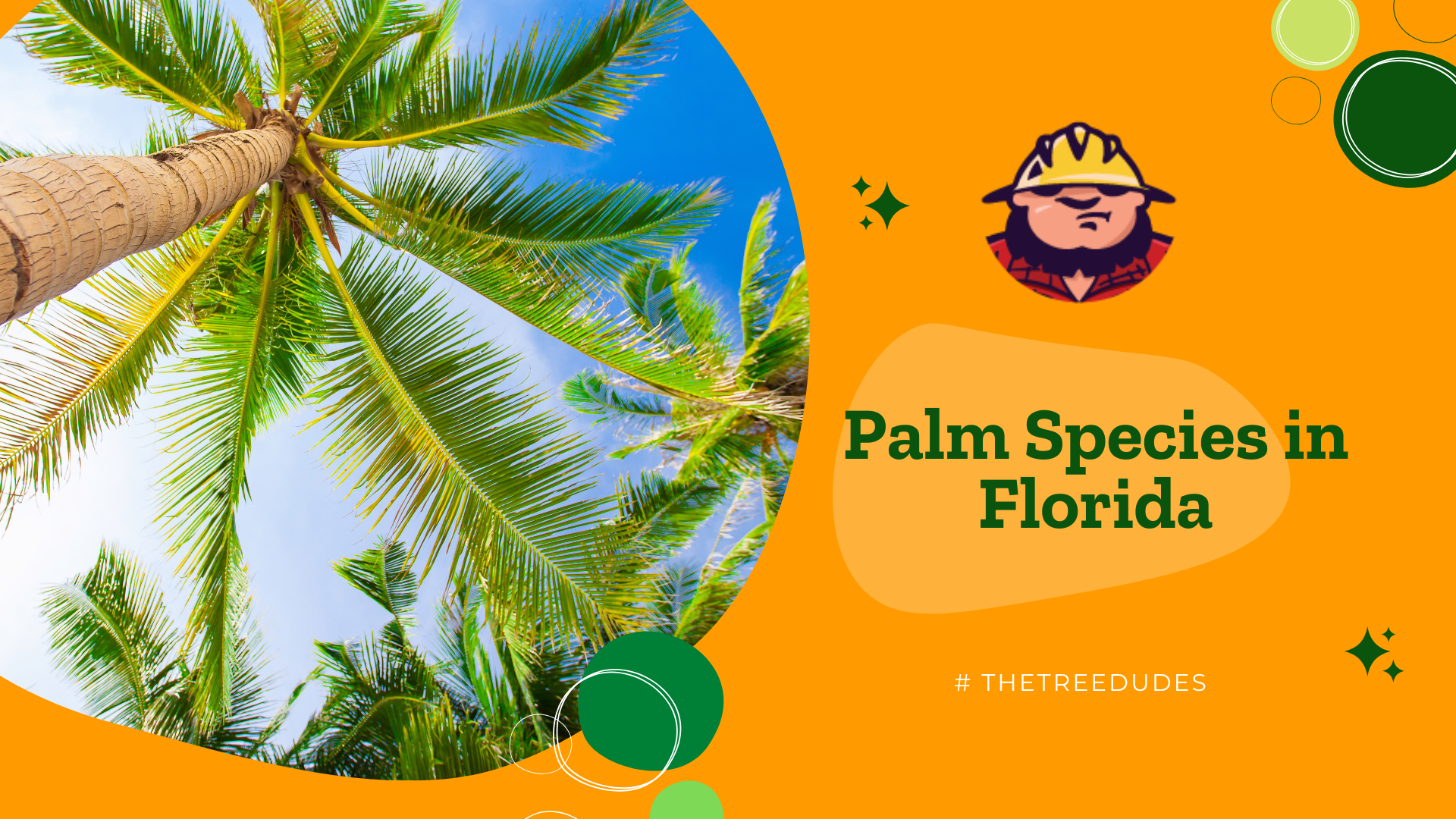
The most wind-resistant trees tend to have deep, extensive root systems anchoring them, strong, dense wood, and trunks or branches that bend under pressure rather than snap. In other words, a tree that sways is far less likely to break. Picture a palm tree in a storm, curving like a flexible pole: it survives because it yields to the wind instead of fighting it.
In contrast, a shallow-rooted tree or one with brittle wood can be toppled or shattered by intense gusts of wind. For example, Florida’s beloved live oak has incredibly dense wood and widespread roots, making it one of the most wind-resistant species identified in University of Florida studies. On the flip side, fast-growing trees like laurel oak or water oak have weaker wood and often fail in big storms.
Shape And Size
A tree’s shape and height also influence its storm survival. Lower-growing, compact trees with a low center of gravity handle wind better than extremely tall, top-heavy trees. A classic example is the Southern magnolia, which has a natural cone-shaped (pyramidal) form. This shape tends to let fierce winds whip around the tree rather than push it over, helping magnolias come through storms relatively unscathed.
Similarly, trees that can “let go” of their leaves in a storm (a survival trick) reduce wind drag. Some hardy deciduous trees drop most of their foliage during extreme winds, so there is less surface for the gusts to grab onto.
Strength in Numbers
Ever notice how trees in a dense forest often survive hurricanes better than lone trees in a yard? There is a reason. Trees protect each other when planted in groups or groves. In a cluster, each tree breaks the force of the wind for its neighbors, much like a team of football players blocking together. A lone tree feels the full force of the wind and is pretty exposed.
For homeowners, this means that planting a windbreak or a small grove of wind-resistant trees can improve each tree’s chance of survival. Even mixing species is beneficial. Experts recommend planting groups of different species together, as a diverse cluster can buffer winds and protect your home better than any single tree alone.
Maintenance And Health
Hurricanes often exploit any weakness, such as dead limbs, decay, or poor structure, to tear a tree apart. If a tree has not been pruned of weak branches, those can rip off and leave wounds. If a tree is already rotting inside, high winds will find a way to snap it. Proper pruning and care significantly increase a tree’s chance of riding out a storm.
Conversely, neglect or improper care can turn even a strong species into a hazard. A tree needs to be “trained” and kept in shape to face hurricane season.
Top Wind-Resistant Trees for Florida and Nearby Regions
Not all trees are doomed when a hurricane blows through. Certain species, many of them Florida natives, have evolved with Florida’s storms or have characteristics that make them remarkably resilient against high winds. These green heroes, some native, some non-native, are known to handle hurricanes better than most.
Live Oak (Quercus Virginiana)
If trees were given awards for storm survival, the live oak would take the gold medal. This iconic Southern shade tree is legendary for its strength and endurance, and with good reason. Live oaks are those big, impressive trees you often see hanging with Spanish moss, with their massive, twisted branches spreading out all over the place.
They possess incredibly dense hardwood and a network of roots that reach far and wide, creating a rock-solid foundation in the soil. This combination of strong wood and deep roots means that live oaks can withstand hurricane-force winds that would easily topple lesser trees.
Why are they so tough? Aside from the wood and roots, live oaks tend to have a low, broad profile – they are often wider than they are tall, keeping their center of gravity low. Their limbs emanate outward and frequently twist and turn, which helps dissipate wind energy. Rather than acting like a giant sail, a mature live oak lets wind pass through its curved limbs and sparse outer leaves.
Live oaks may lose some branches or a lot of leaves in a severe storm, but the main structure of the tree is tough to topple.
They need plenty of room for their roots to spread without hitting house foundations, sidewalks, or driveways. If confined, even this tough tree can become unstable. So, plant a live oak well away from structures (at least 15-20 feet from your home, more if possible) and in an area where roots have open space.
Also, because live oaks do grow massive, be mindful of power lines, you do not want those giant limbs entangling wires in the future. With proper placement and occasional pruning of any weak or low branches, a live oak will be a long-lived, hurricane-hardy champion in your landscape.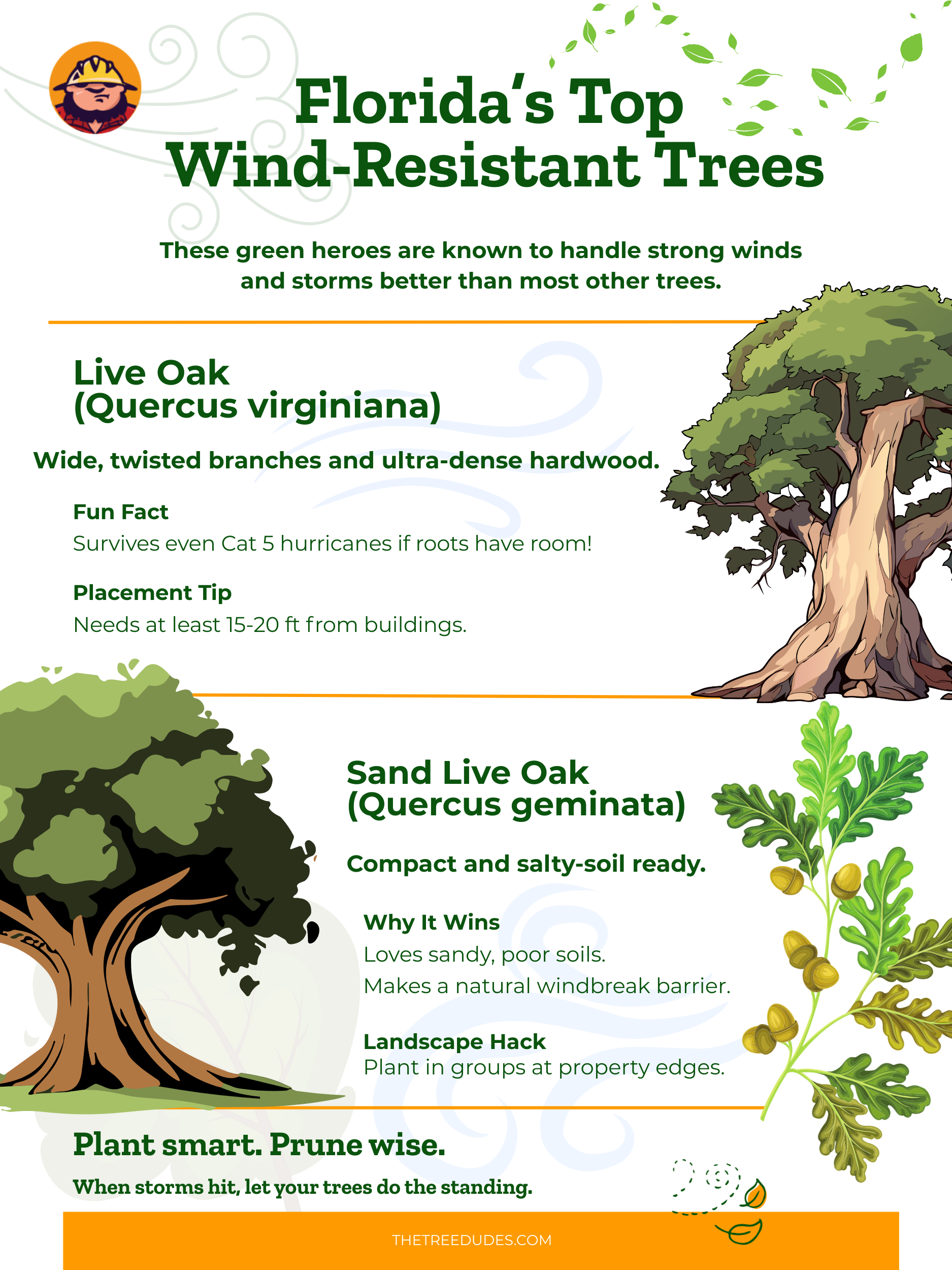
Sand Live Oak (Quercus Geminata)
A close cousin to the live oak, the sand live oak deserves a shout-out as well. Native to Florida’s coastal plains and dunes, this smaller oak has all the toughness of a live oak packed into a more compact size. They typically grow to be a bit shorter (20-50 feet tall) with a shrubby, wide form, and they thrive in sandy, well-drained soils where other oaks might struggle.
If you live near the coast or have dry, sandy soil inland, the sand live oak can be a superb choice. It thrives in salty conditions, shrugs off high winds, and suits smaller yards well. Homeowners often use sand live oaks as windbreaks or as a group planting to form a natural hurricane barrier at a property’s edge. Like the live oak, give it room to spread, and it will reward you with decades of sturdy, shade-giving growth.
Southern Magnolia (Magnolia Grandiflora)
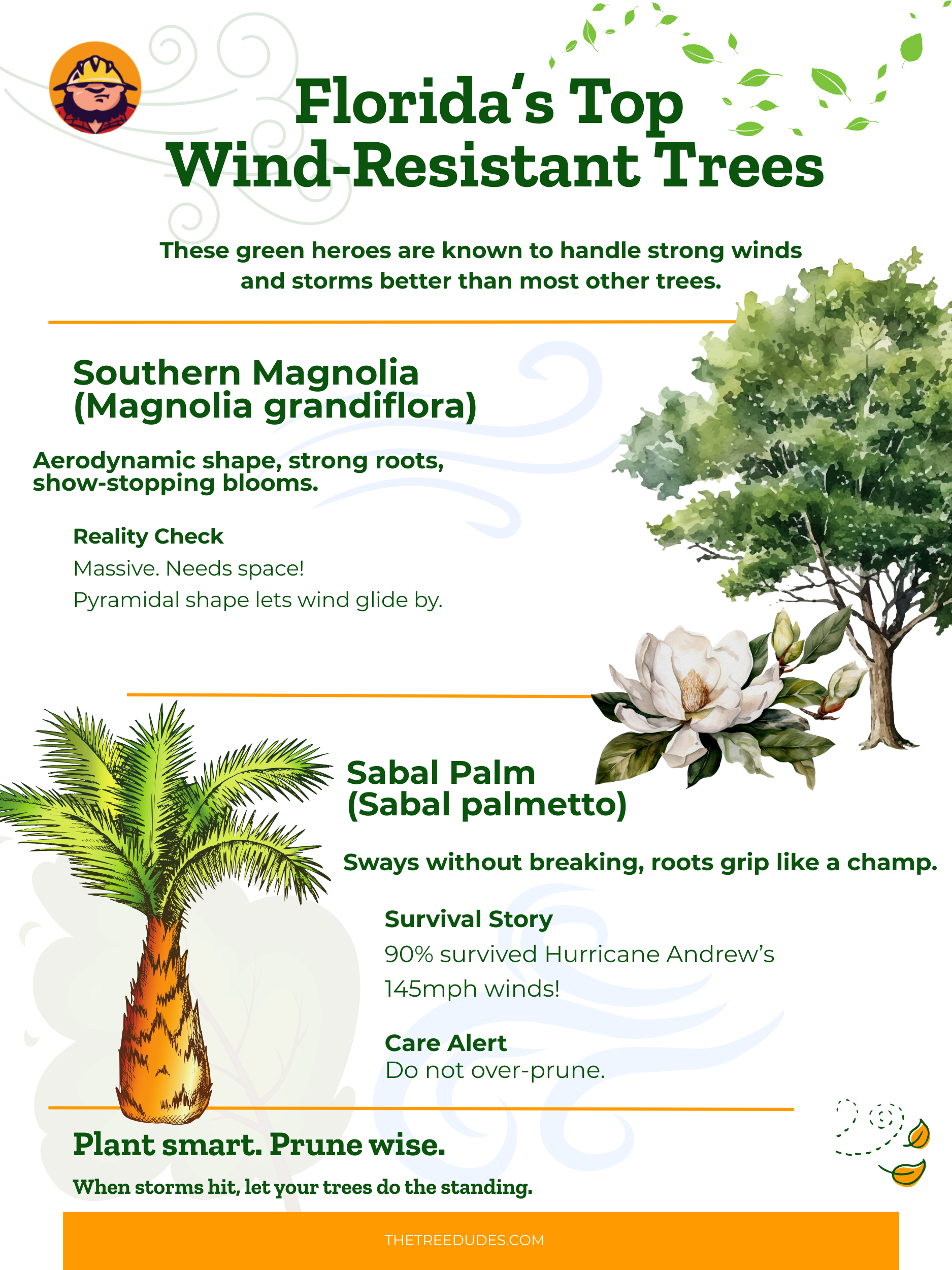
The Southern magnolia is a standout in Southern gardens with its shiny green leaves and big, sweet-smelling white flowers. But this beauty is also a beast when it comes to storm resilience. Southern magnolias have a reputation for withstanding hurricanes that would shred more delicate trees. How do they do it?
Magnolias have strong, deep roots that really hold onto the ground. Anyone who has ever tried to transplant a magnolia knows those roots run deep and wide, which is great for stability in high winds. They are also slow-growing and develop a solid, heavy trunk that does not snap easily.
Perhaps the magnolia’s biggest advantage is its shape. It naturally grows in a pyramidal or conical form (especially when young), tapering from a broad base to a narrower top. This conical shape is aerodynamic in the wind, instead of catching a ton of wind like a flat wall, the magnolia lets wind slide around its form. In fierce gusts, a magnolia might lose some leaves or a small branch or two, but it is unlikely to blow over if healthy.
In fact, after past hurricanes, observers often find magnolias still standing tall next to downed trees. Some folks in Florida started planting more magnolias after seeing them fare well in Hurricane Wilma’s aftermath.
If you are a homeowner, a Southern magnolia can be a real standout in your yard. It not only looks beautiful but also stands up well against the wind. Keep in mind, magnolias do get quite large (up to 60-80 feet high in time, with a considerable spread). They require ample space and should be positioned a safe distance away from structures. Also, their thick canopy casts deep shade, under which not much will grow (not necessarily a storm issue, but a landscaping consideration).
One important tip: space magnolia trees adequately apart if you plant more than one. Their roots will need plenty of room to expand and intertwine with the soil for maximum stability. When well-sited, a magnolia is low-maintenance and generally free of weak wood, just an occasional pruning to remove any dead limbs is usually all it takes to keep it storm-ready.
As a bonus, the leathery magnolia leaves are tough, they tend not to shred into pieces in the wind, meaning the tree often still looks surprisingly intact after a hurricane (while softer-leaved trees look tattered).
Sabal Palm (Sabal Palmetto)
No discussion of hurricane-hardy trees would be complete without the famous sabal palm. Also known as the cabbage palm. Sabal palms are practically emblematic of coastal resilience. When you look at all those hurricane photos from Florida, you usually see palm trees swaying a lot but not snapping. Sabal palms are those very palms, natively found all over Florida, and they have evolved to survive the onslaught of tropical storms.
Their secret? A sabal palm is not a “tree” in the usual sense, but a type of monocot, which means it is more related to grasses than to regular trees. It’s pretty flexible! It has a single tall trunk composed of thousands of fibrous strands, which makes it incredibly pliable in the wind.
Additionally, sabal palms have a deep root system that firmly anchors them, and they have shown a remarkable ability to withstand flooding and storm surge better than many trees. After some of Florida’s worst storms, sabal palms have often remained standing tall where other trees were snapped or uprooted. In Hurricane Andrew (1992), a whopping 90% of sabal palms in the storm’s path remained standing despite 145 mph winds tearing through the area.
For homeowners, sabal palms are a fantastic choice for a hurricane-prone landscape. They do not take up a huge footprint, they add a tropical aesthetic, and they are extremely wind-hardy.
A few care pointers: Do not over-prune your palms. Some people do a “hurricane cut” (removing most fronds), thinking it helps, but experts suggest leaving a normal number of fronds, palms naturally drop their dead fronds anyway, and need enough green fronds to nourish the growing bud.
It is beneficial that in high winds, sabal palm fronds can fold up or rip away on their own to reduce wind resistance (a built-in self-pruning mechanism). Just remove dead, hanging fronds and any large flower/seed stalks before storm season (since those could become projectiles), and your palm is good to go.
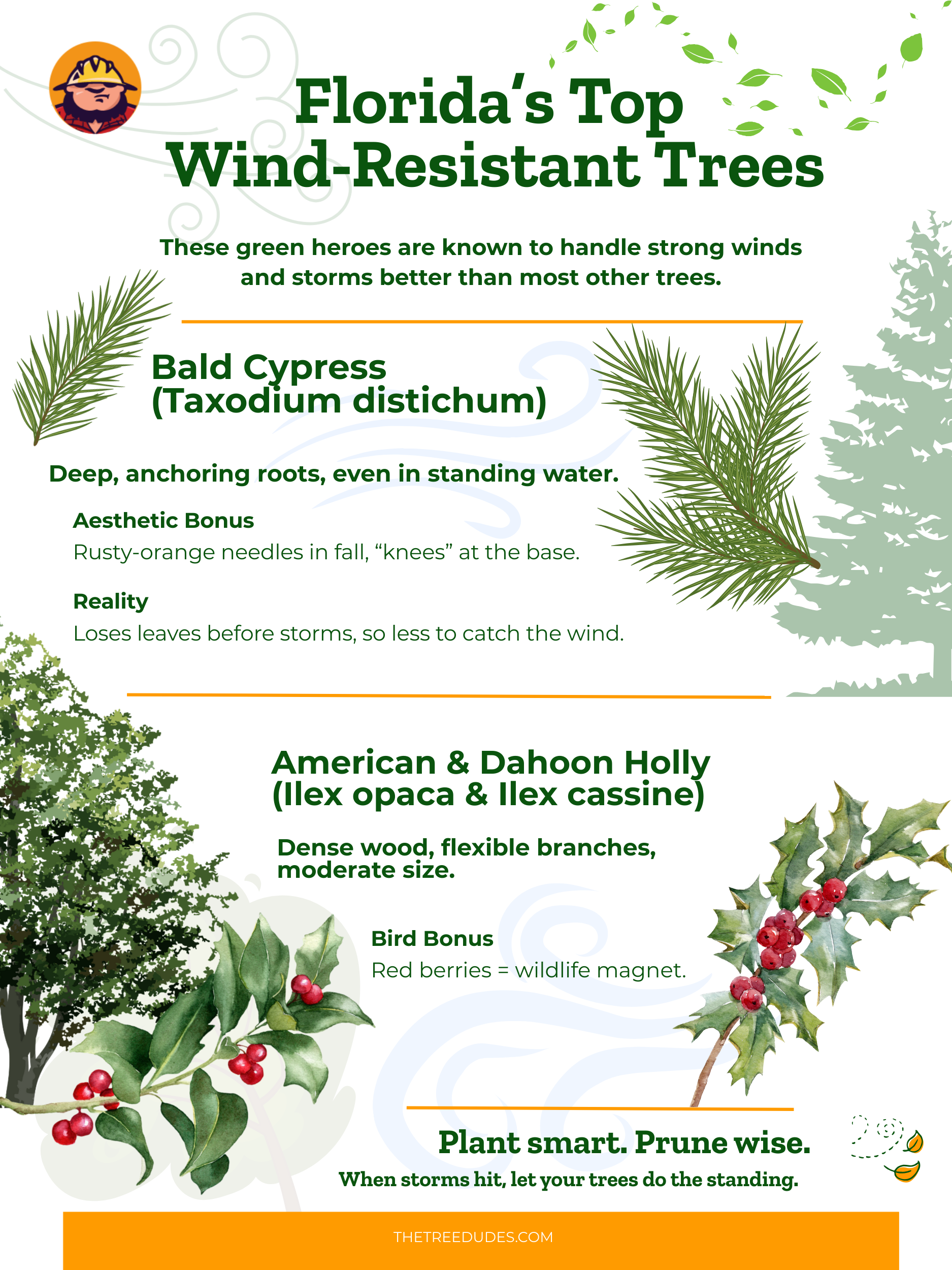
Bald Cypress (Taxodium Distichum)
Surprised to see a swamp tree on this list? Do not be! The bald cypress is a native Florida tree that usually grows in wet areas (swamps, riverbanks, lowlands), but it also happens to handle hurricane winds like a champ. Bald cypress is a beautiful, tall coniferous tree with feathery leaves that turn rusty orange in fall. You often see them in wetlands, complete with “knees” (little stump-like protrusions) around their base.
How does a swamp tree resist wind? Deep roots and a sturdy build. Bald cypress trees sink their roots deep into the muck, often developing extensive root systems that can even help anchor them in soggy soil.
For a homeowner, planting a bald cypress can bring multiple benefits. They thrive in wet spots where other trees might struggle to survive. If part of your yard floods in summer rains, bald cypress would be perfectly at home there.
These trees do get quite tall (50-70 feet or more at maturity, with a straight trunk), so they are best for larger yards or open areas. They have an elegant, almost regal appearance and can live for hundreds of years. In the autumn, their foliage turning warm colors is a lovely sight.
From a storm perspective, just give them room to root. Do not box in a bald cypress with pavement and minimal pruning. They usually form a good structure on their own. Because they drop their small needle-like leaves in winter, they also naturally have less surface area for wind to catch during the peak of hurricane season (late fall storms).
All in all, bald cypress is a quiet, sturdy guardian of your landscape, a tree that can outlast you and perhaps many generations, all while laughing in the face of harsh winds.
Holly Trees
Holies might decorate our holidays with their red berries, but they also deserve fame as tough, wind-resistant trees. Two types of holly in particular thrive in Florida and the Southeast and can handle severe storms: the American holly (Ilex opaca) and the Dahoon holly (Ilex cassine). These are both native evergreen holly trees, and while they do not get as large as oaks or cypress, they prove that size is not everything when it comes to hurricane survival.
American holly is a classic tree with spiky evergreen leaves and bright red berries in winter. It usually grows to 20-30 feet tall in Florida, but can be taller in ideal conditions, and has a pyramidal shape when young, maturing to a fuller canopy. American hollies have strong, dense wood and a deep root system that keeps them well-anchored. Historically, they evolved in the same environments as hurricanes, so it is no surprise they have developed good wind tolerance.
The Dahoon holly is a close cousin, native to wetlands and hammocks of the Southeast. Dahoons are often multi-trunked or have a less formal shape than American holly, but they are exceptionally sturdy. In assessments of wind tolerance, dahoon holly ranks very high. A Dahoon can reach about 20-30 feet as well, with attractive gray bark and dark green leaves, and it produces lovely red berries that birds adore.
One reason these smaller holly trees do so well in storms is their flexible branches and moderate height. They are often below the fiercest wind zone and can sway without snapping. They also typically grow in the understory of forests, meaning they are used to finding ways to stay standing while taller trees around them might fall. It is a survival knack they bring into our yards.
They fit nicely in most suburban yards and can even be used as decorative privacy screens (multiple hollies can be planted in a row or cluster). Planting hollies also supports wildlife, the berries feed birds in winter, so you are not just getting wind protection but ecological benefits too.
Care Tips
Plant your holly in well-drained soil. They like moisture but not permanent waterlogging, unless it is a swampy Dahoon variety that can handle it. Full sun to partial shade is fine. Prune them lightly to remove any dead wood or to shape if needed. Heavy pruning is not usually required, as hollies naturally maintain a strong form.
One important note: if you want the pretty berries, remember that hollies are dioecious (male and female on separate plants). You will need at least one male plant in the vicinity for the female plants to produce those bright red berries. Usually, one male can pollinate several females. Sounds scandalous, but it is just botany!
Some nurseries sell grafted females that are already berry-producing. In terms of storms, there is not much special you need to do, a healthy holly is already a tough cookie. Just keep it healthy, and it should ride out the gales just fine.
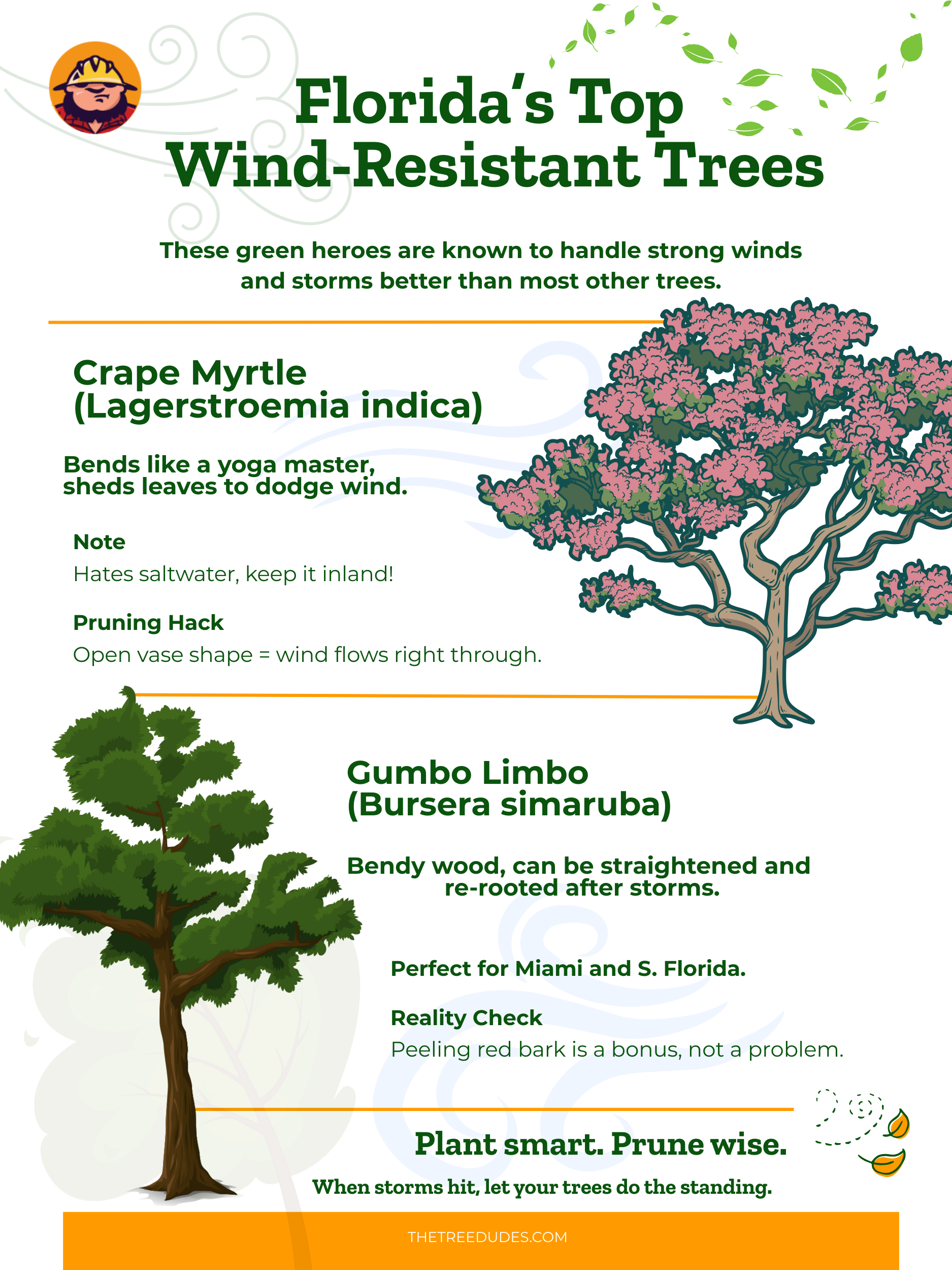
Crape Myrtle (Lagerstroemia Indica)
Crape myrtles are beloved in Southern landscapes for their brilliant blooms and graceful form. You might not immediately think of them as “hurricane-resistant” because they are known more for beauty than brawn. Turns out, crape myrtles can hold their ground even in strong winds. These small ornamental trees (typically 15-25 feet tall in Florida, though some varieties stay much smaller) have a few things going for them in storms. First, they have very flexible limbs and a supple wood structure.
If you have ever pruned a crape myrtle, you know the branches bend easily. In a windstorm, that flexibility means the tree can whip around without branches snapping off. Crape myrtles usually have this cool open shape, kind of like a vase, which lets the wind pass through instead of hitting a solid wall.
Crape myrtles tend to lose their leaves during extreme wind events, as mentioned earlier. Rather than fight the wind with a full head of leaves like a sail, they shed their “sails.” It is almost as if the tree knows to strip down to ride out the storm, then refoliate later. The result is that after a hurricane, your crape myrtle might be a bit bare-looking, but the trunk and limbs are usually intact unless something massive fell on it.
They are also drought-tolerant and do not mind the Florida heat. One thing to consider is salt, crape myrtles do not like salt water, so if you are right on the coast where storm surge or salt spray is a threat, these might not be the best choice in the front line. A bit inland, though, they are fine.
To keep crape myrtles in top shape for storms, do some light pruning each year in late winter or early spring. Maintaining a good branching structure with a few main trunks will ensure your crape myrtle stays strong. Also, avoid over-fertilizing them. You do not want overly lush, fast growth that could be weaker.
Gumbo Limbo (Bursera simaruba)
Down in South Florida, the gumbo limbo is a fan favorite. This tropical native tree is sometimes nicknamed the “Tourist Tree” because its smooth bark is reddish and peels like a sunburn. Beyond the humor, gumbo limbo is one tough tree when it comes to storms. In fact, after hurricanes, gumbo limbo trees are often still standing strong and are noted to recover quickly, even if they lose a branch or two.
How do they manage? Gumbo limbos are known for their soft, stringy wood and super bendy nature. Rather than snapping, the wood tends to bend. Even if a gumbo limbo is knocked over, believe it or not, it can often be righted back up and re-rooted successfully, it is that resilient! People have pushed smaller gumbo limbo trees back upright after a storm, and they just keep on growing, as if nothing happened.
These trees also have a moderate height, usually 20-40 feet in landscapes, and a spreading form with multiple branches, which allows wind to weave through the canopy somewhat. They often grow in a zig-zag pattern, which can help dissipate wind forces.
Another advantage is that gumbo limbo tolerates salt spray and coastal conditions very well, so even hurricanes that involve saltwater flooding will not easily kill them. After Hurricane Irma, for example, many gumbo limbos in coastal areas of Miami and Fort Lauderdale were noted to be among the survivors, whereas more brittle exotic trees snapped.
You will often see gumbo limbo used as a street tree or in parks in Miami because they are relatively low-maintenance and can handle storms and urban conditions. If you plant one, just be aware that it will drop small leaves and some berries seasonally, and its bark peels, but many find the peeling bark attractive because it is often shiny underneath.
Make sure to give gumbo limbo well-drained soil. They do not like to sit in standing water, ironic for a tree found in wet climates, but they usually grow on higher ground in coastal forests.
They do fine in the sandy or limestone soils common in South Florida. Prune them to establish a good shape when young, but avoid over-pruning. They do not usually need heavy cutting. Remove any weakly attached limbs and let the tree develop its natural sturdy form. Gumbo limbo is also fast at healing, if it does get a bit of damage, it will seal off wounds quickly and sprout new growth. All these traits together make it a real survivor.
Green Buttonwood (Conocarpus Erectus)
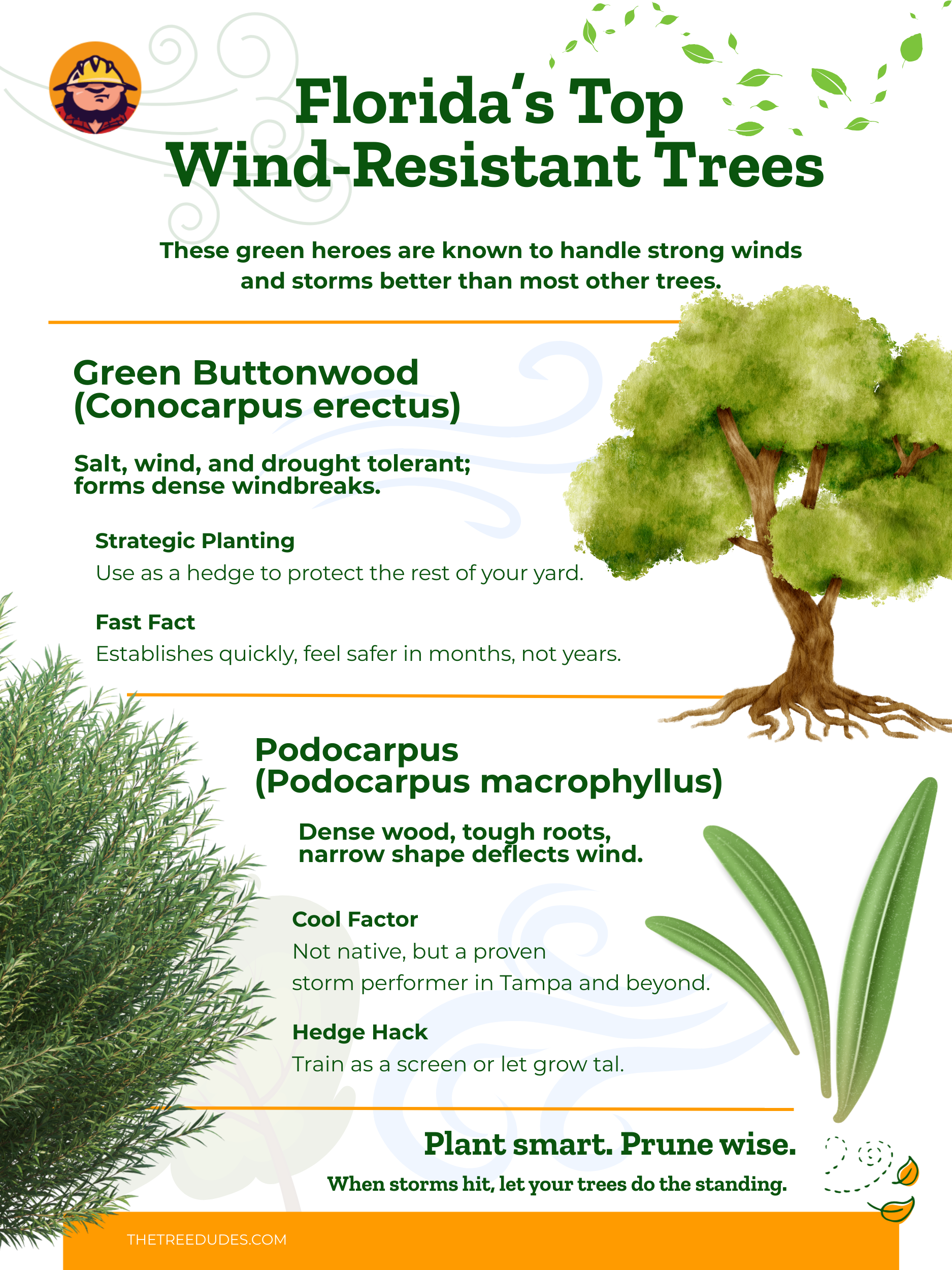
Another native that deserves mention, especially for coastal homeowners, is the green buttonwood. Often found along shorelines and coastal wetlands, the green buttonwood is sometimes called the “fourth mangrove” because of its love for salt and water. This tree is built for challenging coastal weather. It is highly tolerant of salt, wind, and even periods of drought.
In the context of hurricanes, buttonwood’s advantage is its versatility: it stays relatively small to medium, has a strong trunk for its size, and an evergreen, leathery foliage that does not get easily torn. It is known to handle strong winds with minimal damage. After recent hurricanes, many coastal landscapers noted that buttonwoods fared very well, even when other coastal trees (like Australian pines or ficus) were destroyed.
You can plant several buttonwoods in a row and trim them to form a dense hedge that not only provides privacy but also breaks the wind. This is a great strategy for reducing wind around your home’s microclimate. A buttonwood hedge will take the brunt of salt spray and wind, sparing more delicate plants behind it. Since buttonwood grows fairly quickly and can be trimmed to any shape, it is a favorite for coastal landscaping that serves a protective function.
In terms of care, green buttonwood is pretty easygoing. It prefers well-drained soil but can handle occasional flooding by brackish water. It likes sandy, coastal soils. If you are planting it inland, just ensure a sunny spot and average watering until established. One tip from growers: Use buttonwood in groupings or with other trees. It has been observed that it establishes very fast – within a few months of planting, you can have a sturdy little tree that is already improving wind resilience in your yard.
That rapid establishment means it does not take long to start serving its purpose. When pruning (if using as a hedge), do so gradually. Do not scalp it. If growing as a tree, remove lower limbs if you want a more tree-like shape, or let it be more shrubby if you prefer a natural look. Either way, it will be a reliable storm-tough plant. The only thing to watch is extremely cold weather, frost can nip it if temperatures drop too low, but in coastal Florida, that is seldom an issue.
Podocarpus (Podocarpus Macrophyllus)
Podocarpus might be the least “Florida” of the trees on this list. It is native to Asia, but it is widely planted in Florida and has shown impressive wind resistance. Often called the Japanese yew, Podocarpus is an evergreen conifer that does not produce cones like typical pines but has berry-like seeds. It is a popular landscaping plant used as hedges, screens, or even trained into small ornamental trees.
Podocarpus has very dense wood and a tenacious root system, and it tends to stay put in storms. In the Tampa area, for instance, Podocarpus was noted as one of the “extremely high wind resistance” trees on the city’s tree matrix.
Podocarpus typically grows to about 30-40 feet if left untrimmed, with a narrow, columnar shape (when grown as a tree form), or it can be kept much shorter if pruned as a hedge. Its narrow leaves and overall form mean it does not catch a lot of wind. Additionally, being a coniferous species, it has a single main trunk that provides strong support. They seem to have a bit of elasticity, too. A Podocarpus might lean in a big gust and spring back.
Caring for Podocarpus is straightforward. They like well-drained soil and do fine in sun or part shade. They are moderately drought-tolerant once established. If using as a hedge, trim a couple of times a year for shape. They handle trimming very well, and they will flush out new growth nicely.
These plants grow at a slow to medium pace, so you will not have to trim them all the time like you would with a ficus hedge. As far as storms, just keep them healthy. Their pest issues are minimal. One thing to note: in rare cases, Podocarpus could potentially become invasive (some experts keep an eye on it), but currently it is not a big concern. However, birds do eat the berries and might drop seeds elsewhere.
Planting for Storm Resilience
Selecting a tough tree species is half the battle, the other half is planting it right. How you plant and establish a tree can make the difference between a shallow-rooted pushover and a deeply anchored survivor. Here are some smart planting strategies to ensure your trees develop the stability they need long before any hurricane comes knocking. By following these tips, you will help your tree grow deep roots, a sturdy trunk, and a well-balanced canopy, all key ingredients for weathering storms.
Right Tree, Right Place
Choose your planting site carefully. Always consider the tree’s mature size and keep it a safe distance from your home, power lines, and other structures. Large shade trees like oaks or magnolias should be planted well away from the house, typically at least 20-30 feet away (more for very large oaks). This not only prevents future conflicts but also gives the tree’s roots plenty of room to spread symmetrically, which increases stability.
Do not plant tall trees right under power lines. And remember the mantra “right tree, right place”, a wind-resistant tree can still fail if it is crammed into a spot where it cannot expand its roots or crown. So, give it breathing room, and it will reward you with strength.
Depth and Hole Size
A strong tree starts with correct planting technique. Dig a wide, shallow hole, about 2-3 times the width of the root ball, but only as deep as the root ball, so the tree sits at the same depth it was in the pot, or slightly higher. This wide hole loosens the surrounding soil, making it easier for roots to grow outward into the native soil.
Never plant a tree too deep! The root flare (where the trunk widens at the base) should be at or slightly above ground level. If a tree is planted too deeply, its roots can suffocate or grow upward, leading to instability down the road. Also, gently loosen or cut any circling roots on the root ball before planting. You want roots to grow out radially, not continue wrapping around in a circle. Fill the hole back up with the dirt you dug out.
Then, give it a good soak to pack the soil down and get rid of any air pockets. Proper planting ensures the tree can immediately start sending roots outward to anchor itself.
Space and Soil Matter
When choosing a location, think underground. Trees need room for roots every bit as much as they need room above for branches. Try to provide at least a few yards of unobstructed soil area around the trunk in all directions. No close-by sidewalks, driveways, or foundations that would force roots to stay shallow.
If you have to plant near a building, position the tree such that most of its root zone will be toward open space. Ensure there is decent soil depth. Aim for about 3 feet of soil depth if possible.
If your soil is very compacted, take some time to loosen it or even do soil aeration in a broad area before planting. Easier root growth means a wider, more wind-resistant root system. Also, consider soil drainage. Waterlogged soil can lead to uprooting in storms.
Most wind-resistant trees like well-drained soil. If your area tends to flood, pick species that tolerate wet feet and consider planting them slightly higher (on a berm) so roots get oxygen. Healthy, well-spread roots are your tree’s anchor, the more real estate they cover, the better your tree will hold up in high winds.
Plant in Clusters or Groves
As mentioned earlier, trees are often more stable and wind-resistant when they have neighbors to lean on. If you have space, planting groups of trees can create a supportive grove that weathers storms together. For example, instead of one solitary sand live oak, you might plant three of them in a triangle arrangement with 10-15 feet between each. As they grow, their roots will sort of knit together underground, and the canopies will buffer winds for each other.
Additionally, planting some wind-tolerant shrubs around trees can help break the wind at a lower level and direct the wind over the top. This trick is called “wind ramping” by landscapers. Shrubs can deflect wind upward, so the force hits the higher, more flexible parts of the tree rather than pushing at the trunk.
Do not be afraid to create a mini-forest in your yard. Single specimen trees are lovely, but a cluster might stand a better chance in a Category 3 storm. Plus, a grouping of trees can be aesthetically pleasing and environmentally beneficial, as it creates a micro-habitat and shade oasis.
Prefer Natives When Possible
Florida native trees are generally a smart bet because they have adapted to the local climate, pests, and yes, storms. Many of the species we highlighted are native (live oak, magnolia, sabal palm, hollies, etc.). Planting native species can mean your tree establishes quickly and is more resilient to local stressors, giving it an edge when a hurricane arrives.
Natives have “seen it all” before in this environment. That said, some non-natives are also proven performers (like crape myrtle or Queen palm), but always avoid known invasive or brittle exotic species. If you are unsure, a resource like Florida IFAS can provide lists of recommended trees for our area. In storm-prone regions, it is often true that yesterday’s native survivors are today’s best choices for new plantings.
Caring for Your Trees Through Hurricane Season
Congratulations! You have picked resilient species and planted them carefully. Now, how do you keep them in shape to face each hurricane season? Tree care and maintenance is an ongoing job, but it is not as daunting as it sounds. A little attention each year can make a huge difference when the winds howl. The key goals are to maintain your trees’ health (healthy trees are stronger trees) and to prune/manage them in ways that reduce the chance of failure.
Inspect And Prune Regularly
Make it a habit to inspect your trees at least once or twice a year. A good schedule is every spring (before hurricane season starts) and again in late fall. Look for any dead or diseased branches and have them removed.
Dead limbs are just accidents waiting to happen in a windstorm. They can snap off and become dangerous projectiles or create wounds on the tree. Also watch for branches with cracks or splits, and any limbs that are hanging over your roof or near power lines.
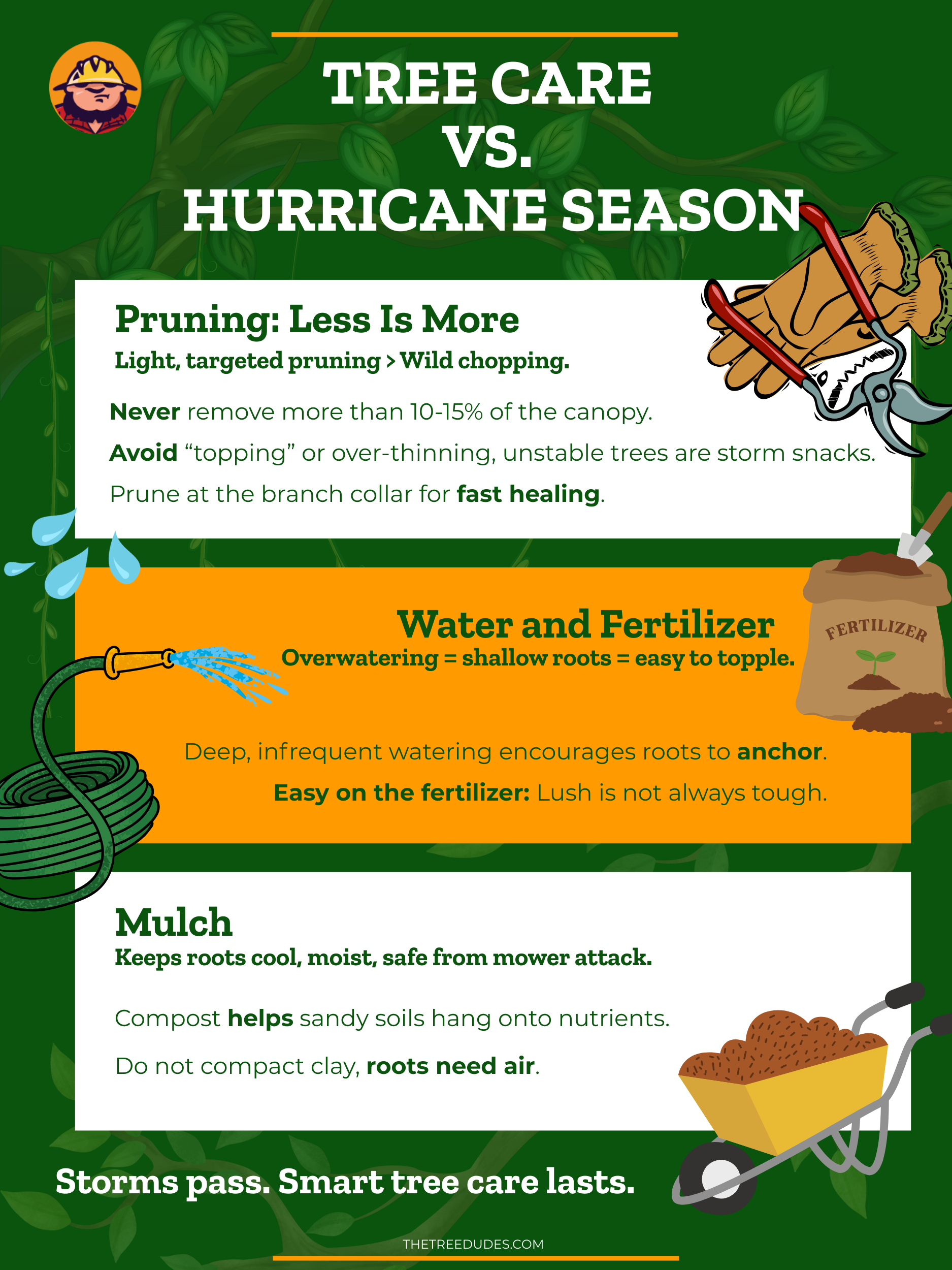
Pruning is best done during the tree’s dormant or slower-growing season. Late winter or spring for many species, or after flowering for those like crape myrtle. Proper pruning means cutting branches at the branch collar (the swollen area at the base of the branch) to allow the tree to seal the wound.
However, be cautious: do not over-prune or “top” your trees. Over-thinning can make a tree unstable, it might regrow a bunch of weak shoots or become unbalanced. A light hand is best, the target may be 10-15% of the canopy at a time, not 50%. Many experts say a well-pruned tree (done by a certified arborist, ideally) is significantly more likely to survive high winds than a neglected tree.
Train Young Trees
If your trees are newly planted or just a few years old, you have a golden opportunity to train them for strength. Structural pruning in the first 5-10 years can establish a solid form that will last a lifetime. Encourage one dominant central leader on shade trees (like oaks or magnolias) by trimming away competing co-dominant stems.
Ensure branches are well spaced along the trunk and try for a mix of angles, 45 to 60 degree branch angles are usually strongest. Remove any narrow, V-shaped crotches while the tree is young, as these often split in storms as the tree grows. A little correction early on leads to a straight, strong structure later. This preventative pruning means that down the line, you will not have heavy, hazardous limbs that need drastic cutting.
Do Not Over-Fertilize or Over-Water
Interestingly, giving your tree too much love can be a bad thing. If you push a tree to grow super fast with a lot of fertilizer, you might get quick growth, but that wood can be weaker and more prone to breakage. It is okay to fertilize lightly once a year if your soil is poor, but follow guidelines and do not try to turn your yard into a tree bodybuilding contest. Likewise, while new trees need regular watering, established trees usually only need supplemental water in droughts.
Over-watering can lead to shallow root growth. Encourage deep rooting by watering deeply but infrequently. For example, a slow soak that penetrates 12 inches or more, done occasionally, will train roots to go deep for moisture, and deeper roots mean a more wind-firm tree. In drought periods, water your trees. A drought-stressed tree can drop branches or even die, and then it is coming down in a storm! But aim for a healthy moderate growth, not overly lush, soft growth.
Mulch And Soil Care
Applying a 2-3 inch layer of mulch (like wood chips or pine bark) around the base of your trees is a simple practice that yields big benefits. Mulch keeps the soil moist, regulates soil temperature, and reduces weeds, all of which contribute to better root growth. A mulched area also prevents lawn mowers or weed trimmers from damaging the trunk (mechanical damage can weaken a tree over time).
Just make sure to keep the mulch a couple of inches away from the trunk. No mulch volcanoes touching the bark, which can cause rot. Healthy roots anchored in good soil are your tree’s best defense against getting uprooted. If your soil is very sandy, as in much of Florida, consider top-dressing with some compost annually under the tree’s drip line to add organic matter. This helps the soil retain nutrients and moisture, fostering stronger root development.
Conversely, if you are in a high clay soil area, avoid soil compaction around trees. Do not park cars under them or constantly tread the root zone, which can suffocate roots.
Watch For Signs of Trouble
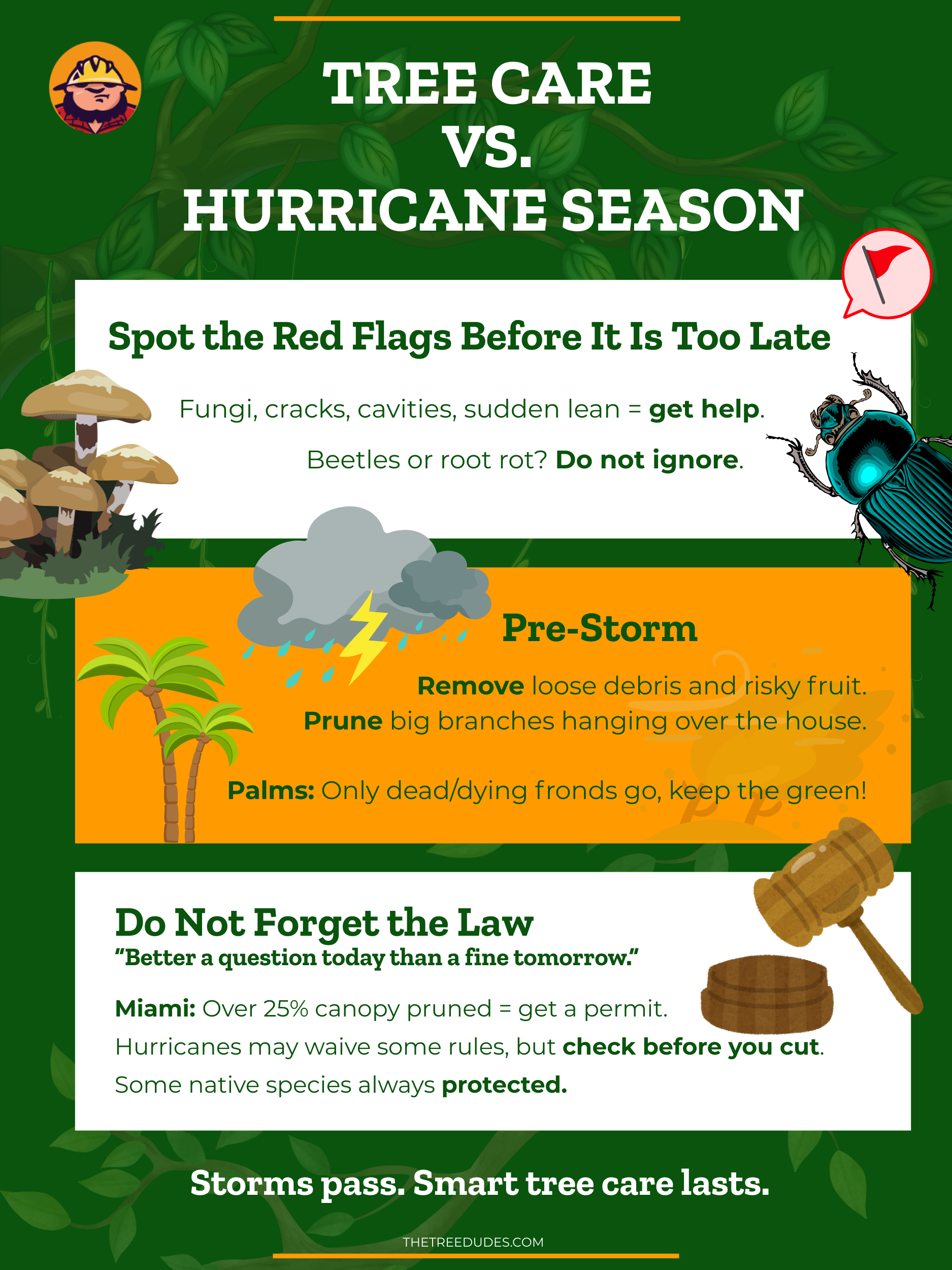
Keep an eye out for any indicators that a tree might be in danger of failing. This includes mushrooms or fungus growing around the base (could indicate internal rot), cracks in the trunk, cavities, or visibly leaning trees that suddenly lean more. Also, if a tree starts dropping branches in calm weather, it might be self-pruning due to some stress, have that checked.
Pest infestations, like beetles or root rot, can undermine a tree’s strength, too. Catching these problems early can mean the difference between treating/saving a tree or having it come down in the next big storm. If you notice something off and are unsure, consider consulting a certified arborist for a thorough inspection.
Pre-Storm Preparations
As hurricane season approaches, do a quick once-over of your yard. Remove any yard debris or weak limbs that you have been procrastinating on. If there are large overhanging branches that worry you, get them pruned before storm warnings go up. Also, take down things like hanging coconuts or large palm seeds.
For palm trees, remove only the dead or dying fronds. Do not cut off all the green fronds (which increases the chance of the top snapping off). Essentially, make your landscape as tidy as possible so there is less material to cause damage. Properly maintained trees should be fine, they will bend and shed small debris, but likely stay structurally intact.
Know Before You Trim: Local Ordinances
Many Florida counties and cities have additional rules about tree trimming or removal, especially for native species or larger shade trees. In Miami, any pruning exceeding 25% of the canopy or crown in one year requires a permit, even on private property. Local emergency orders (e.g., North Port, Hurricane Ian response) may temporarily waive permit requirements for removal of hurricane-damaged trees—but they also require replacement plans aligned with wind-resistant species lists.
When to Call the Professionals: Storm Prep and Post-Storm Cleanup
Even the most avid DIY homeowner has to admit some jobs are better left to the pros, and heavy tree work in the face of storms is one of them. Professional tree services, especially those with certified arborists, bring expertise and equipment that can be lifesavers when preparing for or dealing with the aftermath of a hurricane. As much as we love to save money and do things ourselves, safety and proper technique are paramount when it comes to large trees.
Pre-Storm Assessments And Pruning
The best time to prevent storm damage is before the storm. A licensed arborist can evaluate the trees on your property for any structural issues, diseases, or weaknesses that you might not spot. They can spot when a tree is likely to fall apart. For instance, a hollow trunk, a serious split, or a decaying root flare. By identifying these hazards, you can address them (possibly by removing a dangerous tree or reducing its weight) on your schedule, rather than having it come crashing down unexpectedly.
Professionals can also perform preventative pruning: thinning the canopy appropriately, removing dead limbs high up, and generally conditioning the tree to let wind through. This kind of pruning is both an art and a science. Too little will not help, too much can harm the tree. Certified arborists are trained in proper pruning techniques that maintain tree health while achieving the goal of storm-hardiness.
They might use methods like end-weight reduction, trimming the ends of long heavy branches so they are less likely to break, or cleaning out interior sucker growth. Importantly, they will never “top” a tree. Instead, they make proper cuts that help the tree compartmentalize wounds and grow stronger. If you have large trees near your house, hiring a pro to prepare them can significantly reduce the risk of those trees causing damage in a storm.
Hazard Removal And Cabling
What if you have a big old oak with a split in a major crotch? Or a leaning pecan that you are worried might fall? Tree experts can put in support systems like cables or braces to help strengthen weak branches or trees with multiple trunks. Cabling involves installing high-strength cables in the canopy to redistribute mechanical stress. For example, between two big co-dominant leaders, to keep them from splitting further.
Bracing might involve steel rods through a cracked limb to hold it together. These techniques can sometimes save a tree that has an inherent flaw, keeping it safe during high winds. An arborist will know if a tree is a candidate for cabling or if it is too far gone and should be removed.
Speaking of removal, that is another time to call in the experts: if a tree is dead, rotted, or poses an immediate threat, it is directly over the roof and dropping limbs, professional removal before a storm is the smart choice.
Taking down a large tree, especially near structures or power lines, is incredibly dangerous for an untrained person. It requires proper rigging, saw skills, and often a crew. The last thing you want is to be up a ladder with a chainsaw and have gravity not go the way you planned. Sadly, many hurricane injuries come after the storm, when homeowners try to do heavy tree cleanup themselves.
Post-Storm Cleanup And Emergency Response
After a hurricane passes, you might be looking at broken trees, hanging branches, or even an entire tree uprooted and leaning on something. This is when calling a professional tree service is usually the safest route. They have the equipment, chainsaws, ropes, cranes, bucket trucks, stump grinders, and the experience to remove storm debris efficiently and safely.
For instance, a large limb dangling precariously high up in a tree, ready to fall at any time, is extremely risky to deal with from a ladder. A tree crew can rope it down strategically or use a bucket truck to get to it. If a tree fell on your property, they can cut it up without further damaging your home or injuring someone.
Perhaps most critically, professionals know how to work around power lines. If any downed trees are entangled with wires, do not go near them! Always assume a downed line is live. Tree crews coordinate with utility companies or have certified line-clearance arborists to handle those situations. They also use proper protective gear and follow safety protocols that amateurs might skip.
Every hurricane sees unfortunate cases of homeowners getting badly hurt while running chainsaws or trying to clear heavy branches under tension. A branch that is pinned can snap back violently when cut, for example. Professionals have the training to assess the physics of a fallen tree and cut in the correct order so nothing unexpected happens. It is a skill set that takes time to learn, and it is okay to admit it is beyond the average person’s scope.
Another benefit of using a reputable tree service after storms is waste removal. They will typically haul off the debris or cut it to manageable pieces, and they often have access to recycling facilities (like turning wood into mulch) or proper disposal sites. Dealing with a giant pile of limbs yourself can be overwhelming. Cities often get backed up with curb pickup. Pros can make that headache go away.
Tree Health Post-Storm
Beyond just removal, arborists can help your surviving trees recover. They will know how to properly prune broken branches (making clean cuts at the right spots so the tree can heal). They might recommend treatments for stressed trees, such as deep root fertilization or soil aeration, to help them regain strength. If a favorite tree is leaning but not uprooted, a pro might be able to straighten and brace it, giving it a second chance.
They can also advise you on whether a damaged tree is salvageable or if it is better to remove it. Sometimes what looks awful, all leaves stripped, a few limbs gone, might be fine long-term. Trees can be resilient if given care and time. Arborists can provide that perspective so you do not remove something that could have been saved (or vice versa, save something that is truly unsafe).
Choosing the Right Professionals
When hiring for storm prep or cleanup, look for licensed, insured, and certified tree professionals. In Florida, tree services should have proper insurance. Liability and workers’ comp, tree work is risky, you do not want liability on you. Ideally, choose a company with an ISA (International Society of Arboriculture) Certified Arborist on staff.
Beware of fly-by-night operators who flock in after storms, offering cheap tree work. Unfortunately, there are unscrupulous folks who prey on desperate situations. They may lack insurance or expertise, potentially leaving you with a bigger problem. It is worth maybe paying a bit more for someone trusted and reputable. A good tip is to do your research now, before a storm, and keep the contact information of a preferred tree service handy.
That way, you are not scrambling to vet someone when everyone’s in crisis mode. Also, after a big hurricane, demand will be high, having a relationship with a tree service might put you higher on the list for help.
Florida law now lifts permit barriers for removing hazardous trees, but only with proper documentation from certified experts. Under SB 518, property owners may remove hazardous trees without municipal approval or fees when a certified arborist or licensed landscape architect evaluates the tree and documents that removal is the only practical way to reduce risk. However, some local ordinances still protect certain species or require replacement, so a tree that qualifies as hazardous under state law may still fall under municipal protection rules (e.g., protected grand trees, canopy roads).
Growing a Resilient Landscape for Peace of Mind
Living in Florida and the hurricane-prone Southeast means making peace with the power of nature. We can not stop the storms, but we can shape our environment to better withstand them. By choosing tree species that are proven wind warriors, planting them thoughtfully, and keeping them in good health, we tilt the odds in our favor. Our yards can turn into strongholds of strength, where trees dance through storms and still provide shade on those sunny days that come after.
Imagine walking outside after a hurricane and finding your live oak still proudly standing, your sabal palms merely missing a few fronds but otherwise unharmed, and perhaps just a carpet of leaves to rake rather than huge branches to deal with. This scenario is entirely possible when we plan and care for our trees with hurricanes in mind. It is often said that a little bit of prevention is better than a whole lot of fixing later on. In the context of trees and storms, a weekend spent mulching and pruning your trees in the spring could save you from a world of hurt come autumn storms.
Of course, no preparation guarantees zero damage, nature will do what nature does. But even when an unusually fierce hurricane strikes, having resilient trees and a plan can make the recovery so much smoother. Maybe a branch or two will break, but your tree will live to sprout new growth, and your home will be safer than it might have been otherwise. And if the unthinkable happens and a tree is lost, you will know exactly what sturdy species to replant in its place for the future.