






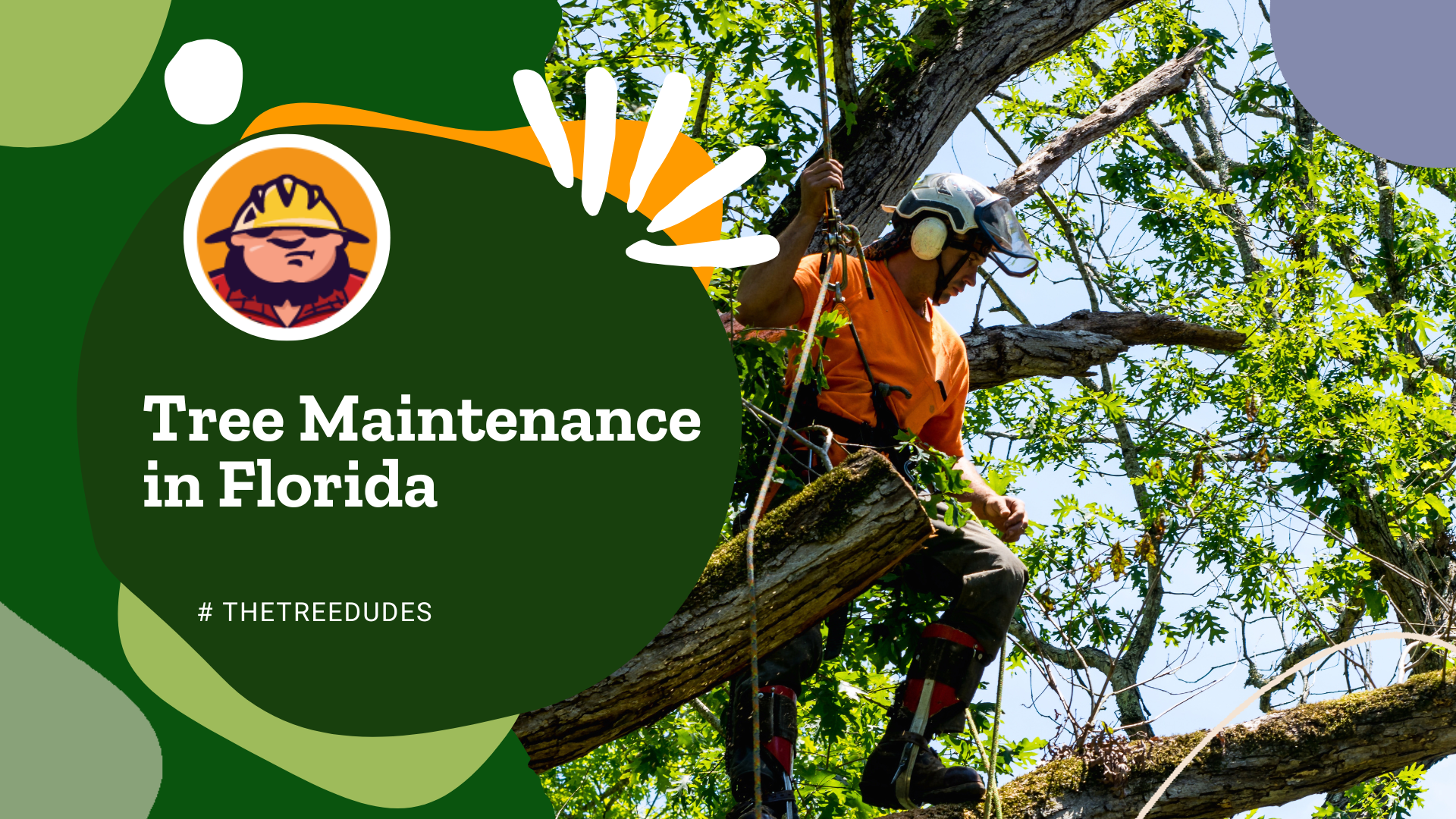
In the Sunshine State, our lush palms and sprawling oaks grow in a unique tropical playground that is equal parts paradise and challenge. Both homeowners and business owners in Miami and the surrounding areas know that well-tended trees can make a property look like a million bucks. While poorly maintained ones can drop heavy fronds on a roof or tangle with power lines at the worst times.
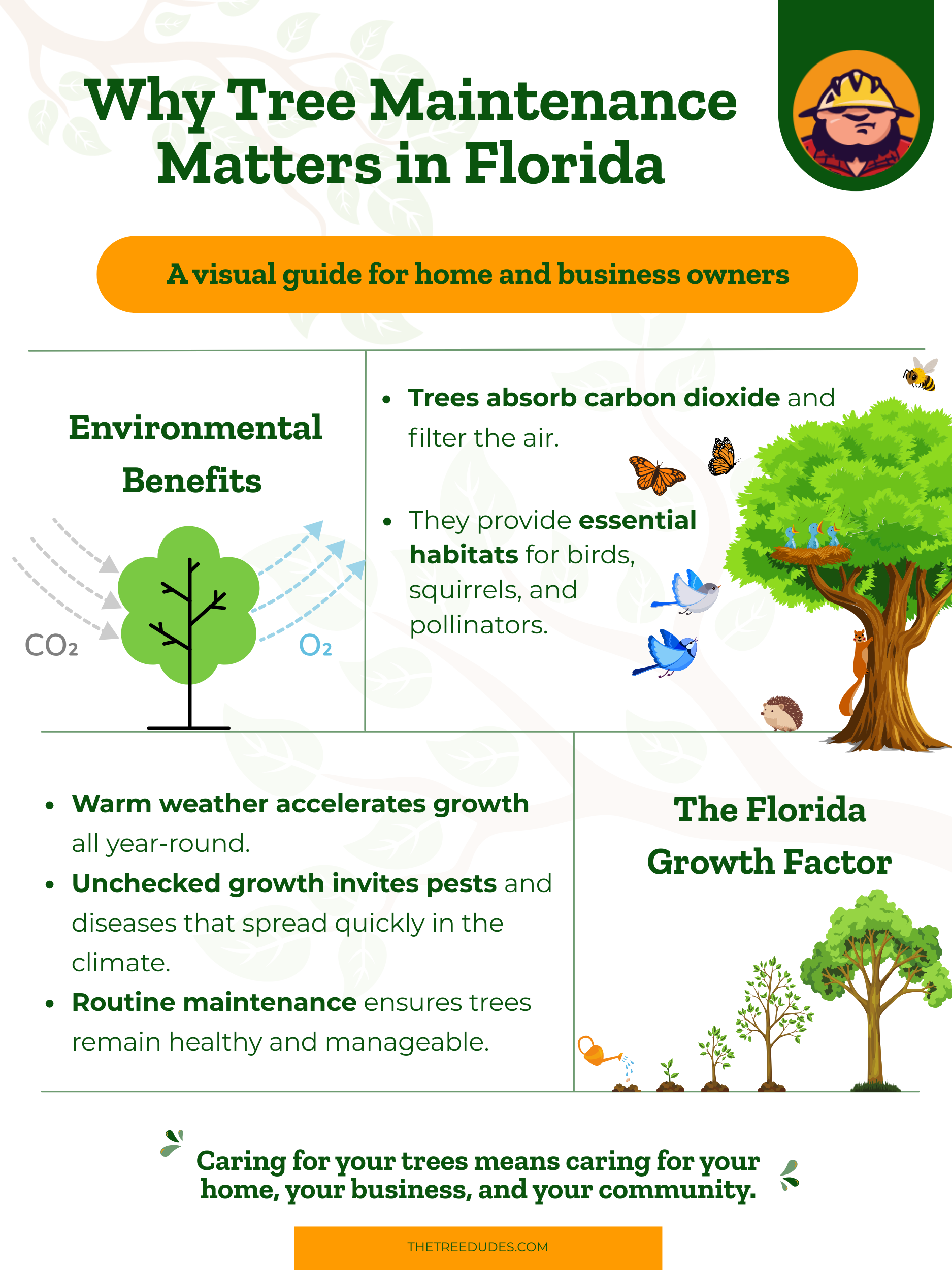
Why Tree Maintenance Matters in Florida
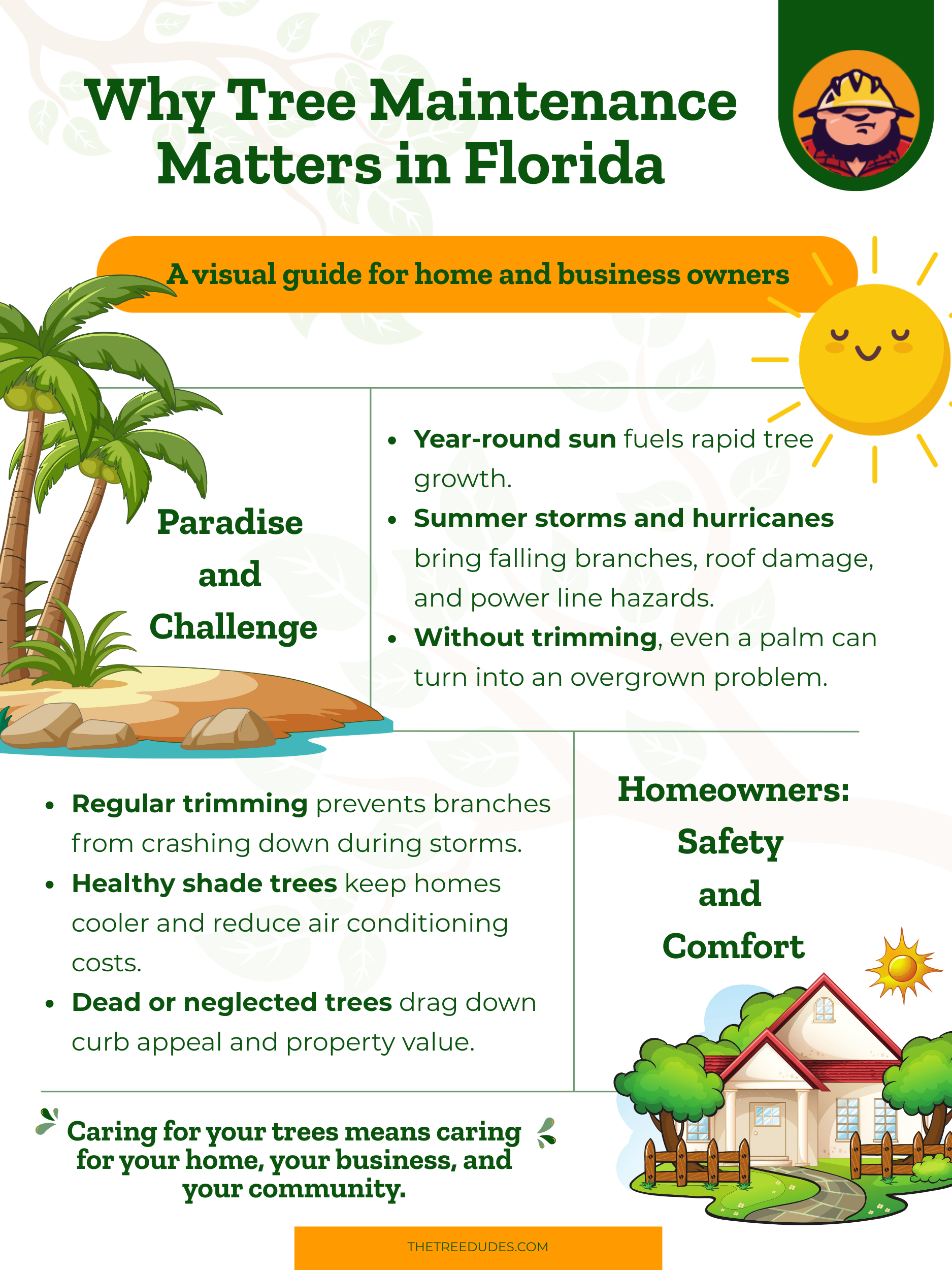
Florida’s landscape is defined by its vibrant greenery. From coconut trees swaying above South Beach to the old live oaks providing shade on the historic streets. However, without proper maintenance, that landscape can quickly become a liability. A well-groomed palm tree is essentially the Instagram model of the plant world.
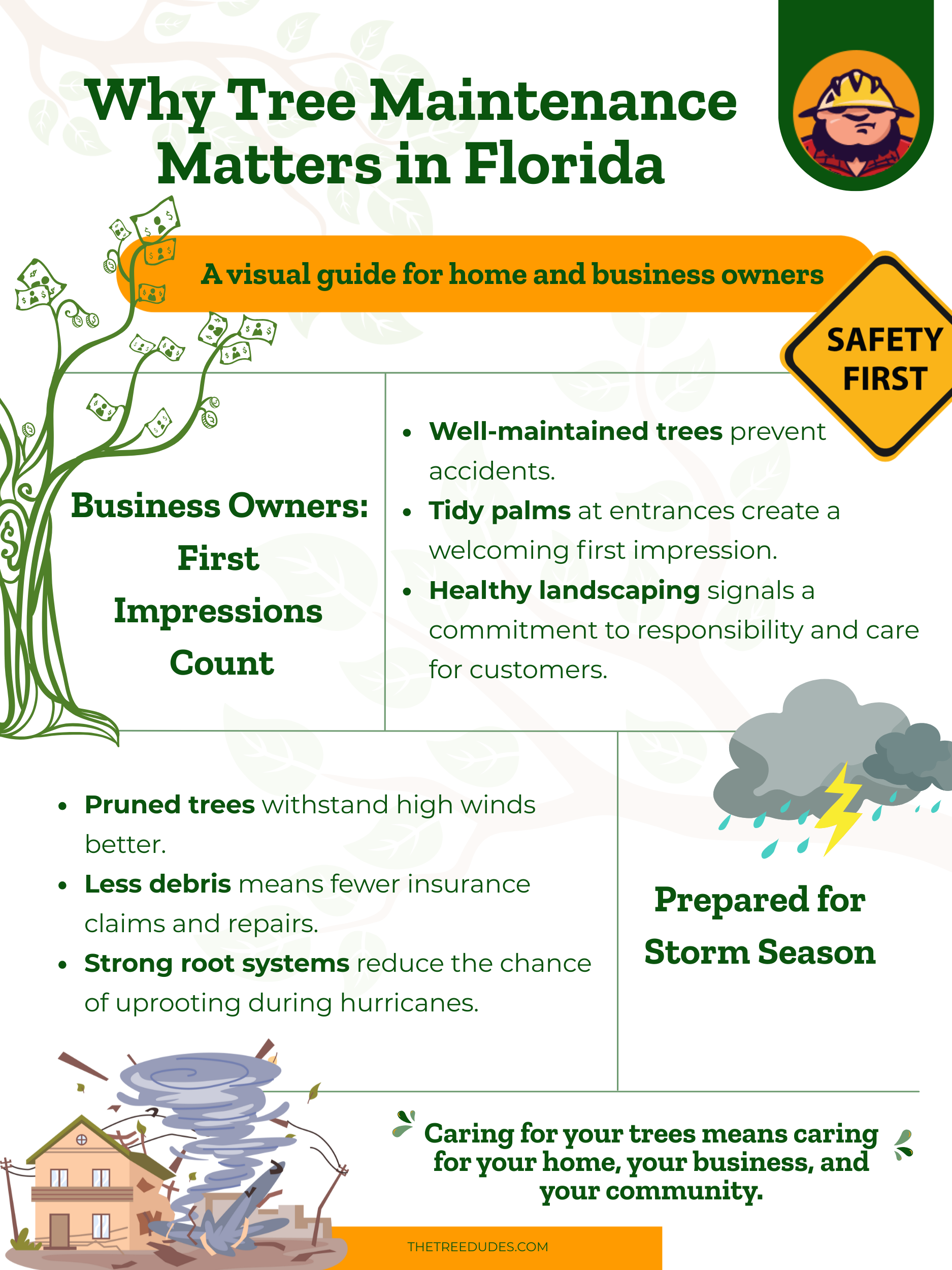
For homeowners, regular trimming and check-ups for your trees can prevent weak branches from crashing down on your roof during one of our notorious summer thunderstorms. For business owners, maintaining those parking lot palms and entranceway trees is not just for aesthetic purposes. It keeps customers safe from falling debris and shows that you care about your property’s appearance. Healthy, pruned trees also withstand storms better, meaning a lesser chance of damage when hurricane-season winds start howling.
Proactive tree care protects your property value, as dead or ugly trees definitely can kill the vibe. It also reduces hazards, like those “tree vs. car” incidents. It also supports the environment. Healthy trees provide shade, absorb carbon dioxide, and serve as habitats for wildlife. It is a win-win-win situation. Your trees thrive, your property shines, and you get peace of mind.
Let’s not forget, Florida’s climate can be both a blessing and a curse for trees. The year-round sun and long growing season mean your backyard oak might shoot up like it is on plant steroids.
Great, right? Yes, until that rapid growth needs taming. Regular maintenance ensures your trees do not turn into overgrown jungle monsters. Plus, a well-maintained tree is less prone to pests and diseases, which in Florida’s warm environment can spread faster than gossip at a beach party. Simply put, caring for your trees is caring for everything and everyone around them.
Florida’s Climate: A Blessing and a Challenge for Trees
Florida is not just any state when it comes to climate. It is a subtropical/tropical playground where trees from all over the world thrive. If trees could talk, every Florida tree from Miami-Dade to Palm Beach would probably say, “We love the sunshine, but wow, do we see some wild weather!” Understanding how Florida’s climate affects tree care is really important to keeping those green giants happy.
Sun, Heat, and Humidity
In Miami and the surrounding areas, we essentially skip winter. Sure, we have a “cooler” season, but freezes are rare, especially in Miami-Dade County. This means many trees never go fully dormant or only rest for a short period. The result? They grow year-round, often faster and fuller than they would in colder climates. Great news if you want a quick shade canopy, but it also means you might need to prune and trim more frequently to keep up.
The high humidity is a double-edged sword: on one hand, it creates a greenhouse-like atmosphere that many tropical plants adore, but on the other hand, it can encourage fungal diseases and pests to flourish. Ever notice mushrooms or fungus on a tree trunk or black mildew on leaves? That is the humid love showing its dark side. Also, our intense sun can be brutal. Newly planted trees can get sunscald (bark damage) if not properly watered and mulched.
The Wet and Dry Seasons
Instead of the classic four seasons, Florida basically has two: hot and wet (summer) and warm and dry (winter). During the summer wet season, roughly June through September, we get afternoon downpours that can total 50+ inches of rain in a year. Trees drink this up, often growing like crazy in these months. But if it rains too much, that can be a problem as well. Waterlogged soil can suffocate roots or even uproot a tree if winds blow when the ground is soft. Plus, heavy rainfall spreads fungal spores and can lead to rot or disease if a tree has wounds.
One important maintenance tip is to prune diseased or vulnerable branches during a dry spell if possible, because pruning during very wet conditions might spread diseases further on the pruning tools or open wounds. Conversely, the winter dry season, which is October through May, often sees much less rain. Newer or shallow-rooted trees might struggle if not watered during prolonged dry stretches.
Yes, even in “sunny Florida,” droughts happen. A wise tree owner monitors rainfall and gives their thirsty trees a drink when Mother Nature takes a break. Deep watering during dry weeks can save a stressed tree. And here is a pro tip: adding a layer of mulch around your trees helps the soil retain moisture and moderate temperature, which is a lifesaver during both scorching summers and surprise cold snaps.
Hurricanes and Storms
If Florida’s sun and rain are the everyday actors, the hurricanes are the dramatic guest stars that steal the show, often destructively. From June to November, we are always dealing with the threat of hurricane season. These tropical storms can whip up 120 mph winds that will test every tree’s strength and every branch’s resilience.
That is why hurricane preparedness is a huge part of Florida tree maintenance. Long before any hurricane is even on the radar, smart homeowners and businesses take action: strategic pruning in late spring or early summer to eliminate weak or overextended branches that could become flying debris. Tree care professionals often recommend pruning trees before the peak of hurricane season, which is August-September, precisely to reduce the risk of storm damage.
It is much better to proactively remove a precarious limb in May than to have it crash through your window in September. Proper pruning, not the hack-job kind, but the kind that follows professional standards, can make a tree more wind-resistant. By thinning the canopy and removing dead wood, wind can pass more freely through the tree, kind of like giving the wind a few “open windows” in the tree to blow through. This reduces the chances of the tree uprooting or breaking. Trees pruned correctly are far more likely to survive storms intact, whereas neglected trees often suffer the most damage.
Florida’s storms not only bring wind, but there is lightning, too. Central Florida is not the Lightning Capital of the USA for nothing. Tall trees can act like natural lightning rods. While you can not completely protect a tree from a direct strike except by installing professional lightning protection systems in valuable trees, keeping a tree healthy and well-watered can help it better recover if it does get zapped. Lots of old oaks have made it through being struck by lightning and bounced back with some good care. But if a weak, rotting tree gets hit? That usually means it is game over.
When and How to Prune and Trim Your Trees
The timing of pruning can greatly affect your tree’s health and growth. Do it at the wrong time, and you could reduce flowering, invite disease, or stress the tree.
Do it at the right time, and your tree will respond with vigor, rewarding you with healthy growth and lots of gratitude in tree language. Here is the lowdown on when to prune various types of trees in Florida’s climate:
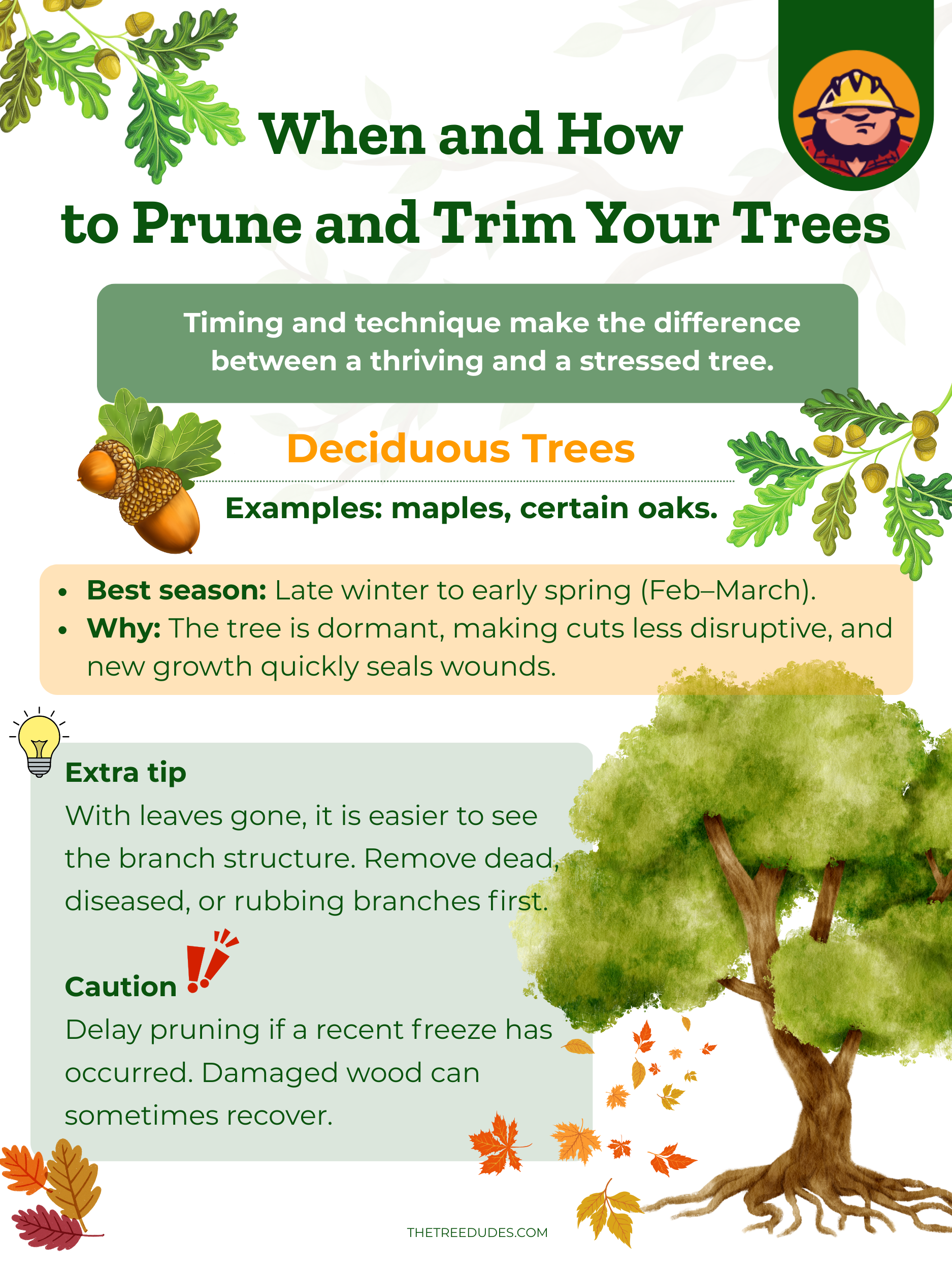
Deciduous Trees
Deciduous trees, the ones that drop their leaves in fall or winter, like maples or certain oaks, have a true dormant season, even in Florida. The best time to prune deciduous trees in Florida is generally late winter to early spring, just before new growth begins. Around late February or March in South Florida, these trees are gearing up to put out new leaves.
Pruning them at this time is ideal because: 1) the tree is dormant or just about to wake up, so you are not interrupting its active growth, and 2) the wounds will bounce back pretty fast once spring kicks in.. Imagine pruning as giving the tree a fresh haircut right before school picture day, it starts the season looking its best, and can channel energy into new healthy branches and leaves rather than trying to sustain old, sagging ones.
Also, with fewer leaves on the tree in late winter, it is easier to see the branch structure and make good cuts. Always remove any dead or diseased branches first. Safety first for the tree’s health, then any crossing or rubbing of branches. By the time April rolls around, your deciduous trees will burst out of “sleep mode” with vigor, without any awkward, unwanted limbs stealing energy from the show.
One caution: if a hard freeze just occurred or is expected imminently, a rarity in Miami but can happen in northern parts of Florida, it is wise to delay major pruning. Frost-damaged wood can look dead but might not be, and pruning too soon might remove parts that could recover. In Miami-area tropical conditions, freezes are usually not an issue, so late winter pruning is typically smooth sailing.
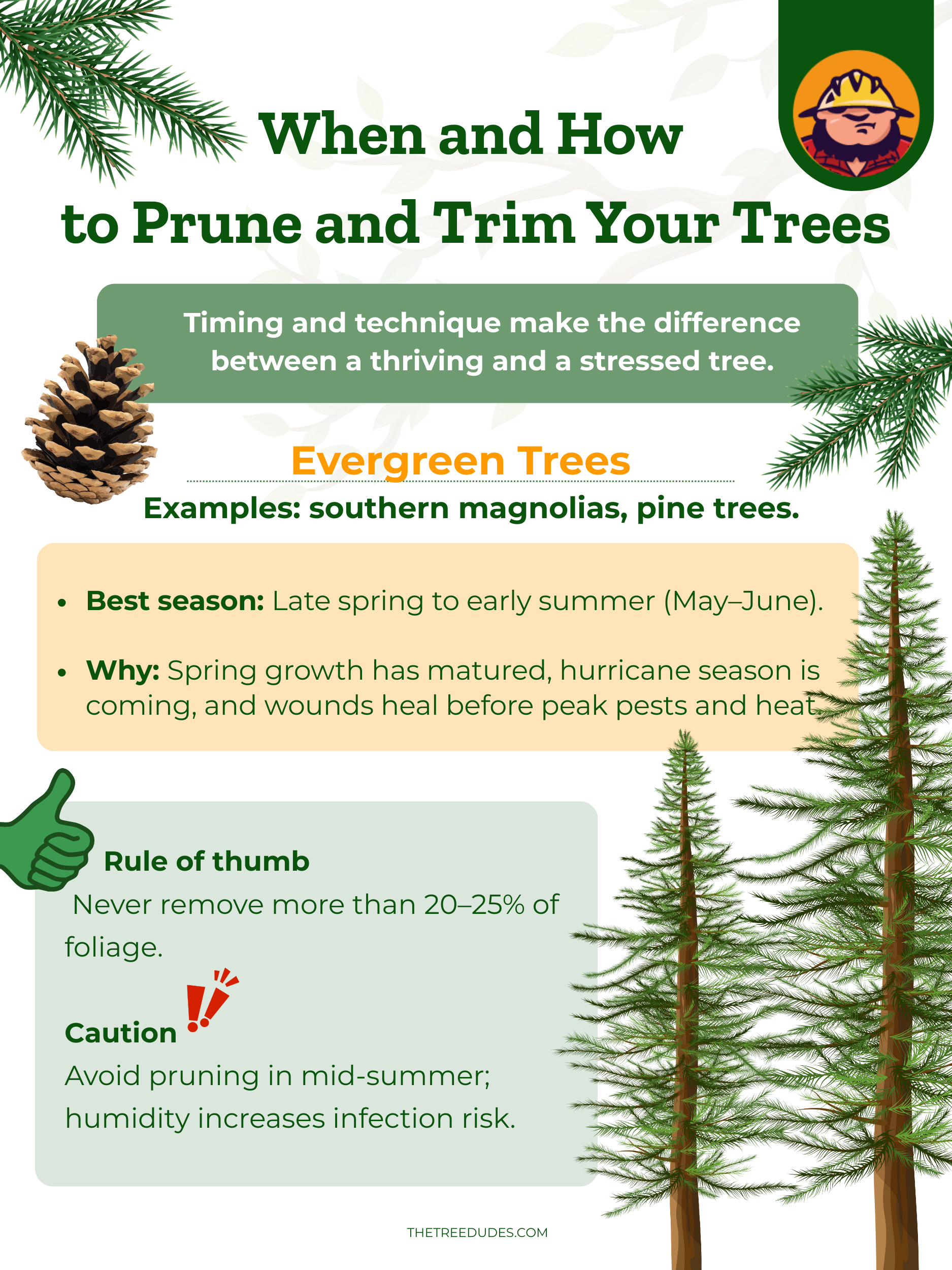
Evergreen Trees
Evergreen trees, which keep leaves year-round, like live oaks, southern magnolias, or many non-native ornamentals, do not have a dramatic dormancy, but they do have slower and faster growth periods. In Florida, many evergreens have a growth spurt in spring and sometimes a smaller one in fall.
A good time to prune evergreen trees is late spring, around May, or very early summer, after the first flush of new growth has matured. Why? Because the tree has just grown and will have time to recover before the next growth cycle. Pruning in late May or June can also prepare the tree for the upcoming hurricane season by clearing out excess branches. However, you generally want to avoid major pruning in the peak of summer because high heat and humidity can stress the tree and open pruning wounds to quicker infection.
Minor snips are fine any time, but save bigger cuts for the slightly cooler margins of summer. Another reason late spring can be optimal is that many pests and diseases hit their stride in warm, wet summer months. By pruning in late spring, you remove potential problem branches early, and the cuts have some time to begin healing before those conditions ramp up. Always follow the rule of thumb for pruning evergreens: never remove more than 20-25% of the tree’s foliage in one go.
Over-pruning is a big no-no. It can weaken the tree, and in some cities, it is literally against the law to hack a tree too much, but more on that later. So, if that live oak in your yard is looking a little too live, like it is trying to join your living room through the window, plan a thoughtful trim in late spring. Trim away low-hanging limbs, especially those that could threaten structures in a storm, thin out dense areas slightly to let air through, and always make clean cuts at branch collars so the tree can seal the wound.
Your evergreen will thank you by staying… well, evergreen.
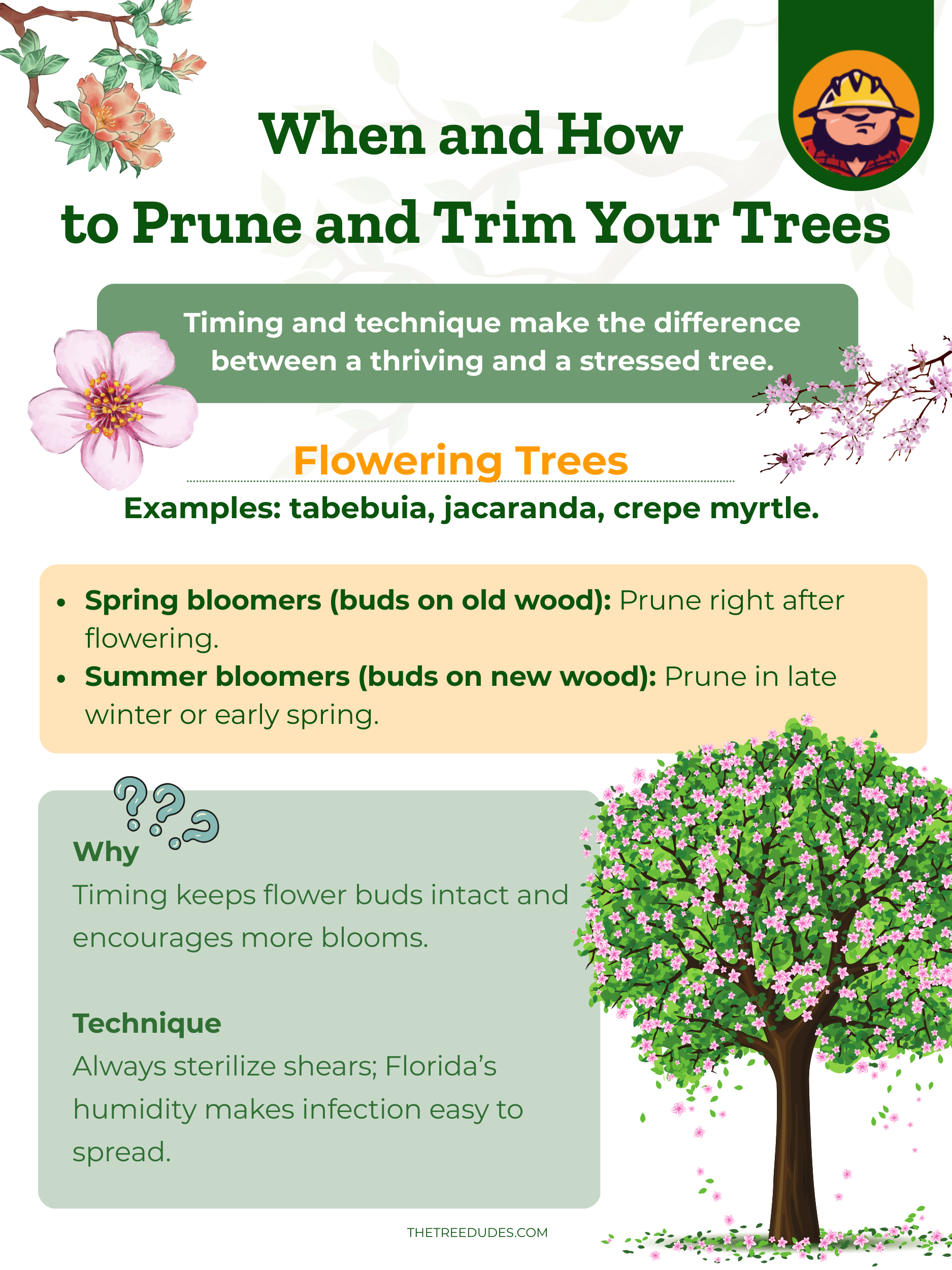
Flowering Trees
Florida’s flowering trees are legendary. From prumeria to jacarandas to magnolias. To keep those blooms popping, the timing of pruning is what matters. After the flowers have bloomed, it is smart to prune trees that flower in late winter or spring. A lot of these trees actually grow their flower buds on the wood from the year before. Take our gorgeous Tabebuia or Cassia trees, for instance. Those stunning yellow or pink blossoms you see in spring come from the older branches.
For summer-blooming trees like Crepe myrtles or certain hibiscus trees, which tend to bloom on the current season’s growth, late winter or early spring pruning is generally fine, even beneficial. These dudes are the opposite of the spring bloomers. They actually bloom on new branches. Pruning them in February or March, when they are not actively blooming, encourages a burst of fresh growth that will carry flowers in summer.
Make sure to grab your sharp and clean tools when you are pruning flowering trees or any trees. Florida’s humidity means bacteria and fungi are everywhere; a clean cut with sterilized shears. You can wipe them with isopropyl alcohol between cuts. It helps prevent introducing infections into those pruning wounds.
A well-timed, well-executed pruning job can actually increase the number of blooms the following year by redirecting the tree’s energy into fewer, healthier buds. So if you have a bougainvillea or orchid tree that did not bloom much last year, check if you pruned it at the wrong time or not at all. It probably just needs a little trim after blooming to really kick off a flower show next time around.
Palm Trees
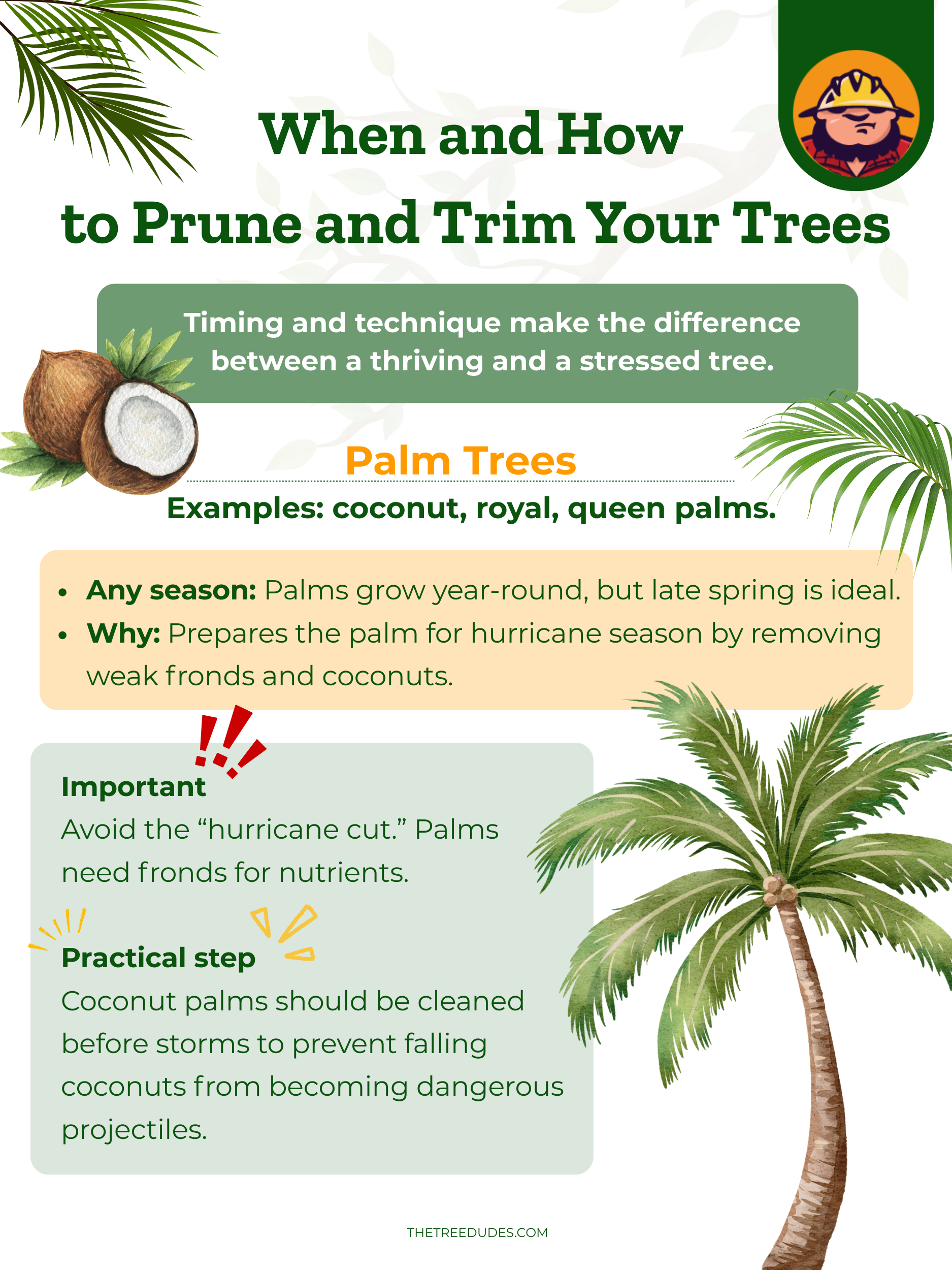
Palms are quite different from typical shade trees in how they grow and how they are maintained. First off, palms do not have a true dormant season. They continuously produce new fronds from the top, regardless of the season. That means, technically, you can prune palms any time without timing affecting growth the way it does for other trees. However, there is a generally recommended time: late spring is often cited as the best time for pruning if needed.
Pruning in spring means your palm will go into the storm season with only healthy, secure fronds remaining. Now, an important note: palm pruning is not something you do often or heavily. When it comes to palms, keeping it simple is the way to go. Unlike an oak that might need thinning, palms actually need their fronds to gather and store nutrients. Over-pruning palms, like the notorious “hurricane cut” where someone removes all but a few fronds sticking up like a mohawk, is generally bad for the palm’s health and does not really help it in hurricanes either.
A healthy palm naturally drops its dead fronds. The main reason to prune a palm is to remove brown or yellowing fronds for aesthetics and to prevent them from dropping unpredictably, and to remove flower or seed stalks if you do not want the mess of seeds like the ones queen palms leave behind. Also, in South Florida, a very practical reason to prune palms is coconut removal. If you have coconut palms, those lovely coconuts can turn into cannonballs in a storm. Ideally, remove or trim the coconuts before hurricane season kicks in.
Early summer, June or even late May, is a smart time to hire a coconut removal service to climb and pluck those heavy nuts down, eliminating the risk of them becoming airborne missiles. Professional crews will use bucket trucks or will climb the palms with safety gear to twist off the coconuts and dead fronds.
One more thing on palm trimming: many palms in Miami’s streetscape are tall, really tall. Pruning them involves either a cherry-picker truck or a skilled climber with spikes. Spikes should only be used on palms that are being removed or on very old coconut palms solely for coconut trimming, since spikes can wound certain palms.. If you own a business with palms lining your storefront or are a homeowner with a majestic royal palm by the driveway, check those palms now and then. Remove any hanging, dead fronds promptly, as they can drop on cars or people.
And if you see signs of palm disease, like wilting, discolored new spears, or oozing at the crown, call a certified arborist who knows palms. We have diseases like lethal yellowing and Ganoderma butt rot that specifically target palms in Florida. Early removal of an infected palm can sometimes save neighboring palms by halting spread.
Prune palms sparingly, at the right times, and let them keep as many green fronds as possible. Your palm will live a longer, happier life, providing that postcard-worthy vibe to your property.
Fruit Trees
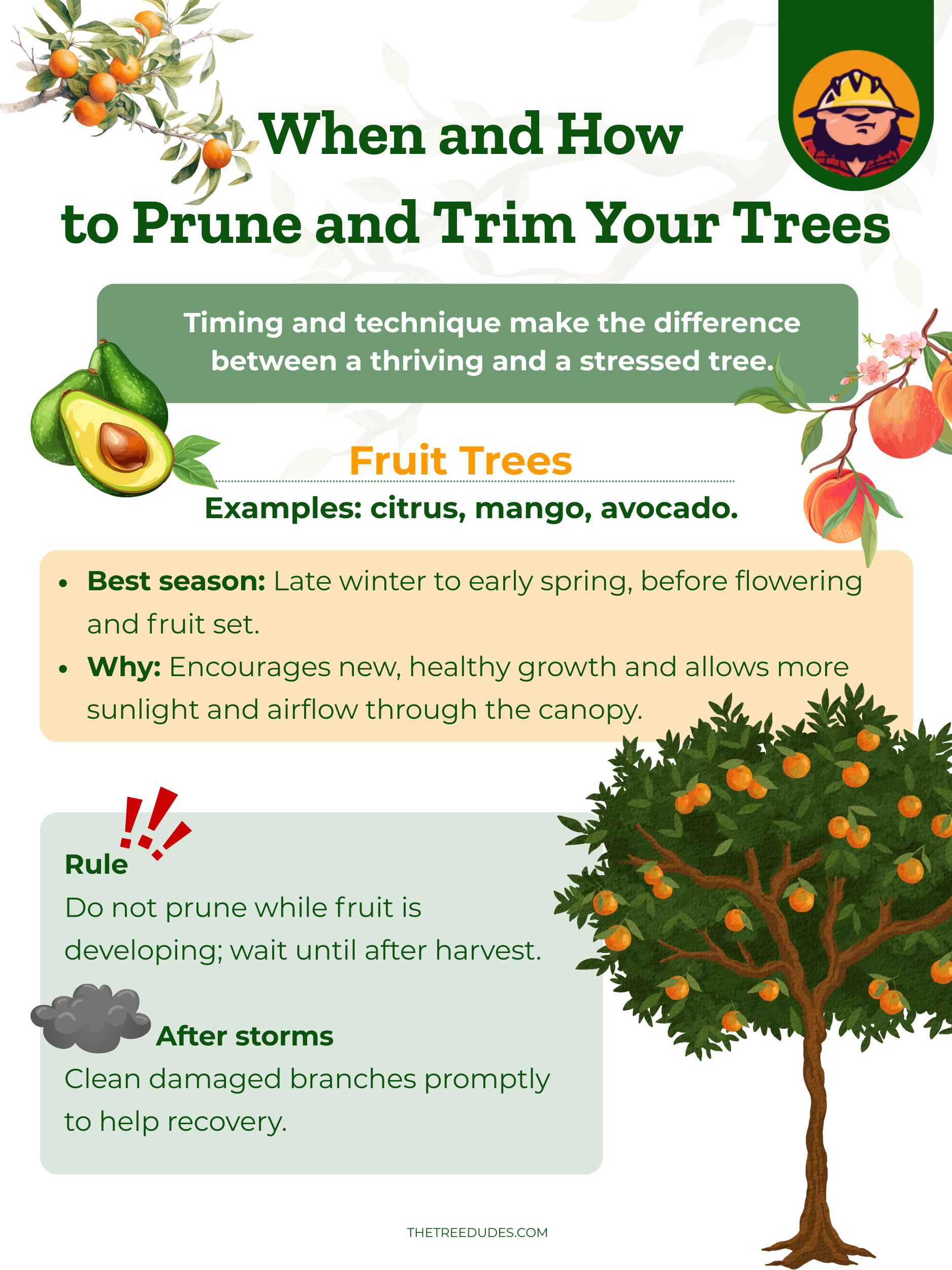
Fruit trees in Florida deserve their own little spotlight. From citrus to mangoes to avocados, many Floridians enjoy fruiting trees in their yards. When you prune fruit trees the right way, it helps keep them healthy, controls how big they get, and boosts their fruit production. Generally, the best time to prune fruit trees like peach or apple, or even our semi-tropical fruits like mango, is late winter to early spring, just before they put out new growth and blossoms.
For example, pruning a mango in February in South Florida can be ideal. It is right before its big spring growth and flowering flush. You want to prune before buds form if possible, so you are not knocking off potential fruits. Pruning early also helps sunlight penetrate the canopy, which can improve fruit quality and reduce fungal issues by increasing airflow.
With citrus, timing can be a bit more forgiving since many citrus varieties can have multiple bloom times, but the end of winter is a safe bet to tidy up the tree. Make sure to get rid of those strong shoots that pop up at the base or roots and any water sprouts, which are the ones that shoot straight up from the branches. They will not produce any fruit and just waste your plant’s energy.
One thing to avoid: pruning during fruiting. If your orange tree is full of little green oranges in May, hold off on major cuts, or you will be literally throwing away your oranges. Wait until after harvest for any significant structural pruning. Keep in mind that pruning can reduce the fruit load in the immediate next season because you are removing some budding wood, but it often leads to better fruit in the long run. A healthier tree, and the remaining fruit gets more nutrients.
After a hurricane or tropical storm, if fruit trees get damaged, do a cleanup pruning right after the storm to give them the best chance to recover and possibly produce a late-season crop if they are capable. Also, fruit trees here can grow quite large in our climate, looking at you, avocado trees. Do not worry about cutting them back to keep them at a good size. It makes it easier to pick fruit and reduces the chance of limbs breaking under fruit weight or the wind. As always, clean tools, good cuts, and do not over-prune. With the right timing and techniques, your Florida fruit trees will reward you with juicy produce and remain healthy.
A Note on Tree Trimming Technique
No matter the timing, how you prune is just as critical. Always follow proper pruning techniques. Remove branches at the branch collar, which is the swollen area at the base of the branch, rather than hacking in the middle of limbs, to allow for proper healing. Never “top” a tree. This is considered tree mutilation and can seriously harm the tree’s structure and health. Plus, in many Florida municipalities, it is actually illegal or punishable to top or severely over-prune a tree. Limit how much you take off: that 25% rule we mentioned is both for the tree’s health and, interestingly, it aligns with local regulations that often require a permit if you exceed it.
In the City of Miami, for example, pruning more than 25% of a tree’s canopy without a permit is against the rules. But even if there were no law, taking too much at once can send a tree into shock or make it more vulnerable to pests or illness. So we prune conservatively and intentionally. If you are unsure how to make the right cuts or how much to trim, consider bringing in a certified arborist to either do the job or coach you through it.
Special Care Tips for Florida Trees
Beyond timing your pruning, tree maintenance in Florida involves a handful of other best practices. Proper feeding, hydration, check-ups, and a good environment are needed. Here are some Florida-specific tree care tips that will help your leafy friends thrive:
Feeding Your Trees
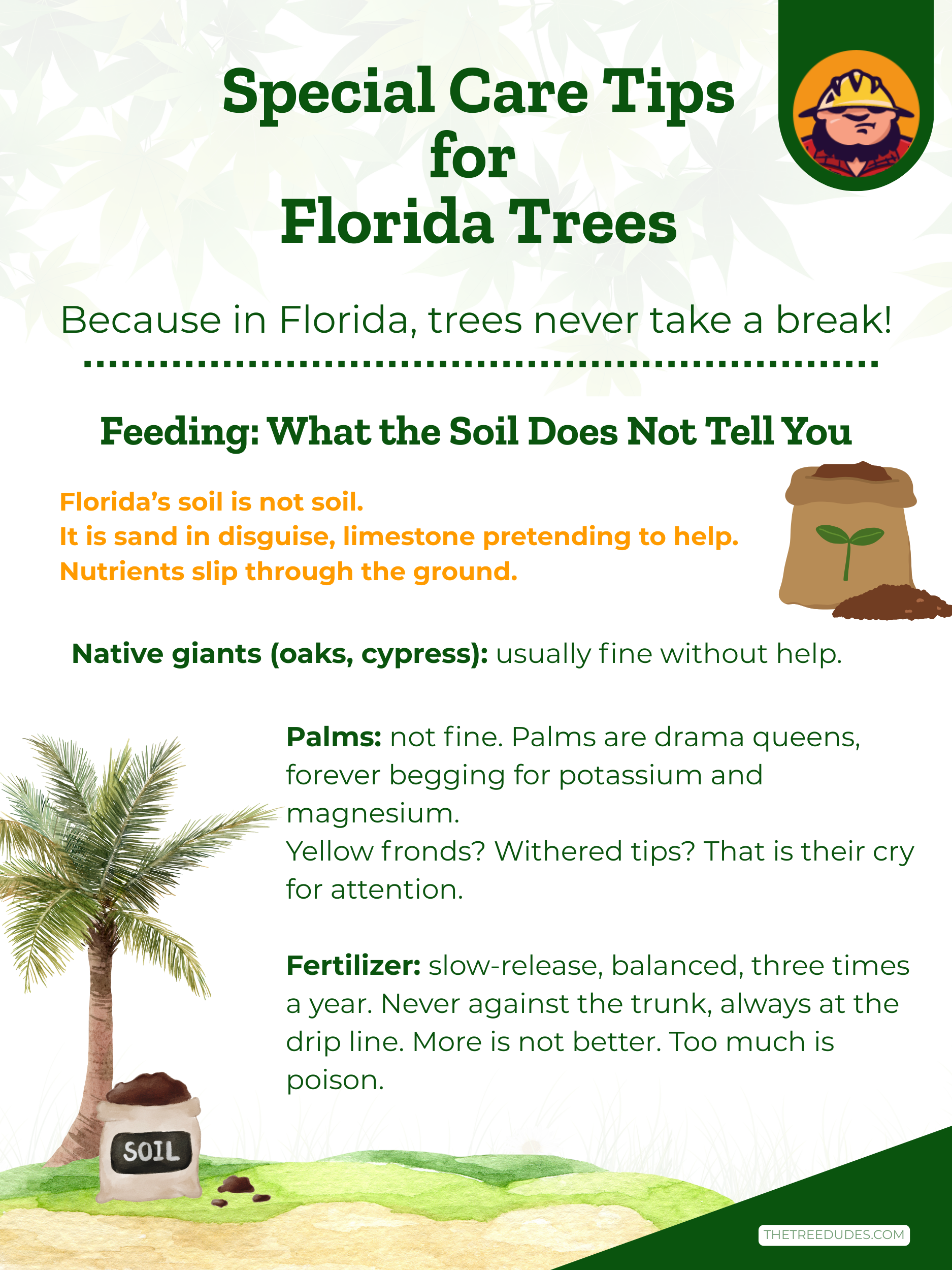
Florida’s soil is famously sandy and often nutrient-poor. In many parts of Miami-Dade and Broward, the “soil” might as well be beach sand mixed with limestone fill. This means trees do not always get all the nutrients they need from the ground alone. Fertilization can help, but it has to be done wisely.
Using too much fertilizer can actually cause more problems than it solves, especially in Florida. Generally, mature native trees, like live oaks, cypress, etc., often do fine without fertilization if the soil is decent and they have a layer of organic mulch. But ornamental and exotic trees, fruit trees, and especially palm trees may benefit from regular feeding.
Palms, in particular, are susceptible to deficiencies in elements like potassium and magnesium. If you have ever seen a palm with yellowing fronds or withered-looking new growth, it is likely a nutrient issue. In fact, potassium deficiency is the most common nutritional disorder of palms in Florida, leading to yellow or brown fronds that die prematurely. Using a specially formulated palm fertilizer is often recommended to keep palms lush and green.
These palm fertilizers have the right mix of nitrogen, potassium, magnesium, manganese, and other micronutrients that palms crave. A typical schedule might be fertilizing palms about three times a year, say, spring, summer, and fall. Always follow product guidelines, more is not better. And broadcast the fertilizer around the drip line, not right up against the trunk, because tree roots extend outward quite far. After applying, water it in well to distribute the nutrients into the soil.
For flowering and fruiting trees, a slow-release balanced fertilizer in late winter can boost spring growth and blooms. Citrus trees have their own needs. Many citrus-specific fertilizers contain extra minerals like iron and zinc. One thing: do not fertilize a tree that is drought-stressed or newly planted until it has recovered or established roots. Fertilizing at the wrong time can actually stress the tree more, forcing it to grow when it is struggling to get water. And absolutely avoid fertilizing during the peak of a drought, as it can scorch roots. In drought times, focus on watering, not feeding.
On the flip side, in the wet season, avoid fertilizing right before a huge rainstorm unless you want all those nutrients to wash away before the tree gets them. When done properly, fertilization in Florida helps trees maintain lush, green foliage and resist pests or disease. If you are unsure about your soil, you can test it through UF/IFAS Extension offices.
Sometimes the soil pH is off, especially near coastal areas with shell and limestone, which can lock up certain nutrients. Adjusting pH might be needed for something like iron chlorosis (common in high pH soils). This might sound like a lot, but basically: feed your trees if they need it, using the right stuff at the right time, and they will reward you by looking fabulous.
Watering and Irrigation
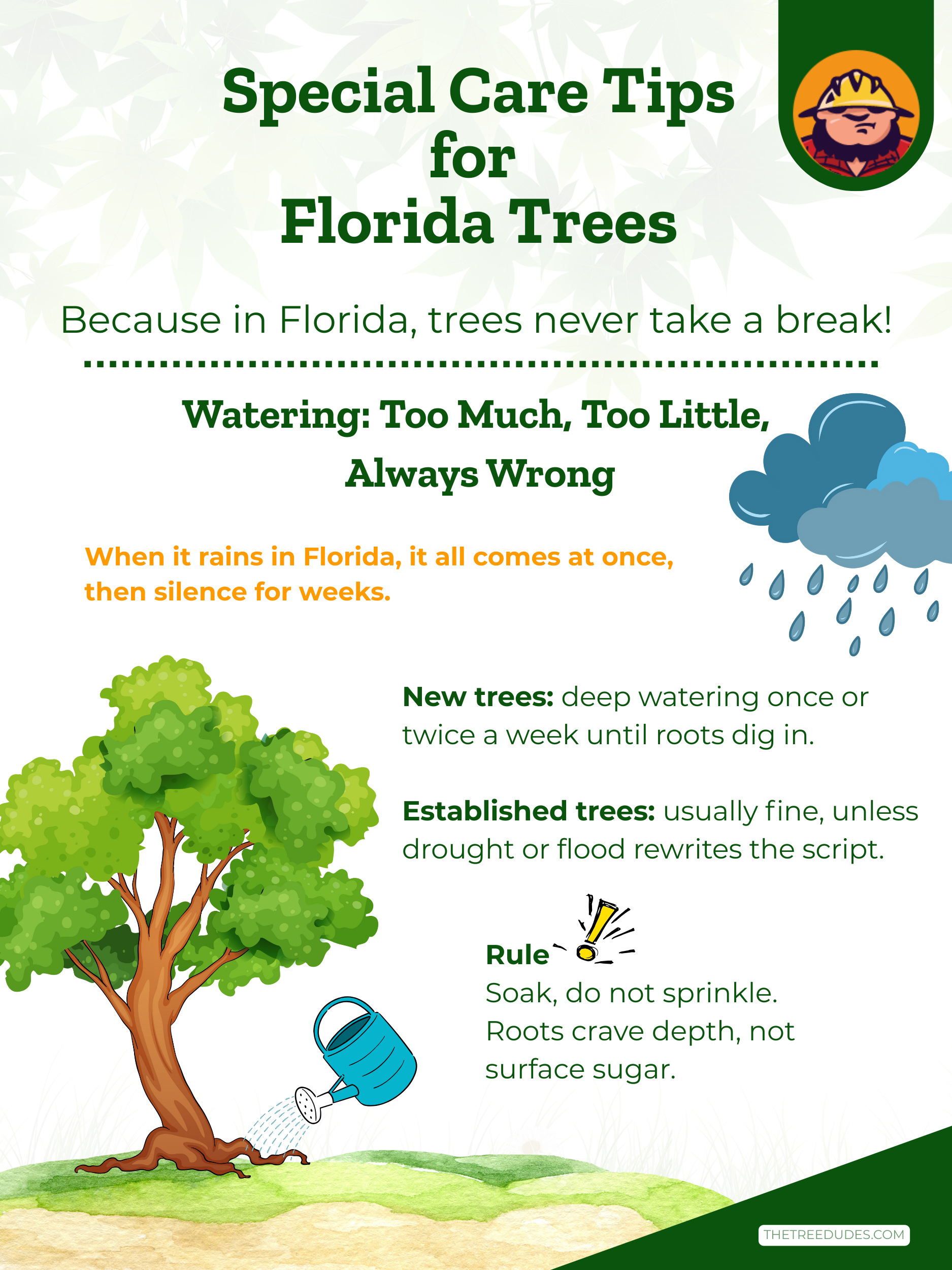
Florida’s rain patterns can lull us into forgetting about watering until a dry spell hits and plants start wilting. New trees, in particular, need consistent watering for their first 1-2 years while they establish roots. In Miami’s dry winter months, if there has been no rain for a couple of weeks, it is time to drag out the hose or turn on the irrigation for your young trees.
Deep watering is important: it encourages roots to grow downwards. It is better to water deeply once or twice a week than lightly every day. For established large trees, you usually do not need to water them unless we are in an extreme drought. They have extensive root systems that find moisture. But be mindful of drought signs: wilted leaves that do not perk up in the evening or excessive leaf drop out of season.
If you see that, a slow soak of the root zone can help. On the other hand, if we are experiencing monsoon summer and it rains every afternoon, ensure there is adequate drainage around trees that do not like “wet feet.” Some trees, like magnolias or live oaks, handle periodic flooding fine, but others, like avocado trees, can get root rot if water sits too long. If you have a yard that tends to flood, consider creating a small mound to plant your tree on. Many South Florida homes do this for fruit trees. It elevates the root crown above the typical wet-season puddling.
Also, avoid overwatering with your sprinklers: not only is it wasteful, but constantly soggy soil can lead to fungal issues and root rot. Remember, tree roots need oxygen as well as water. Soil that is always saturated has no air pockets. Using mulch is extremely helpful for moisture regulation. A 2-3 inch layer of bark or wood chip mulch keeps soil moisture more even and reduces evaporation, which will prove to be essential during those May dry spells. Just keep mulch a few inches away from the trunk to prevent rot and pests at the base.
Florida’s climate might dump a lot of rain at once and then give none for weeks. Your job as a tree caretaker is to buffer those extremes a bit. Save some of that wet-season abundance in the soil with mulch, and supplement during the dry times with a hose. The result: a tree that is not water-stressed is stronger and more resilient all around.
Pest and Disease Vigilance
Our perpetual summer means one thing for bugs and diseases: they never take a vacation.
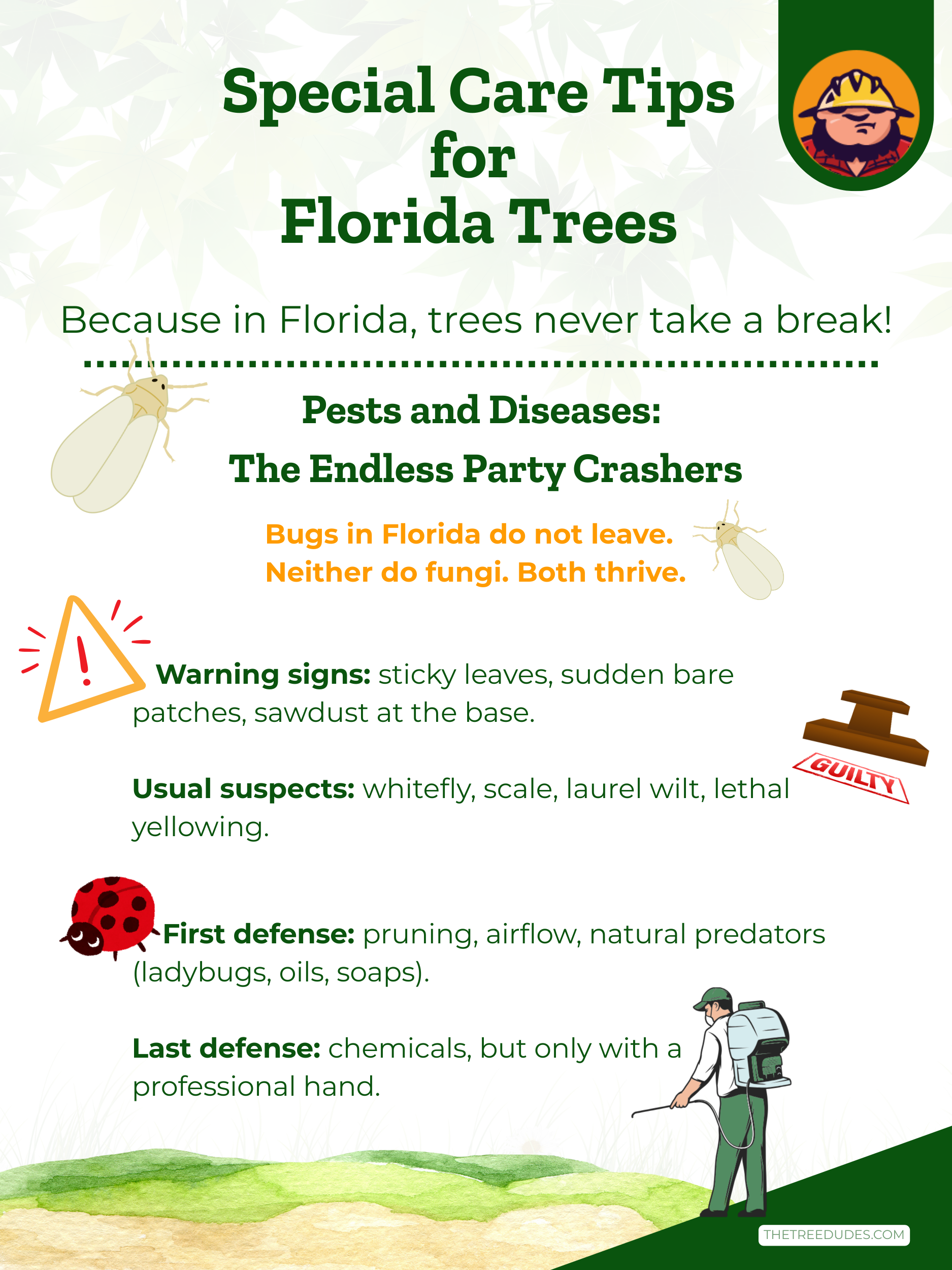
Florida’s trees can be host to a variety of pests, from tiny scale insects and whiteflies, which might make leaves sticky with “honeydew”, to larger critters like caterpillars munching on new leaves. An important part of maintenance is just keeping an eye on your trees. Stroll around your yard or property every so often and look up. If you see a section of a tree that is defoliated or discolored while the rest looks fine, that is a red flag.
Common issues in South Florida include: spiraling whitefly on gumbo limbo and black olive trees, ficus whitefly on ficus hedges, and various scales on palms and shrubs. When it comes to diseases, we have issues like fungal wilts and blights. Laurel wilt has taken out a bunch of native avocado and swamp bay trees. Oak wilt, though not as prevalent in South FL, can hit certain oaks. And as mentioned, lethal yellowing or its cousin Texas Phoenix Palm Decline can kill palms like phoenix species and some coconut varieties.
Integrated pest management uses environmentally friendly approaches first, like beneficial insects, as ladybugs love aphids for lunch, pruning off affected areas, or horticultural oils or soaps for soft-bodied bugs. Save chemical treatments as a last resort or for severe infestations, and even then, consider hiring a professional arborist or pest control professional who knows trees, because misusing treatments can harm the tree or the environment. For fungus issues, sometimes pruning out the affected limbs and improving air flow is enough. Using soil drenches or trunk injections, like the ones used for laurel wilt in avocado trees, are pretty complex technique that is probably better handled by the pros.
A little bit of prevention goes a long way. It is way better than trying to fix a problem later. Keeping a tree pruned, watered right, and fertilized when necessary helps it stay healthy and stronger against pests and diseases compared to a tree that is struggling. It is similar to how a healthy person resists sickness. But if you do catch something early, say you notice some weird sawdust at the base of the trunk or leaves turning odd colors, then consult resources or an expert sooner rather than later.
The University of Florida IFAS Extension has great online resources and local agents you can ask about mysterious tree ailments. And many reputable tree services include health checks as part of maintenance. Routine maintenance visits for fertilizer or pruning can double as a doc visit for your trees. Staying vigilant in Florida’s bug-friendly climate will save you heartache by avoiding full-blown infestations or losing a tree to a disease that might have been stopped.
Storm Prep and Cleanup
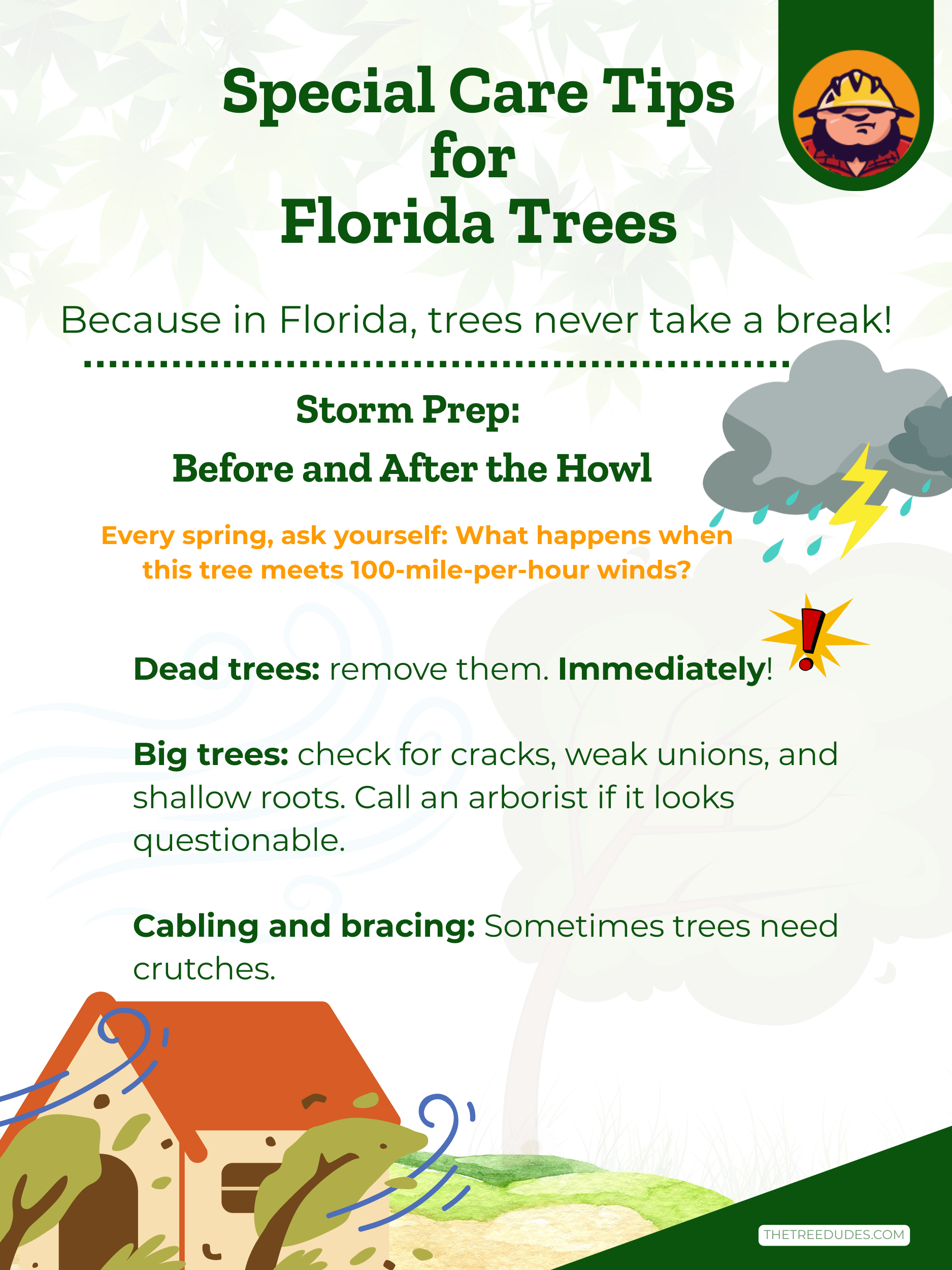
Every late spring, take stock of your trees. Remove dead trees entirely. A dead tree is just waiting to tumble down. In fact, a dead tree is considered a hazard, and in many places you are required to remove it promptly. For large healthy trees, consider a professional hazard assessment.
Arborists can identify structural issues like cracks, weak branch unions, or root problems that might not be obvious to an untrained eye. They might suggest cabling or bracing a large limb common for sprawling live oaks to give it extra support. Or they might recommend removing a particularly risky branch that overhangs your roof. These pre-storm actions can literally be lifesavers. After a storm, when the sun comes out and you are surveying debris, prioritize safety. If a tree is damaged but not an immediate threat, you can schedule a non-urgent removal or pruning.
But if a tree or large limbs are down on power lines or leaning precariously, call emergency services or professional tree crews right away. Do not risk life trying to DIY a storm cleanup with a chainsaw. Many tree services have 24/7 emergency response teams for exactly this reason. They will have the right equipment to remove fallen giants. Post-storm, also remember your trees are likely stressed: give them some care with water if roots were exposed or if there was saltwater flooding, a gentle rinse or some fresh water helps flush salts, and do not rush to fertilize a storm-damaged tree. Let it recover a bit first.
The Power of Mulch
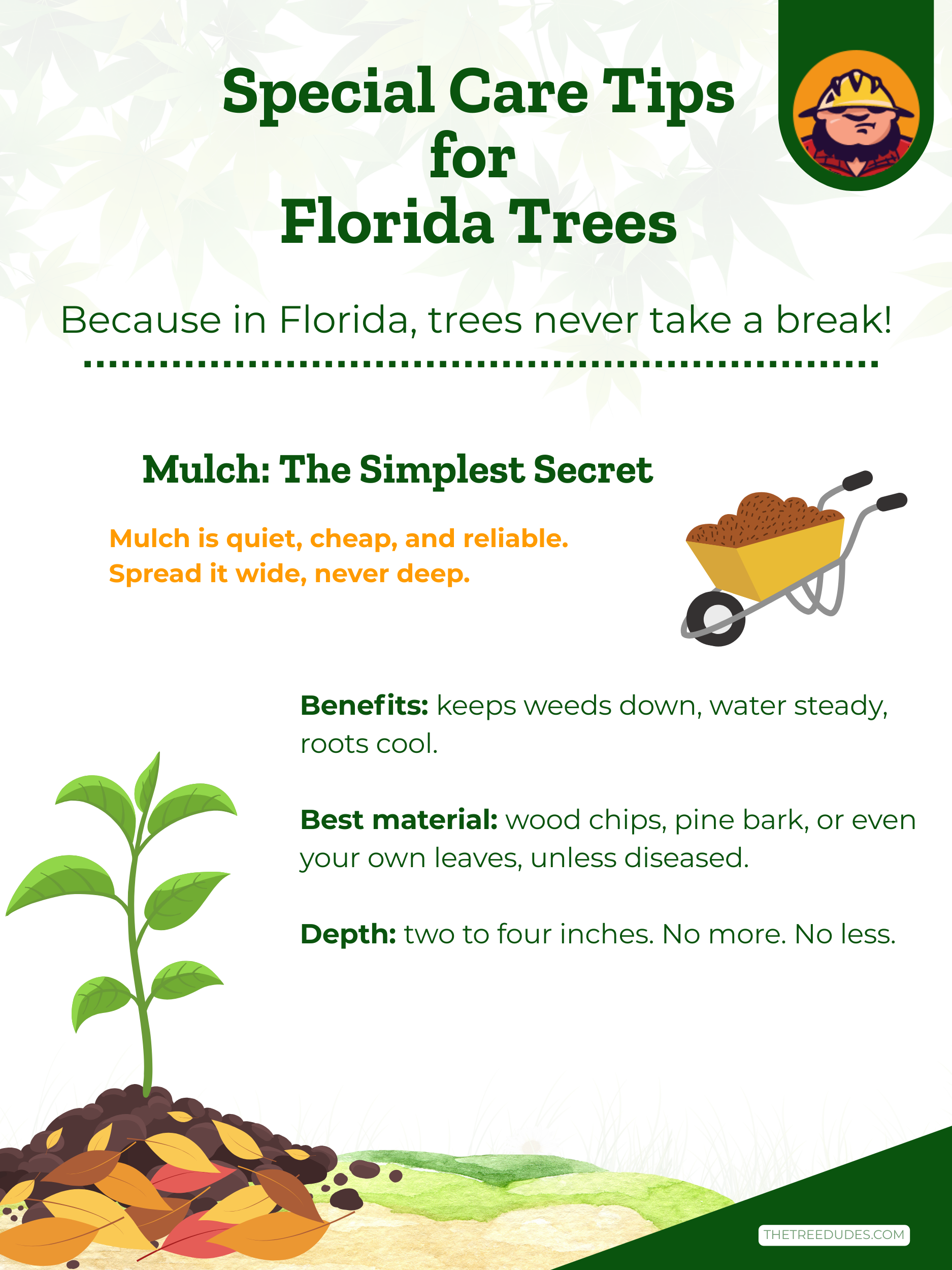
We already discussed mulch a bit in the context of water, but it is worth highlighting: mulching around your trees is one of the simplest, most cost-effective maintenance tasks you can do. It provides weed suppression, moisture retention, and temperature moderation for the roots.
You can mimic a natural forest by mulching your trees with wood chips, pine bark, or even fallen leaves you raked up elsewhere, as long as they are not diseased. Just spread it in an even layer out to as wide an area as you can, ideally out to the tree’s drip line if possible. Two to four inches thick is plenty. Keep it a few inches away from the trunk because constant moisture on the trunk invites rot and insects.
Know the Rules: Permits, Laws, and Local Ordinances
Now for the part that might not be as fun as dreaming about tropical gardens, but it is super important: knowing Florida’s tree laws and permits. Yes, trees in Florida come with homework! But fear not, we will break it down in simple terms, because getting on the wrong side of a tree ordinance can cost you hefty fines or even legal trouble. Different counties and cities have their own rules, but here are some general and local pointers, especially relevant to Miami-Dade and the surrounding areas:
Permits for Removal and Pruning
In a lot of places in Florida, you have to have a permit to take down a tree. Miami-Dade County, for instance, has a strict tree protection ordinance. It is illegal to cut down, destroy, or remove any tree in unincorporated Miami-Dade without first obtaining a permit from the county.
Similarly, cities like Miami, Miami Beach, and Coral Gables all require tree removal permits for most trees. These permits ensure that not everyone is just chopping trees freely. Remember, a mature tree is considered part of the community’s green infrastructure. When you apply for a removal, usually the city or county will check: Is the tree dangerous? Is it diseased or dead? Is it causing property damage or preventing approved development?
Often, they will also require you to plant a new tree as mitigation for the one removed, unless it was dead or a prohibited species. There are typically exemptions. For example, Miami-Dade’s code exempts single-family homeowners removing trees on their property under certain conditions, like if the tree is not a protected “specimen” tree. A protected specimen usually means a very large or historic tree.
Also, fruit trees like mango or avocado, and certain exotics, might be exempt from permits. And dead trees can usually be removed without a permit because, well, they are dead and dangerous. But always check first. If you cut down a tree that the city later tells you was off-limits, you might get hit with fines and could be asked to plant new ones or pay a pretty hefty fee. Permits might sound like a hassle, but they are often processed pretty quickly. Miami-Dade says roughly 30 days, give or take. If you hire a professional tree service, they will usually handle the permitting process for you or guide you through it.
For pruning, you generally do not need a permit for routine trimming. Unless you are doing something major that could be considered equivalent to destroying the tree. If you are in Miami and want to chop off more than a quarter of a tree’s leaves in a year, you will need to grab a pruning permit. That is because taking more than a quarter of the leaves off a tree can severely harm it. Normal pruning that follows professional standards, like ANSI A-300 standards, which arborists abide by, is allowed without a permit.
Essentially, as long as you or your tree service prunes in a way that is healthy for the tree. Like no hat-racking, no topping, no stripping it bare, you are fine. But if a neighbor or inspector thinks you “pruned” your tree into a giant broccoli stalk with no leaves, you could get cited for unpermitted removal because excessive pruning can count as effectively destroying the tree. So, moral of the story: prune responsibly, and you stay on the right side of the law.
Florida’s Private Property Rights Law
Some years ago, Florida passed a state law that is a game-changer for homeowners. In 2019, House Bill 1159, codified as Florida Statute 163.045, was enacted to prevent local governments from overregulating tree removal on residential property. This law basically says: if a certified arborist or licensed landscape architect determines that a tree on your residential property is dangerous, meaning it presents a danger to persons or property, then you can remove it without needing a permit or paying any mitigation fees to the city or county.
In other words, state law gives private residential property owners the right to promptly deal with dangerous trees. You do need documentation, though. You can not just declare the tree dangerous yourself. You should get an arborist to inspect the tree and write a letter or report stating that the tree is unsafe. With that in hand, local authorities should not hassle you about removing it. They also can not require you to replant a new tree in its place under this law.
This applies to residential properties and non-commercial properties. It does not cover, say, a shopping center or a common area. Those still follow local rules. Also, it specifically excludes mangrove trees, which are protected by separate laws. The law was designed to stop situations where, for example, a homeowner knew their old oak was rotting and leaning over the house, but the city would not give a permit until it actually fell. Now you can act proactively. It is a great relief, but use it wisely. “Dangerous” truly means the tree is at risk of failure, not just that you dislike where it is planted.
And it is always good form to inform your local city if you are invoking this law, even if you are not formally applying for a permit, just so everyone’s on the same page. Some cities have created a form or affidavit that you submit with the arborist’s report so they have a record. Communication goes a long way to avoid misunderstandings.
Professional Tree Services in Miami
Tree maintenance can be a labor of love. Emphasis on labor! Climbing tall ladders with chainsaws, hauling heavy branches, diagnosing tree “illnesses”… it is not everyone’s cup of Cuban coffee. Thankfully, you are not alone in this jungle. Professional tree services are here to take the burden off your shoulders and ensure you do not take a palm frond to the head in the process.
In Florida, the way things are here makes it really helpful to have people around who know how to trim trees for a living. We know exactly how to make that coconut palm hurricane-ready, or how to prune your mahogany so it does not freak out from over-trimming.
Tree Trimming and Pruning
Professionals will assess each tree and prune it following ANSI standards, meaning your tree gets a haircut, not a scalping. Professionals handle everything from fine pruning of ornamentals to high-up palm frond removal. The benefit of having pros do it is as much about the convenience as it is about the expertise. Certified arborists know how to make cuts that promote healing and how to shape a tree without harming it.
They also bring the right equipment, like bucket trucks, ropes, and harnesses, so that even a 50-foot royal poinciana can be pruned safely. And yes, they haul away the debris, turning those cut branches into mulch or compost whenever possible. If you have palm trees, you can hire specialized palm tree trimming and pruning services, which include trimming brown fronds and, if needed, coconut removal. As mentioned earlier, removing coconuts before storm season is crucial: hire a professional coconut crew for exactly that.
Professionals climb or use lifts to get those coconuts down safely. No coconuts will rain on your parade. After a trimming service, your trees will look neater, be safer, and thank you in their own way.
Tree Removal
Sometimes, sadly, a tree has to go. It might be diseased, dead, posing a danger, or in the way of new construction. A professional tree removal service covers everything from taking down small trees to orchestrating the removal of giant, decades-old behemoths in tight urban spaces. Removal is not just cutting at the trunk and yelling Timber. In residential areas, we often have to carefully rope down pieces to avoid damage to homes or power lines.
Professionals will evaluate the tree’s condition and the surroundings, then use techniques like sectional dismantling or cranes to remove it safely. Importantly, professionals are well-versed in the permitting process. They can advise you on whether a permit is needed, and even handle the paperwork for you.
By the time they are done, that problematic tree will be gone, and we can even grind the stump if you want. Tree removal is definitely not a DIY-friendly task for large trees. Florida’s mix of soft soils and large tree sizes can make it unpredictable. Always call a licensed professional for removals, especially for big trees.
Stump Removal and Rootball Removal
After a tree comes down, you are often left with the stump, a constant tripping hazard and an eyesore that can sprout weird little shoots. Removing a stump is a whole different challenge. We offer stump removal, which typically involves using a stump grinding machine to chew the stump wood down below ground level. We actually note that standard tree removal service does not include stump and rootball removal by default
Our team can grind the stump out and even do rootball removal if you want the roots gone to replant or landscape the spot. Why hire pros for this? Well, stump removal can be dangerous and labor-intensive. There is fast-spinning machinery, underground utilities to worry about, and sometimes fire or chemicals are used, which we can manage safely, but you probably do not want to experiment with. And if you have a stump that someone tried to DIY burn or dig and just gave up on, as we have seen half-charred stumps or hacked-at roots left behind, we can tackle those, too.
Tree Planting and Transplanting:
If you are looking to add to your landscape, professional tree planting services ensure it is done right. In Florida, planting a tree involves considerations like choosing the right species for the location (right plant, right place), proper planting depth, because planting too deep is a common mistake, and soil amendments.
Professionals help homeowners and businesses select trees that will thrive in our tropical climate and suit their property. We also handle tree transplanting. Maybe you have a small tree that you want moved to a new spot, or you are relocating and want to take a beloved tree with you. Transplanting, especially for larger trees, is complex: it involves careful root pruning, digging a rootball, using equipment to lift the tree, and replanting it with care so it survives the move.
Our experts know how to do this with minimal stress to the tree. We also guide you on the aftercare. Newly planted or transplanted trees need extra attention, like watering, staking, etc., for the first year or so. With professional help, your new trees get the best start in life, increasing the odds they will grow strong and beautiful for years to come.
Emergency Tree Services
When a hurricane or tropical storm hits, or even just an unexpected strong wind, you might find yourself with a tree on the ground or one leaning precariously. Our emergency tree removal and storm cleanup teams are on call 24/7 for exactly those scenarios. We respond quickly to make your property safe. Cutting and removing fallen trees, tarping roof holes if needed, clearing driveways, and removing hanging, broken limbs. We also do hazardous removals, which refers to taking out trees that are in a dangerous condition, like a lightning-struck pine that is half-splintered, or a dead palm next to a power line.
These situations need special care and often coordination with utilities or city crews. For businesses, having a contractor who can come post-storm and get your property safe and accessible can be a lifesaver. You want your business back up and running ASAP without a downed tree blocking the parking lot.
We pride ourselves on efficient, safe emergency work, even under tough conditions. The best advantage of professionals in emergencies is safety. We have the experience to avoid accidents during such stressful operations. We have chainsaw chaps, helmets, ropes, cranes, the whole arsenal, to deal with storm-damaged trees. So when Mother Nature throws a tantrum, you have someone to call.
Commercial and HOA Maintenance
And what about ongoing care, especially for commercial properties or large residential communities? We offer commercial tree services and HOA maintenance plans. That means we can set up an annual or bi-annual schedule to come in and prune all the trees in, say, an apartment complex or a homeowners’ association neighborhood. Regular maintenance contracts ensure every tree on the property gets attention. Reducing liability for the property owner and keeping everything looking uniformly great.
Services can include not just pruning, but also fertilization, pest treatments, and storm prep as needed. For example, a shopping center might hire us to trim their parking lot palms each May and do a post-hurricane-season inspection in November. We also do commercial mowing and land clearing if needed. The benefit for a business or HOA is peace of mind. You have a partner keeping your green assets in top shape year-round, and often at a cost savings by bundling services.
Specialty Services
Beyond the common services, many tree care companies offer some niche but important services. Cabling and bracing is one of those services. If you have an old sprawling tree that is splitting or a limb you want to save, we can install support cables or rods to reinforce it. This can extend the life of a beloved tree and mitigate risk.
Tree health consultations. Our ISA-certified arborists can come out, inspect all your trees, and give you a report on their condition, any treatments needed, etc. This is great before buying a home with big trees, kind of like a tree home inspection.
Keep Calm and Love Your Trees
Tree maintenance in Florida may seem like a lot to digest, but it boils down to a simple philosophy: care for your trees, and they will care for you. A well-maintained tree is an absolute asset, boosting curb appeal, providing cool shade from the Miami sun, improving air quality, and even upping property values. By pruning at the right times, giving them a good environment, and respecting the laws that protect our urban forest, you are ensuring that our communities stay green and gorgeous.
Sure, Florida’s climate throws some curveballs, from whipping winds to ravenous bugs, but with the knowledge you have gained, and perhaps a trusty arborist on speed dial, you are well-equipped to handle whatever comes. Remember to be safe above all. Know your limits on the DIY front. Climbing a swaying palm or operating a chainsaw 30 feet up a ladder is best left to those of us who do it daily.
Check in on your trees regularly, enjoy their presence, and act promptly if you spot issues. After all, these gentle giants can not speak for themselves, but they give us signs when they need a hand. When we respond with proper maintenance, they repay us with decades of beauty and benefits.
So go ahead, step outside and give that Florida tree a pat, or maybe just a proud look, so the neighbors do not wonder. Feel that humid breeze rustling the leaves? That is your tree saying “thank you” for caring. Here is to many years of happy, healthy trees in the Sunshine State. May your Miami palms stay calm and your oaks live long!